
Related News
- 00
0000-00
How to size heavy-duty loaders for North American mining operations - 00
0000-00
How altitude affects mining excavator performance in Latin America - 00
0000-00
Caterpillar Launches New Cat 6060 and Upgraded Autonomous Mining System - 00
0000-00
When does eco-friendly construction equipment pay for itself? - 00
0000-00
Will a wheel loader quick coupler fit your existing attachments?
Starting June 1, 2026, the European Union will enforce new electromagnetic compatibility (EMC) immunity testing requirements for electric excavators placed on the EU market. This regulatory update directly affects manufacturers, exporters, and importers of electric construction machinery — particularly those based in China supplying to EU distributors or end users. The change signals a tightening of CE marking compliance pathways and introduces concrete operational implications for supply chain readiness and product certification timelines.
Event Overview
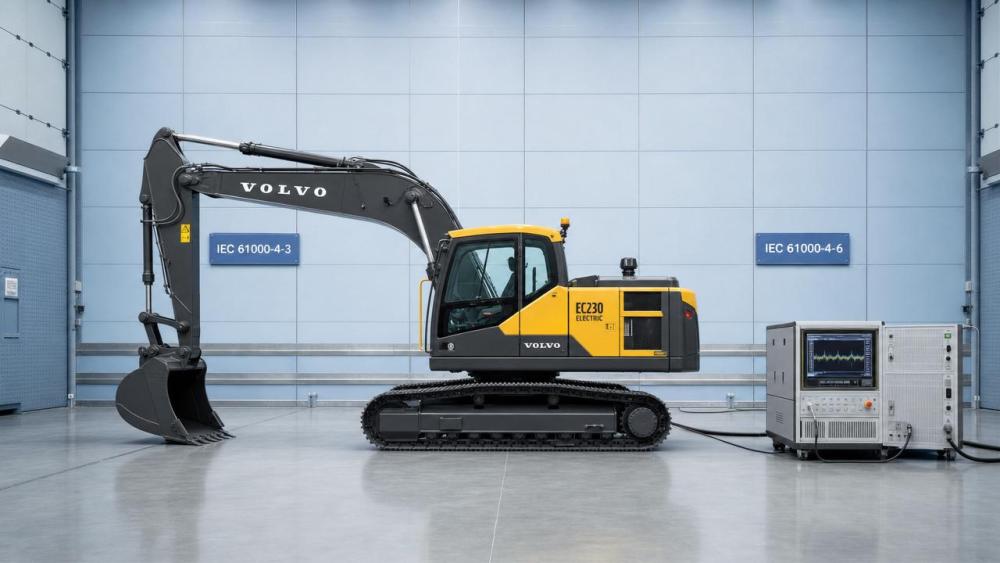
The European Commission has formally adopted Regulation (EU) 2026/892, effective June 1, 2026. It mandates that all electric excavators sold in the EU must pass upgraded EMC immunity tests per IEC 61000-4-3 and IEC 61000-4-6 standards as part of CE conformity assessment. Products lacking CE certificates reflecting this updated requirement will be denied customs clearance and warehouse entry in the EU.
Industries Affected
Original Equipment Manufacturers (OEMs) and Exporters
OEMs — especially Chinese manufacturers exporting electric excavators to the EU — are directly affected because the revised CE certification becomes a mandatory pre-market gate. Non-compliant units cannot legally enter the EU market after June 1, 2026, regardless of prior CE status.
The impact manifests primarily in extended time-to-market: retesting and recertification require additional lab capacity, technical documentation updates, and potential hardware or firmware revisions to meet immunity thresholds.
CE Certification Bodies and Testing Laboratories
Notified Bodies and accredited labs handling EMC testing for construction equipment face increased demand for IEC 61000-4-3 (radiated immunity) and IEC 61000-4-6 (conducted immunity) assessments. Workload pressure may lead to longer turnaround times and scheduling constraints, especially for clients initiating applications close to the deadline.
This affects not only test execution but also technical review cycles, as evidence of immunity robustness (e.g., shielding design, filter implementation, grounding layout) must now be substantiated in technical files to a higher standard.
Importers and Authorized Representatives in the EU
EU-based importers and Authorized Representatives bear legal responsibility for ensuring CE conformity under the Machinery Regulation (EU) 2023/1230. With the new EMC requirement, they must verify that technical documentation and test reports explicitly cover the upgraded immunity tests — not just generic EMC declarations.
Failure to validate compliance may result in liability exposure, product recalls, or enforcement actions by national market surveillance authorities.
What Stakeholders Should Monitor and Do Now
Confirm applicability and scope with notified bodies
Manufacturers and importers should immediately confirm with their designated Notified Body whether existing CE certificates for electric excavators include coverage under IEC 61000-4-3 and IEC 61000-4-6. If not, a formal variation or full recertification process is required — and must be initiated well before May 2026 to avoid delays.
Review product design and EMC mitigation measures
Engineering teams should revisit PCB layout, cable routing, enclosure shielding, and power supply filtering — all critical to passing radiated and conducted immunity tests. Early-stage design validation against IEC 61000-4-3/4-6 can reduce late-stage non-conformities and costly redesigns.
Update technical documentation and internal compliance workflows
Technical files must now explicitly reference test reports meeting the updated standards. Internal quality systems should reflect the new requirement in checklist-driven conformity assessments — especially for new model introductions or major revisions post-June 2026.
Monitor national market surveillance guidance
While Regulation (EU) 2026/892 is binding across the EU, national authorities may issue implementation notices or interpretation clarifications. Stakeholders should track publications from bodies such as Germany’s ZLS, France’s DGCCRF, or the Netherlands’ NVWA for procedural details on verification during customs inspection or post-market checks.
Editorial Observation / Industry Perspective
Observably, this regulation represents a targeted technical escalation — not a broad policy shift — within the EU’s established EMC framework. It reflects growing attention to real-world electromagnetic resilience in battery-powered heavy equipment operating near radio transmitters, variable-frequency drives, or industrial wireless networks.
Analysis shows the requirement is less about introducing novel concepts and more about enforcing stricter pass/fail criteria under existing immunity standards. For industry, it functions primarily as a compliance checkpoint rather than a technology barrier — provided stakeholders treat it as a defined engineering and documentation task, not an abstract regulatory hurdle.
From an industry standpoint, this development is best understood as a signal of increasing granularity in EU type-approval expectations for electrified machinery — one likely to extend to other electric construction equipment (e.g., telehandlers, mini-loaders) in future amendments.
Conclusion
This regulation does not alter the fundamental CE marking process for electric excavators, but it does raise the evidentiary bar for EMC immunity compliance. Its significance lies in operational enforceability: from June 1, 2026, successful customs clearance in the EU will depend on demonstrable adherence to two specific IEC immunity standards. For affected enterprises, the most appropriate interpretation is pragmatic — treat it as a fixed, time-bound technical requirement demanding advance preparation, not a speculative or negotiable element of market access.
Source Attribution
Main source: European Commission Regulation (EU) 2026/892, published in the Official Journal of the European Union.
Points requiring ongoing observation: National market surveillance authority guidance on enforcement procedures and accepted test report formats; potential alignment updates with harmonized standards under the EU Machinery Regulation.