
Related News
- 00
0000-00
Construction Equipment Market Outlook: What to Watch in 2026 - 00
0000-00
Off-Road Machinery Safety Risks in Mud, Slope, and Rough Terrain - 00
0000-00
How to Compare Construction Equipment Manufacturers Beyond Price - 00
0000-00
Earthmoving Technology Trends That Will Reshape Jobsite Efficiency - 00
0000-00
Construction Machinery Costs: Buy, Rent, or Lease in 2026?
In tight jobsites, every movement counts. Today’s excavator technology helps operators work with greater precision, control, and confidence where space is limited and error costs time.
From advanced hydraulic response to 3D guidance and compact machine intelligence, these features are changing how crews dig, swing, and grade in confined areas.
For urban infrastructure, utility repair, demolition support, and roadside work, excavator technology now plays a direct role in safety, productivity, and finish quality.
Precision Requirements in Tight-Site Excavator Technology
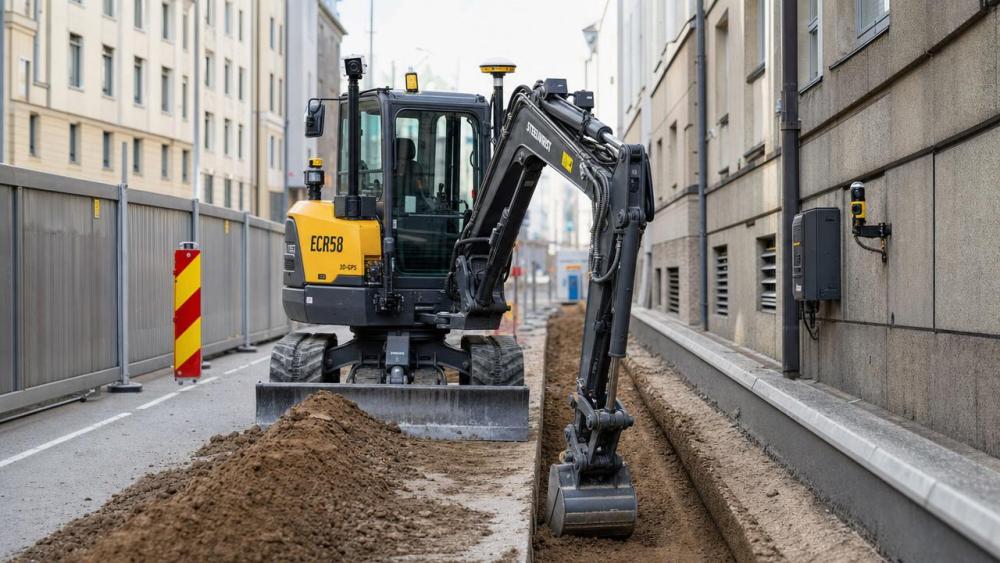
Tight sites reduce swing clearance, visibility, and recovery room. Operators often work beside traffic, structures, buried utilities, or temporary barriers.
In these conditions, excavator technology must support accurate bucket placement, predictable rotation, and stable grading over repeated cycles.
Precision is not only about machine size. It comes from how hydraulics, sensors, controls, and software translate operator input into repeatable motion.
Modern excavator technology also reduces overdigging. That matters when trench depth, slope control, and material separation affect schedule and rework costs.
Core precision indicators
- Smooth boom, arm, and bucket coordination
- Controlled swing start and stop behavior
- Stable attachment response at low travel speeds
- Reliable grade accuracy with less manual checking
- Clear situational awareness near obstacles
Key Technology Features Improving Accuracy
The most effective excavator technology combines mechanical refinement with digital assistance. Each feature supports a different part of the precision workflow.
Electro-hydraulic control systems
Electro-hydraulic controls improve metering accuracy. They help the machine respond proportionally to joystick input, especially during low-speed, high-precision operations.
This makes feathering easier. Operators can trim trench walls, place pipe bedding, or clean around foundations without abrupt cylinder movement.
Load-sensing and flow-sharing hydraulics
Load-sensing systems match hydraulic output to actual demand. Flow-sharing keeps multiple functions moving together even when load conditions change.
That matters when digging while slewing or lifting while tracking slowly. Motion stays more balanced, reducing correction cycles and wasted fuel.
3D machine guidance and grade control
3D guidance is a major step forward in excavator technology. It combines GNSS, inertial sensors, and jobsite models to show bucket position in real time.
On constrained sites, this limits guesswork. Operators can maintain trench depth, drainage slope, and final grade with fewer stakes and fewer checks.
Some systems add semi-automatic functions. These help prevent overcutting and support smooth finishing near target surfaces.
Swing control and fine travel modulation
Tight spaces demand precise upperstructure rotation. Advanced swing control reduces overshoot and softens stopping force near walls or live traffic lanes.
Fine travel modulation also improves repositioning. Short adjustments become easier when the machine does not lurch during track movement.
Camera systems and object awareness
Visibility support is increasingly important in excavator technology. Rear, side, and bird’s-eye camera views reduce blind spots around compact work zones.
Integrated object alerts can improve awareness near fencing, parked equipment, and temporary structures. This reduces accidental contact and hesitation.
Industry Signals Shaping Precision-Focused Equipment
Across the broader machinery sector, several trends are pushing excavator technology toward finer control, lower emissions, and more digital jobsite integration.
These signals affect crawler excavators, compact models, skid steer workflows, and grading support equipment across integrated project environments.
Operational Value of Excavator Technology in Confined Work
The business value of precision goes beyond cleaner digging. Better excavator technology supports tighter tolerances, faster completion, and less disruption around active sites.
Reduced rework and material waste
When bucket position is controlled more accurately, crews remove only the required volume. This lowers backfill demand and protects finished subgrade conditions.
Safer work near buried and fixed assets
Precision-focused excavator technology helps maintain predictable movement. That is important around pipe corridors, retaining walls, foundations, and temporary shoring.
Faster cycle consistency
Smooth controls improve repeatability. Operators spend less time correcting swing angle, bucket orientation, and final grade, which strengthens cycle time stability.
Better finish quality
Grade assistance and hydraulic finesse help produce cleaner trench bottoms and more uniform slopes. That improves downstream performance for paving, pipe, and drainage work.
Typical Tight-Site Applications and Feature Priorities
Not every confined application needs the same technology package. Feature priorities should match task type, ground conditions, and tolerance expectations.
Practical Selection and Use Considerations
Choosing excavator technology for precision work should focus on job match, not feature count alone. Several practical factors influence real-world results.
- Check hydraulic smoothness at very low input, not only peak digging force
- Evaluate screen visibility and interface simplicity under daylight conditions
- Confirm sensor calibration routines are fast and repeatable onsite
- Match tail swing, undercarriage width, and attachment size to access limits
- Review data compatibility with grade files and broader jobsite workflows
Training also matters. Even advanced excavator technology performs best when operators understand machine modes, assistance limits, and calibration checks.
Maintenance should not be overlooked. Wear in pins, bushings, sensors, or hydraulic components can gradually reduce the precision benefits of modern control systems.
Implementation Priorities for Better Precision Outcomes
A structured rollout often produces better results than adding every digital feature at once. Start with the highest-impact needs on the most constrained tasks.
- Identify where overdigging, clearance risk, or grade variation occurs most often
- Prioritize excavator technology that directly addresses those bottlenecks
- Standardize setup, calibration, and daily inspection routines
- Track rework reduction, fuel efficiency, and cycle consistency after adoption
Excavator technology is evolving from optional assistance into a core part of precision earthmoving. In tight sites, that shift delivers measurable operational value.
Review the confined-area tasks performed most often, then align control, guidance, and visibility features with those exact demands. That is the clearest next step toward sharper results.