
Related News
- 00
0000-00
How to verify capacity before sourcing equipment from manufacturers - 00
0000-00
When to choose LGP dozers for infrastructure site preparation - 00
0000-00
How to size heavy-duty loaders for North American mining operations - 00
0000-00
How altitude affects mining excavator performance in Latin America - 00
0000-00
Caterpillar Launches New Cat 6060 and Upgraded Autonomous Mining System
How to verify capacity before sourcing equipment from manufacturers
Can your shortlisted supplier deliver the right machines, at the required volume, when your project needs them? Verifying the capacity of equipment sourcing manufacturers takes more than reviewing brochures or accepting quoted lead times. For procurement teams buying excavators, wheel loaders, or grading equipment, reliable due diligence means checking production throughput, existing order commitments, critical component availability, and quality-control records.
The distinction that matters is simple: a factory’s ability to build equipment is not the same as its ability to fulfill your order. Spare assembly space means little if hydraulic pumps are unavailable, test benches are fully booked, or earlier customers already hold the available production slots. Capacity verification should establish what the supplier can deliver for your configuration and delivery window—not what the plant might produce under ideal conditions.
Define the order before asking about capacity
A capacity assessment starts with a stable purchasing specification. “Twenty excavators” is not sufficiently precise. Machine size, boom configuration, attachments, engine specification, hydraulic options, and destination requirements can change the production route and component lead times.
Issue a requirement sheet covering quantities by configuration, acceptable substitutions, inspection requirements, delivery location, and the date each batch must be ready for work. Separate mandatory features from preferences. A supplier may have standard machines available while a particular auxiliary hydraulic package requires additional procurement and testing.
Also define what “delivered” means. Factory completion, release after inspection, port departure, arrival at destination, and site commissioning are different milestones. A quotation promising a production lead time does not necessarily include inland transport, export preparation, shipping, customs clearance, or operator familiarization.
Replace headline output with demonstrated available capacity
Ask the manufacturer to distinguish installed capacity, demonstrated output, and uncommitted capacity. Installed capacity describes a theoretical production capability. Demonstrated output shows what the factory has actually completed. Uncommitted capacity is the portion still available after existing orders, maintenance, and other constraints are considered.
Request recent production records for the relevant machine family, preferably spanning several production cycles. Useful evidence includes dated completion reports, serial-number records, final inspection releases, and shipment documentation. Commercial information can be redacted or reviewed under a confidentiality agreement.
Do not compare unlike machines. Output from a compact skid steer line does not prove capacity for large crawler excavators. Even on a shared line, a more complex configuration may consume additional assembly hours or require a separate testing sequence.
- Check output by model family and configuration, rather than accepting total factory production.
- Compare planned completions with actual accepted machines to reveal recurring slippage.
- Separate machines awaiting rework from units genuinely ready for shipment.
- Review scheduled labor, maintenance downtime, and any overtime assumed in the delivery promise.
- Ask whether proposed additional shifts have trained personnel and supporting inspection coverage.
A credible capacity calculation starts with demonstrated throughput for the relevant product mix, deducts committed workload and planned downtime, and allows for normal disruption. Annual nameplate output divided by twelve is not enough.
Find the constraint that controls your delivery
Walk through the complete production route: fabrication, machining, surface preparation, painting, assembly, software configuration, testing, and dispatch. The bottleneck may sit far from the final assembly line. Several assembly stations cannot compensate for a single overloaded hydraulic test station.
During a factory audit, compare the production schedule with physical work in progress. Look for queues, missing components, machines moved aside for repairs, and finished units waiting for inspection. Ask production staff why those units are waiting. Their explanation should match the planning records.
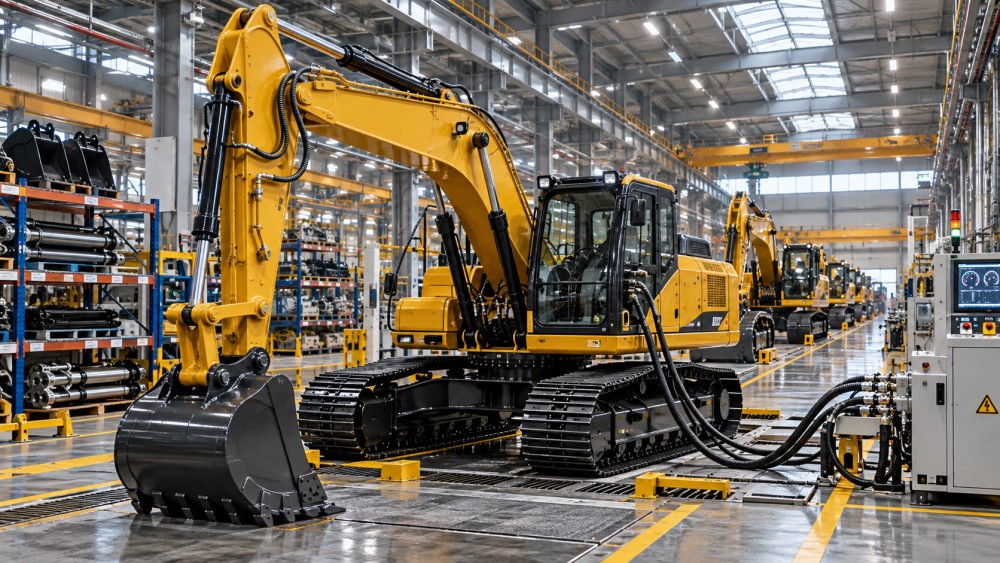
For wheel loaders, axle or transmission availability may constrain completion. For motor graders, control-system installation and calibration may affect release. Electric equipment adds battery, charging-interface, and electrical testing considerations. These are potential constraints to investigate, not assumptions about every manufacturer.
An idle line is not automatically evidence of spare capacity: it may be waiting for parts. Conversely, a busy plant may still have a well-controlled slot available. What matters is whether the supplier can connect your order to a workable sequence of resources and dates.
Verify critical components and existing commitments
Request an order-specific material availability review. Focus on components that are difficult to substitute or could stop completion: engines, hydraulic pumps and valves, undercarriages, axles, transmissions, electronic controllers, and specialized attachments.
For each critical item, establish whether it is physically in stock, reserved for another order, covered by a confirmed purchase order, or supported only by an indicative quotation. A component appearing in an inventory system does not prove it is available for your machines. Check allocation status and, where appropriate, inspect stock against part numbers.
Ask to see the time-phased production plan with other customers’ identities removed. Your order should occupy identifiable slots, with material readiness and testing dates attached. “We will prioritize you after the deposit” is weaker evidence than a documented allocation approved by production planning.
Subcontractors require attention too. If structural fabrication, machining, or painting is outsourced, establish how the manufacturer checks that supplier’s capacity and quality. Moving work outside the factory does not remove the bottleneck; it can make it less visible.
Count accepted machines, not assembly completions
Capacity only has purchasing value when the resulting equipment meets the agreed specification. Review inspection plans, test records, nonconformance reports, and evidence that corrective actions were closed. A quality-management certificate may support supplier screening, but it does not establish available capacity or prove that your machines will pass acceptance.
Agree on model-specific acceptance criteria before placing the order. Depending on the equipment, these may cover hydraulic performance, functional operation under agreed conditions, leakage, safety systems, attachment interfaces, and control-system configuration. Use the purchase specification, applicable requirements, and agreed test methods rather than an improvised checklist.
For digitally enabled graders or remote-capable machines, distinguish installed hardware from a commissioned system. Software licenses, sensor calibration, compatible communications, and site setup can affect readiness even when mechanical assembly is complete.
Trace a sample of serial numbers from production through inspection and release. Review whether previously reported defects recur. If a supplier claims rising output while inspection backlogs are growing, the additional assembly activity may not translate into dependable deliveries.
Use audits to test claims, not collect photographs
An effective audit follows an order through the system. Select a comparable machine and reconcile its material records, production status, test results, and dispatch paperwork. Confirm which legal entity operates the factory and which entity will sign the contract, particularly when dealing through an exporter or trading company.
Where travel is impractical, combine an independent inspection with a live factory walkthrough and controlled document review. Request views of specific stations and records rather than relying on edited promotional footage. Remote checks have limits, so unresolved high-value risks may still justify an on-site visit.
Global Earth-Mover Dynamics (EMD) examines the relationship between machinery technology, supply chains, and asset utilization across excavators, loaders, graders, bulldozers, and skid steers. That perspective supports a useful procurement distinction: sector intelligence can identify where constraints may emerge, but only supplier-specific evidence can validate a production commitment.
Compare the cost of a credible schedule
A lower machine price can be outweighed by temporary rental, idle crews, expedited freight, repeat inspections, or delayed site mobilization. Compare suppliers on the cost of obtaining accepted, usable equipment by the required date—not simply the quoted unit price.
Build a base delivery scenario and a plausible disruption scenario for each shortlisted supplier. Use your project’s actual rental rates, logistics quotations, and delay exposure rather than generic industry percentages. Check whether partial deliveries reduce disruption or merely create additional transport and commissioning costs.
Payment terms should reflect verified progress. Depending on commercial circumstances, milestones might relate to material allocation, identifiable production progress, successful factory acceptance, and shipment documentation. An advance payment alone does not prove that components or production slots have been secured. Any guarantees, delay remedies, or inspection rights need appropriate commercial and legal review.
Make the award conditional on a traceable plan
Before approval, assemble a short capacity file containing the agreed configuration, demonstrated output evidence, allocated production slots, critical-material status, acceptance plan, and logistics milestones. Record unresolved assumptions alongside named owners and confirmation dates.
If evidence remains incomplete, reduce the exposure: use a staged order, require an initial batch to pass acceptance before releasing later quantities, or maintain a technically qualified alternative. None of these measures replaces due diligence, but they can limit the consequences of an uncertain commitment.
The final question is not whether the manufacturer appears large enough. It is whether your machines have a documented route from available components to accepted equipment at the required destination. If that route depends on unconfirmed parts, unstaffed shifts, or unspecified testing, the delivery promise is not yet ready to support a purchasing decision.