
Related News
- 00
0000-00
How an earthmoving equipment portal helps vet factory capabilities - 00
0000-00
How to assess equipment specifications against applicable standards - 00
0000-00
How Middle East climate conditions should shape heavy equipment selection - 00
0000-00
Can an industrial equipment sourcing supplier directory improve vendor selection? - 00
0000-00
How earthmoving equipment is applied in canal construction
Tags
- crawler excavators
- wheel loaders
- motor graders
- bulldozers
- skid steer loaders
- earthmoving equipment
- earthmoving machinery
- infrastructure equipment
- precision grading equipment
- loading machinery
- earthmoving equipment portal
- high-intensity loading machinery
- earthmoving equipment portal factory
- excavator electro-hydraulic control
- crawler excavator
- wheel loader
- bulldozer
How an Earthmoving Equipment Portal Helps Vet Factory Capabilities
Buying crawler excavators, wheel loaders, motor graders, bulldozers, or skid steer loaders is rarely a matter of comparing a few brochure specifications. A machine may look suitable on paper, carry a competitive quoted price, and still prove to be a poor fit once it reaches a quarry, road project, municipal site, or mine. The issue is often not the headline machine configuration. It is whether the factory behind it can consistently build, test, support, and adapt that configuration for the intended market and duty cycle.
This is where an earthmoving equipment portal factory assessment can add practical value. A specialized portal does not replace a plant audit, independent inspection, or contractual due diligence. What it can do is make those later steps much more focused. By connecting machine-level information with manufacturing trends, hydraulic technology, regulatory developments, supply-chain signals, and intelligent-control readiness, it helps buyers ask better questions before they commit time and budget to a supplier shortlist.
For high-value equipment, the most useful early decision is often not “Which model should we buy?” but “Which factories deserve deeper verification?” That distinction matters. It changes the conversation from catalog comparison to capability assessment.
A machine specification is not a factory capability
An excavator’s operating weight, bucket capacity, engine rating, breakout force, and travel speed are relevant, but they reveal only part of the production story. Two machines presented with similar specifications may be built around very different component sourcing, welding controls, machining tolerances, assembly procedures, calibration methods, and after-sales parts systems. Those differences may not become visible until the machine is working continuously in abrasive material, high heat, high altitude, or remote terrain.
The same applies across equipment categories. A wheel loader intended for bulk-material transfer needs more than a stated bucket size; drivetrain behavior, axle durability, cooling capacity, tire options, and service access deserve scrutiny. A grader offered for airport or road work should be evaluated beyond blade dimensions, especially where machine-control interfaces, sensor compatibility, articulation response, and grading repeatability are important. For bulldozers, stated drawbar pull does not independently confirm the long-term performance of the undercarriage, transmission, cooling package, or blade-control system.
A capable portal helps place specifications in their operating context. It can reveal which features are central to a manufacturer’s established product architecture and which may be optional additions intended to satisfy a tender. That is not a reason to dismiss newer configurations. It is a reason to identify where evidence should be requested.
Turning industry intelligence into a factory-vetting framework
Global Earth-Mover Dynamics (EMD) follows the machinery that reshapes infrastructure: crawler excavators, high-intensity loading machinery, precision grading equipment, bulldozers, and compact skid steer platforms. Its value for supplier evaluation lies in the connection between technical signals and commercial decisions. Rather than treating equipment as isolated products, EMD examines the hydraulic systems, control logic, emissions direction, infrastructure investment cycles, and automation requirements that influence factory priorities.
That wider view is useful because manufacturing capability is dynamic. A factory that has strong experience in conventional mechanical controls may be developing electro-hydraulic proportional systems but not yet have deep field history with them. Another may assemble electrically driven equipment but rely heavily on externally sourced battery, inverter, or software subsystems. Neither position is automatically unacceptable. The key is to understand the maturity of the exact configuration being quoted and the factory’s responsibility for integration, diagnostics, warranty, and upgrades.
An intelligence portal can help buyers organize this inquiry around evidence rather than reputation alone. The most valuable information is usually not a generic claim that a supplier has “advanced production.” It is a clearer picture of what equipment families the factory builds repeatedly, what systems it controls internally, which critical parts are sourced, and how it validates finished machines.
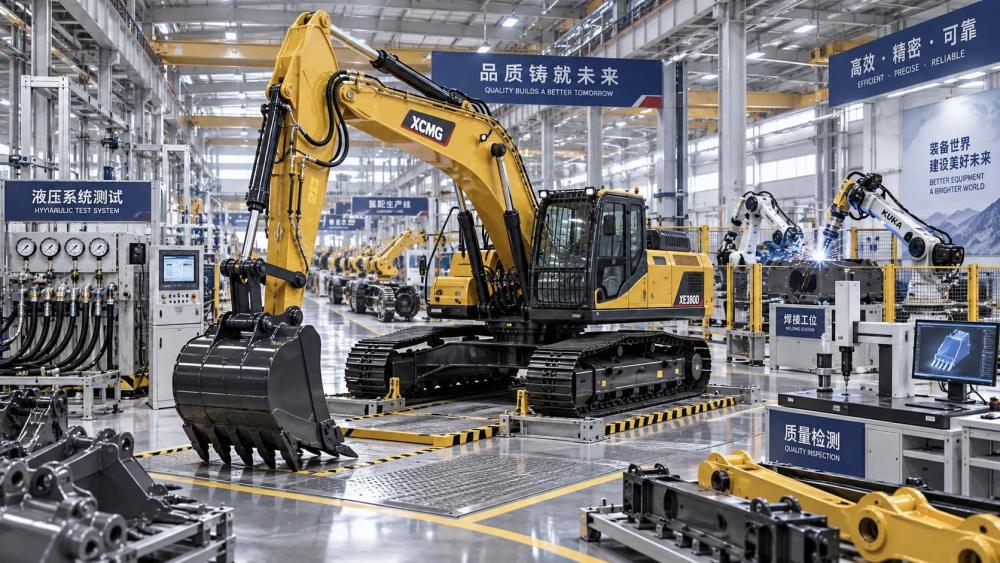
Five capability areas worth examining
The following areas provide a useful structure for comparing factories without reducing the decision to a scorecard exercise.
These questions are more informative when they are tailored to the machine’s actual task. A skid steer supplier may need to demonstrate hydraulic auxiliary compatibility and attachment support. A crawler excavator factory may require deeper discussion of boom and arm fabrication, hydraulic response, undercarriage options, and work-tool matching. With graders, the ability to integrate GPS or laser-based systems can be as relevant as traditional mechanical construction quality when a project demands precise surface control.
Use portal research to identify inconsistencies before a factory visit
A factory visit is more productive when the visitor already understands the questions that deserve attention. Portal research can help map a supplier against the broader equipment landscape: its stated model range, technical positioning, target sectors, component relationships, technology announcements, and the market shifts affecting its product category. EMD’s Strategic Intelligence Center, for example, tracks themes such as full-hydraulic bulldozer transmission efficiency, excavator electro-hydraulic control behavior, remote-control communications for hazardous sites, and the growing relevance of compact machines in urban development.
These themes are not abstract trend material. They can expose practical questions. If a supplier promotes remote operation, buyers should ask whether the system is factory-integrated or third-party supplied, how latency and connectivity constraints are addressed in the intended environment, and who provides fault diagnosis. If a factory offers a lower-emission engine package, it is reasonable to request confirmation of the engine configuration, applicable market documentation, fuel-quality assumptions, and service arrangements for emissions-related components.
A useful warning sign is a mismatch between ambition and evidence. A broad product portfolio is not necessarily a weakness, but a supplier that claims equal depth in heavy mining loaders, precision graders, compact loaders, electric machines, and autonomous operation should be able to explain how each line is supported. Buyers should look for consistency between claimed specialization, visible production resources, technical documentation, and the people available to answer detailed questions.
The hard-to-see risks: components, customization, and delivery discipline
Many sourcing problems begin when a quoted machine is treated as a fixed object. In reality, earthmoving equipment may change materially with the engine option, bucket or blade setup, auxiliary hydraulics, cab package, tires or tracks, quick coupler, climate package, telematics hardware, and local safety requirements. Customization can be valuable, but it also creates risk if the factory has not formalized how changes are engineered, documented, and tested.
Ask for a configuration record that identifies the proposed machine clearly enough to be inspected later. Clarify which components are standard, which are optional, and which are substituted depending on supply. For critical systems, it is reasonable to request component make and model information where commercially appropriate. The goal is not to dictate every sourcing decision. It is to prevent a material deviation between the evaluated configuration and the delivered one.
Delivery capability should be assessed with equal care. A stated production lead time is only one part of the picture. Buyers should understand whether long-lead items are already allocated, how export packing is handled, what pre-shipment testing is planned, and whether manuals, spare-parts lists, and service tools will be ready when the machines arrive. For project equipment, a delayed attachment or missing diagnostic interface can be as disruptive as a delayed base machine.
Why technology maturity now belongs in supplier selection
Earthmoving machinery is moving toward cleaner powertrains, better operator assistance, connected maintenance, and varying levels of remote or autonomous operation. The pace differs by machine class, operating environment, charging or fuel infrastructure, and local regulation. Buyers should avoid assuming that a feature marketed as “smart” is equally mature across every product line.
EMD’s focus on the intersection of hydraulic force, spatial algorithms, and decarbonization is valuable here. Precision grading systems depend on more than sensors; they require reliable integration between positioning inputs, control software, hydraulic actuation, and field support. Electrified equipment requires a credible view of charging, battery-service responsibility, thermal management, and residual operational constraints. Remote systems depend on communications architecture that may be suitable for one mine or controlled site and unsuitable for another.
The appropriate question is not whether a factory has adopted every emerging technology. It is whether the supplier can define the limits of what it offers, document the configuration, and support it through the machine’s working life. Clear boundaries are more reassuring than vague promises of autonomy or electrification.
From online intelligence to a defensible supplier decision
The best use of an earthmoving equipment portal is as a decision-preparation tool. Begin with the work profile: material type, required output, operating hours, terrain, climate, transport limits, operator skill, attachments, and destination-market rules. Then use category-specific intelligence to identify the technical systems most likely to affect reliability and project fit. That creates a sharper request for information and a more disciplined factory audit.
Before placing an order, confirm the final configuration, applicable compliance documentation, inspection scope, acceptance criteria, warranty boundaries, initial spare-parts recommendation, and responsibility for commissioning support. Where the project is demanding or the supplier relationship is new, independent pre-shipment inspection and direct verification of the proposed production site are sensible safeguards.
EMD’s perspective is that infrastructure equipment should be assessed as part of a longer operating system: machine, controls, factory discipline, service network, regulations, and jobsite reality. Intelligence cannot substitute for verification, but it can prevent a buyer from verifying the wrong things. When supplier questions are anchored in the real mechanics of excavating, loading, grading, pushing, and compact-site work, factory capability becomes easier to distinguish from sales presentation.