
Related News
- 00
0000-00
How to size heavy-duty loaders for North American mining operations - 00
0000-00
How altitude affects mining excavator performance in Latin America - 00
0000-00
Caterpillar Launches New Cat 6060 and Upgraded Autonomous Mining System - 00
0000-00
When does eco-friendly construction equipment pay for itself? - 00
0000-00
Will a wheel loader quick coupler fit your existing attachments?
In 2026, heavy equipment maintenance is no longer just a technical issue—it is a capital allocation decision that directly affects fleet uptime, depreciation, and long-term ROI. For financial decision-makers, knowing when to repair aging machines and when to replace them can protect margins, reduce lifecycle costs, and strengthen investment planning. This article breaks down the key cost signals behind smarter equipment decisions.
The core search intent behind this topic is practical and financial: readers want a reliable way to decide whether continued repair spending still makes economic sense. They are not looking for generic maintenance advice. They want a framework for comparing operating cost, utilization risk, residual value, financing conditions, and replacement timing in 2026.
For finance approvers, the most urgent questions are straightforward. Is this machine still earning its keep? Are rising repair bills hiding bigger downtime costs? Will replacement improve cash flow predictability? And how should maintenance data be translated into budget, depreciation, and investment decisions that can be defended internally?
The most useful content, therefore, is decision-oriented. It should focus on cost thresholds, lifecycle economics, risk signals, and a repeatable repair-versus-replace method. Broad technical explanations should play a supporting role only when they help quantify business impact.
Why the repair-or-replace question matters more in 2026
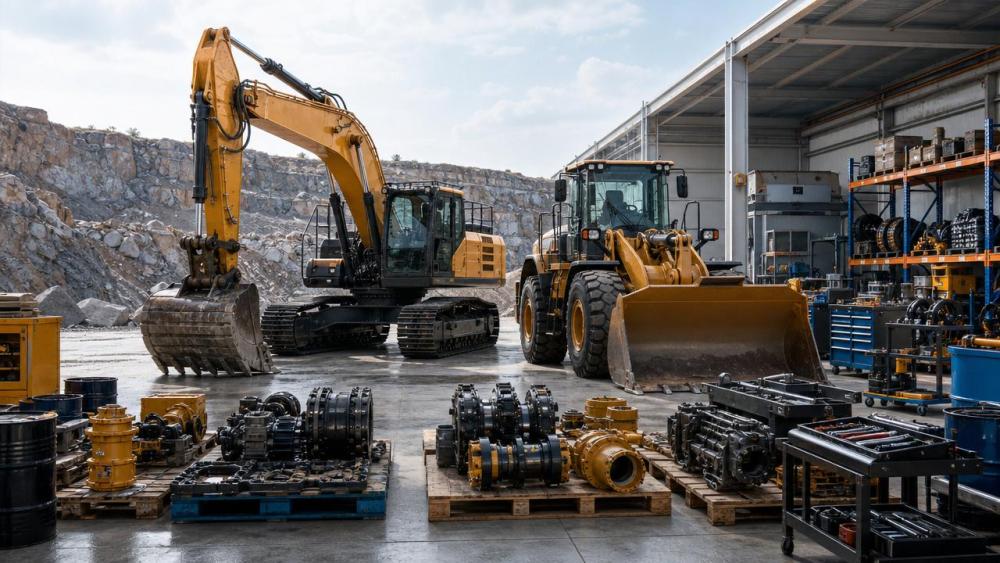
In 2026, heavy equipment maintenance decisions are happening in a tighter operating environment. Contractors, quarry operators, and infrastructure fleets face higher parts costs, labor constraints, stricter emissions expectations, and stronger pressure to improve asset productivity.
That means an aging excavator, loader, dozer, grader, or skid steer is no longer judged only by whether it can still run. It is judged by whether it can deliver predictable output at an acceptable total cost.
For finance teams, this changes the conversation. The issue is not simply “Can we postpone replacement for another year?” The better question is “What is the lowest-risk use of capital over the next 24 to 36 months?”
Heavy equipment maintenance becomes a financial control lever because repair decisions affect uptime, rental substitution, project delays, operator efficiency, fuel consumption, and resale value. When several machines enter late-life status at once, maintenance strategy directly influences annual capital planning.
In many fleets, repair spending rises gradually enough that it does not trigger immediate alarm. But when maintenance cost growth outpaces the machine’s productive contribution, the business is effectively funding decline rather than preserving value.
What financial approvers should measure before approving another major repair
Before approving a large repair, decision-makers should ask for a short list of metrics that connects workshop activity to financial outcomes. Without that link, maintenance decisions remain reactive and inconsistent.
The first metric is maintenance cost as a percentage of replacement asset value. If annual maintenance on an older machine is climbing toward a material share of the cost of a newer equivalent unit, replacement deserves serious attention.
The second is cost per operating hour. This should include preventive maintenance, corrective repairs, component rebuilds, outsourced labor, field service, and parts. A machine with low book value can still be expensive if hourly support costs are rising sharply.
The third is downtime cost per hour or per day. This is often underestimated. If equipment failure stops a crew, delays trucking, disrupts paving sequence, or requires emergency rental, the true cost of repair decisions extends far beyond the workshop invoice.
The fourth is utilization quality. A lightly used machine may justify additional repair if it serves a niche purpose and has low operational risk. A heavily used production asset in earthmoving or mine loading deserves much stricter thresholds.
The fifth is residual value trajectory. Older machines can lose resale value quickly once reliability becomes uncertain. Replacing a machine before the market discounts it heavily can improve net ownership economics.
Finally, finance teams should review failure frequency, not just total repair cost. A single expensive repair on an otherwise stable unit may be acceptable. Repeated failures across hydraulic, drivetrain, undercarriage, cooling, and electronics systems often indicate structural decline.
The clearest signs your heavy equipment maintenance costs are too high
Not every old machine should be replaced. Some equipment ages well, especially when application, maintenance discipline, and operator behavior are favorable. But several warning signs usually show that repair spending is no longer strategic.
One warning sign is repair clustering. If a machine experiences multiple major repairs within a short period, the issue is rarely isolated. It often suggests that age, fatigue, or system interdependence is creating a cascade of failures.
Another signal is increasing unplanned downtime despite regular servicing. Preventive maintenance should stabilize performance. If breakdowns continue to rise, the fleet may be paying more without restoring reliability.
Watch for component aging in core production systems. On crawler excavators, repeated hydraulic pump, swing, travel, or boom-end repairs matter more than cosmetic issues. On wheel loaders, transmission, axle, and linkage wear can have major operating consequences.
On bulldozers and graders, undercarriage wear, powertrain instability, and control-system issues can significantly affect productivity and grading accuracy. On skid steers, attachment hydraulic performance and repeated engine or lift-arm failures can erode margin quickly.
A further red flag is that operators begin avoiding certain units. When dispatchers or site managers quietly assign a machine only to low-risk jobs, the asset is already imposing hidden constraints on project planning.
Emergency rentals are another important indicator. If a machine’s downtime regularly forces short-notice rental at premium rates, internal maintenance cost reports may be understating the true economic penalty of keeping it.
When repairing still makes financial sense
Repair is often the right decision when the machine has strong application fit, acceptable reliability history, and a clear path to lower near-term cost. The goal is not to replace assets early for appearance’s sake, but to protect return on invested capital.
A targeted repair may be justified when the failure is isolated and the machine has otherwise delivered stable service hours. For example, a planned engine rebuild on a well-maintained loader can be more economical than immediate replacement.
Repair also makes sense when replacement lead times are long and the machine remains operationally essential. In such cases, a structured interim repair can bridge capacity needs while procurement and financing are arranged.
Another valid case is seasonal or backup equipment with limited annual utilization. If the machine supports peak demand or serves as operational redundancy, a lower-cost repair strategy may produce better economics than purchasing a new underused asset.
Finance teams should also consider whether repair extends useful life enough to match contract visibility. If the company expects a temporary slowdown or uncertain project pipeline, preserving liquidity through selective repair may be prudent.
However, repair should be approved with conditions. There should be a defined spending cap, expected service-life extension, and post-repair performance target. Without those controls, “repair” can become an open-ended capital avoidance habit.
When replacement becomes the smarter investment
Replacement becomes more attractive when maintenance spending no longer buys predictability. If each new repair only postpones the next failure, the business is not preserving an asset—it is subsidizing uncertainty.
For finance approvers, the strongest case for replacement usually combines three factors: rising total maintenance cost, meaningful downtime risk, and strong operational benefit from a newer model. Any one factor alone may not be decisive, but together they are powerful.
Newer equipment can improve economics in ways that basic repair comparisons miss. Better fuel efficiency, telematics visibility, lower emissions exposure, reduced operator fatigue, and stronger cycle-time performance can all contribute to lifecycle savings.
Replacement is especially compelling for high-hour production units. A frontline excavator in heavy trenching, a loader in aggregate handling, or a dozer in continuous push work has little tolerance for reliability volatility.
It is also often wise to replace before major value destruction occurs. Selling or trading a still-functional machine can preserve residual value and reduce the cash gap to acquisition. Waiting until reliability collapses usually weakens negotiating leverage.
In 2026, replacement timing should also reflect regulatory and technology direction. Fleets working under stricter emissions rules, customer reporting requirements, or autonomy-readiness expectations may find that newer machines offer strategic compliance advantages beyond maintenance savings.
A simple repair-versus-replace framework for budget decisions
Finance teams do not need a perfect model to make better decisions. They need a consistent framework that compares realistic scenarios over a defined planning horizon, usually 24 to 60 months.
Step one is to estimate the machine’s future maintenance and repair cost by year. Use historical data, adjusted for age-related failure probability, parts inflation, labor rates, and known component risk.
Step two is to add downtime cost. Include lost production, delay exposure, rental substitution, and overtime recovery. This is where many repair cases become less attractive than they first appear.
Step three is to compare those costs with replacement economics. Model purchase price, financing or lease terms, expected maintenance reduction, fuel savings, warranty support, and residual value at the end of the analysis period.
Step four is to assign a risk factor. If the old machine supports mission-critical operations, the tolerance for surprise failure should be low. If the machine is noncritical, the business may accept more variability.
Step five is to document the decision threshold. Many organizations adopt internal rules, such as escalating review when annual maintenance exceeds a set percentage of replacement cost or when downtime exceeds a defined number of days.
This structured approach improves governance. It turns heavy equipment maintenance from a workshop expense discussion into an investment comparison grounded in measurable business outcomes.
How fleet data improves maintenance decisions in 2026
Data quality is becoming a major differentiator. Telematics, service logs, oil analysis, fault-code trends, and utilization records now make it easier to identify whether a machine is aging normally or entering a high-cost failure phase.
For finance leaders, the value of data is not technical detail alone. It is improved confidence in forecast accuracy. Better failure prediction supports better budgeting, replacement scheduling, and vendor negotiation.
Machines with complete maintenance histories are easier to evaluate objectively. They also tend to hold value better because condition can be evidenced rather than guessed. That matters when planning disposal or trade-in.
Integrated data also helps distinguish poor maintenance practice from genuine end-of-life economics. Some assets look uneconomic only because preventive work has been inconsistent. Others are well maintained but still no longer financially competitive.
As OEM connectivity expands across excavators, loaders, graders, bulldozers, and compact equipment, fleets that use data well will make replacement decisions earlier, with less disruption and stronger capital discipline.
Common mistakes that distort repair-or-replace decisions
One common mistake is focusing only on the next repair bill. A $25,000 repair can feel cheaper than a $350,000 replacement, but that comparison is incomplete unless future repairs, downtime risk, and productivity differences are included.
Another error is treating depreciated assets as “cheap to own.” Low book value does not mean low economic cost. In fact, older fully depreciated machines sometimes consume the most cash through repairs and lost utilization.
Some companies also delay replacement because prior repairs created emotional commitment. This sunk-cost thinking is dangerous. Past spending should not justify future spending unless future returns remain attractive.
A further mistake is using average fleet metrics for all assets. Production-critical machines, support units, and specialty equipment should not share identical decision thresholds. Context matters.
Finally, organizations often separate maintenance and finance too sharply. Workshop teams understand failure risk; finance teams understand capital constraints. Better decisions happen when both perspectives are combined in a common evaluation model.
Conclusion: heavy equipment maintenance decisions should protect ROI, not just delay spending
In 2026, the best heavy equipment maintenance strategy is not the one that minimizes this month’s outlay. It is the one that delivers the lowest total economic risk across the machine’s remaining useful life.
For financial approvers, that means asking harder but better questions. Is repair restoring reliable production, or only extending uncertainty? Is replacement a cost burden, or a way to stabilize margins and improve asset productivity?
The answer will vary by machine, application, and capital environment. But the principle is consistent: evaluate maintenance, downtime, utilization, residual value, and replacement economics together, not in isolation.
When that discipline is applied, repair decisions become more defensible, replacement timing becomes more strategic, and fleet investment planning becomes far stronger. In a market where uptime and capital efficiency both matter, that is the real advantage.