
For procurement teams, the lowest machine price is rarely the lowest fleet cost. Total ownership cost reveals the real commercial impact.
When comparing construction equipment manufacturers, buyers should measure productivity, uptime, fuel use, service support, compliance risk, and resale value together.
This framework helps procurement teams defend decisions with data, not habit, brand preference, or short-term capital budget pressure.
Start with the cost question procurement actually owns
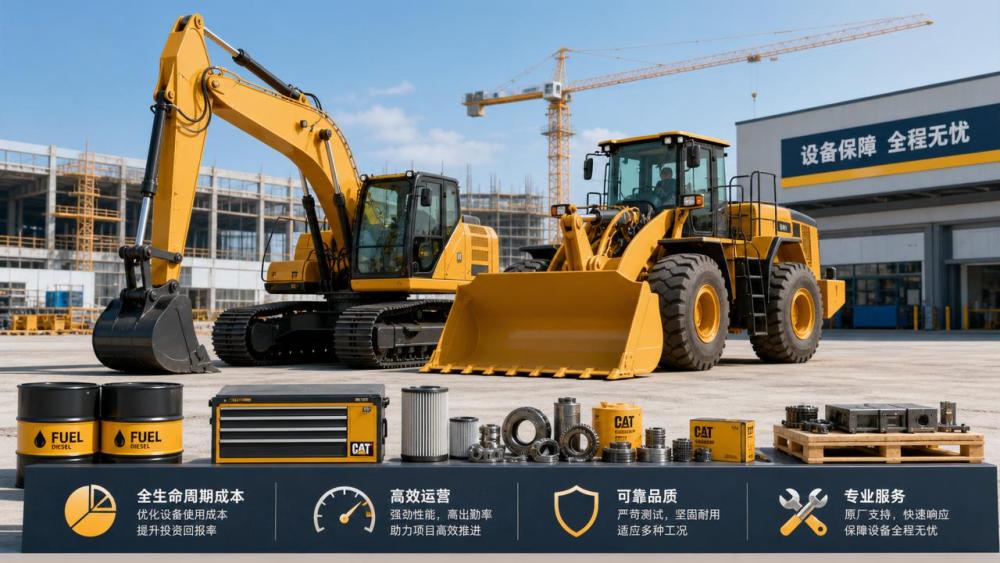
The essential question is not which machine is cheapest. It is which asset produces the required output at the lowest controlled risk.
A crawler excavator, wheel loader, grader, dozer, or skid steer creates value only when it works productively and predictably.
Total ownership cost, often called TCO, combines acquisition cost with operating cost, downtime cost, financing, compliance, and disposal value.
For procurement teams, TCO is also a negotiation tool. It turns supplier claims into measurable assumptions before contracts are signed.
The strongest construction equipment manufacturers support this process with transparent data, realistic maintenance schedules, verified fuel figures, and credible dealer coverage.
Define the duty cycle before comparing machines
No TCO model is useful without a clear duty cycle. The same machine can perform very differently across applications and environments.
Procurement should document material density, haul distance, underfoot conditions, climate, working hours, operator skill, attachment use, and target production rates.
A wheel loader in quarry loading faces different cost pressures than one feeding an asphalt plant or handling municipal materials.
An excavator used for trenching has different hydraulic demand from one breaking rock, loading trucks, or working with tiltrotators.
Manufacturers that help model real duty cycles usually provide more reliable value than suppliers offering only catalog specifications and generic performance promises.
Compare acquisition price only after normalizing configuration
Purchase price still matters, but it must be compared on equal specification. Otherwise, procurement may reward an incomplete quotation.
Normalize engine rating, bucket size, undercarriage type, tire class, counterweight, technology packages, cab protection, telematics, and attachment compatibility.
Clarify whether freight, commissioning, extended warranty, operator training, diagnostic tools, and first-service consumables are included in the quoted price.
A lower headline price may hide missing guarding, weaker hydraulics, reduced cooling capacity, or limited digital functionality required by the jobsite.
Procurement teams should request a configuration matrix, then compare each construction equipment manufacturer against the same operational baseline.
Fuel and energy efficiency are lifetime cost drivers
Fuel is often one of the largest controllable expenses in earthmoving fleets. Small efficiency differences become substantial over thousands of hours.
Buyers should compare liters per hour, fuel per ton moved, fuel per cubic meter excavated, or fuel per kilometer graded.
Production-based metrics are better than idle fuel figures because they reflect the machine’s ability to convert energy into useful work.
Ask manufacturers for test conditions, load factors, eco-mode assumptions, idle management behavior, and hydraulic efficiency data under comparable operating cycles.
For electric or hybrid equipment, compare charging infrastructure, battery warranty, energy cost, thermal management, utilization limits, and expected degradation.
Maintenance intervals matter less than maintenance reality
Long service intervals look attractive, but procurement must evaluate whether service tasks are practical, fast, safe, and locally supported.
Review oil change intervals, filter accessibility, grease points, automatic lubrication options, diagnostic alerts, undercarriage inspection requirements, and software update processes.
Also compare planned maintenance kits, technician labor hours, service truck requirements, and downtime needed for routine maintenance activities.
A machine with slightly shorter intervals may cost less if parts are cheaper, access is easier, and faults are diagnosed faster.
Request a five-year maintenance schedule from each manufacturer, including consumables, fluids, labor assumptions, and expected component replacement milestones.
Parts availability can decide real uptime
Uptime depends heavily on the dealer network, parts inventory, technician capability, and escalation speed when machines fail under pressure.
Procurement should ask where critical components are stocked, including hydraulic pumps, electronic controllers, sensors, undercarriage parts, cylinders, transmissions, and cooling parts.
Measure promised response times separately for inspection, diagnosis, parts delivery, repair completion, and temporary machine replacement if available.
Remote jobsites, mines, ports, road programs, and disaster recovery projects require different support assumptions from urban construction sites.
The best construction equipment manufacturers treat aftermarket support as a value proposition, not an accessory after the sale.
Downtime cost should be priced, not described
Many procurement models mention downtime but do not assign a number. That makes supplier reliability claims difficult to compare.
Estimate downtime cost using lost production, standby labor, delayed subcontractors, rental replacement, penalties, demobilization, and disrupted project sequencing.
For high-intensity loading or grading work, one failed machine can slow an entire chain of trucks, pavers, crushers, or crews.
Ask each manufacturer for fleet reliability data, mean time between failures, warranty claim trends, and references from similar applications.
Even when exact figures are confidential, a manufacturer’s willingness to discuss reliability openly signals maturity and accountability.
Operator productivity changes the cost per unit
Machine productivity is not only horsepower, bucket capacity, or blade width. It also depends on controllability and operator confidence.
Compare visibility, cab ergonomics, vibration, noise, control response, automatic functions, grade assist, payload systems, and attachment changeover speed.
In excavators, electro-hydraulic control logic can improve precision, reduce fatigue, and help operators maintain repeatable trenching or loading cycles.
In motor graders, GPS and laser-guided systems can reduce rework, survey dependency, material waste, and the number of finishing passes.
Procurement should include operator trials when possible, because a technically superior machine may underperform if crews resist its controls.
Technology value must be tied to measurable outcomes
Telematics, machine control, autonomy readiness, and remote diagnostics can reduce cost, but only when integrated into fleet management workflows.
Compare data ownership, API access, subscription fees, alert accuracy, fuel reporting, geofencing, utilization dashboards, and maintenance planning functions.
Grade control may justify a premium where material tolerances are tight, rework is expensive, and skilled operators are scarce.
Autonomous or semi-autonomous features may create value in hazardous mines, repetitive loading cycles, or large controlled infrastructure sites.
Do not pay for technology as decoration. Pay for reduced fuel, fewer errors, safer work, higher utilization, or shorter project cycles.
Emissions compliance affects both access and residual value
Non-road emissions regulations increasingly affect where machines can work, how long they remain compliant, and who will buy them later.
Procurement should compare engine certification, aftertreatment complexity, diesel exhaust fluid availability, regeneration behavior, and local service experience.
In low-emission zones, public infrastructure tenders, ports, tunnels, and urban projects, compliance may determine eligibility rather than preference.
Machines aligned with future emissions standards may retain value better, especially where buyers face tightening regulations and carbon reporting requirements.
However, buyers should balance compliance with operational practicality, fuel quality, technician readiness, and the cost of aftertreatment failures.
Residual value is a strategic assumption, not a guess
Residual value can significantly change TCO, especially for fleets that replace equipment on fixed cycles or finance assets aggressively.
Compare auction data, dealer buyback offers, global export demand, brand perception, component reputation, machine age, hours, and service history.
Some construction equipment manufacturers command stronger resale value because secondary buyers trust their parts supply and long-term durability.
Procurement should avoid using optimistic resale percentages without evidence from comparable models, regions, and machine conditions.
A guaranteed residual program can reduce risk, but teams must read return conditions, hour limits, damage definitions, and maintenance obligations carefully.
Financing, warranty, and contracts can shift risk
TCO is influenced by payment structure, interest rate, lease terms, tax treatment, warranty coverage, and service contract design.
Compare standard warranty, extended powertrain coverage, full machine warranty, component exclusions, travel charges, and response commitments.
A full-service maintenance contract can improve budget certainty, but only if the scope matches actual application severity.
For critical projects, uptime guarantees, loaner machines, parts consignment, or performance-based service agreements may justify higher purchase prices.
Procurement should evaluate not only cost, but also which party carries the risk when performance assumptions fail.
Build a weighted scorecard for manufacturer comparison
A structured scorecard helps procurement compare manufacturers consistently and explain recommendations to finance, operations, and executive leadership.
Typical categories include purchase cost, fuel efficiency, maintenance cost, dealer support, reliability, productivity, technology, compliance, safety, and residual value.
Weight each category according to application. A mine may prioritize uptime and support, while a city contractor may prioritize compact versatility.
Use evidence levels for every score, separating verified field data, third-party references, manufacturer projections, and unvalidated sales claims.
This prevents a polished presentation from outweighing jobsite proof, especially during competitive tenders involving multiple equipment brands.
Ask suppliers questions that expose weak assumptions
Good procurement questions reveal whether a manufacturer understands your operating reality or is simply defending its price position.
Ask for fuel consumption under your duty cycle, expected component life, top failure modes, local parts fill rates, and technician training records.
Request references from customers using similar machines, attachments, utilization levels, materials, climates, and maintenance practices.
Ask how telematics data supports preventive maintenance, warranty claims, operator coaching, and fleet utilization decisions.
Finally, ask what cost risks the manufacturer is willing to share through warranty, service contracts, buybacks, or uptime commitments.
Use pilot testing when the purchase is mission-critical
For large fleet purchases, a short pilot can prevent expensive mistakes and improve confidence across procurement and operations.
Measure fuel, cycle time, payload accuracy, operator feedback, fault codes, maintenance time, grading accuracy, idle ratio, and support responsiveness.
Keep the test fair by matching operators, materials, work patterns, attachments, and measurement methods across competing machines.
Pilot results should update the TCO model, not sit separately as informal feedback or anecdotal preference.
Where pilots are impossible, demand stronger references, extended demonstrations, performance guarantees, or staged purchasing with review gates.
The right manufacturer is the one reducing lifecycle uncertainty
Brand strength matters, but procurement should define strength as predictable lifecycle performance under real operating pressure.
The best choice may not be the cheapest or most technically advanced machine. It is the most defensible value proposition.
That value comes from reliable production, efficient energy use, practical maintenance, responsive support, compliance durability, and credible resale performance.
As fleets move toward electrification, autonomy, and data-driven maintenance, construction equipment manufacturers must prove capabilities beyond mechanical specifications.
Procurement teams that compare TCO rigorously will reduce risk, improve utilization, and build fleets that support long-term commercial advantage.
Conclusion: turn equipment buying into lifecycle value management
Comparing construction equipment manufacturers through total ownership cost changes the procurement conversation from price negotiation to value management.
It forces every claim about fuel, uptime, service, technology, compliance, and resale value into a structured decision framework.
For buyers, the goal is not to select a famous brand. It is to select a machine ecosystem that performs reliably.
When procurement connects field reality with financial modeling, equipment decisions become clearer, more accountable, and easier to defend.
That is how modern fleets protect margins, reduce operational surprises, and gain advantage in increasingly demanding infrastructure markets.