
Related News
- 00
0000-00
How to size heavy-duty loaders for North American mining operations - 00
0000-00
How altitude affects mining excavator performance in Latin America - 00
0000-00
Caterpillar Launches New Cat 6060 and Upgraded Autonomous Mining System - 00
0000-00
When does eco-friendly construction equipment pay for itself? - 00
0000-00
Will a wheel loader quick coupler fit your existing attachments?
Tags
A bucket-chain dredger can appear straightforward in a procurement schedule: a continuous chain, a ladder, buckets, screening or recovery equipment, and a hull or floating platform. In diamond-bearing material, however, the purchase decision is rarely determined by headline excavation capacity. The more consequential questions concern how rapidly high-contact components will wear, how easily they can be replaced, and whether a failure in one subsystem can stop the whole recovery circuit.
For procurement teams, uptime risk has a direct commercial effect. A dredger may be working in a remote mine site, a river reach with limited access, or a waterway project where operating windows are constrained by water levels, permits, weather, or vessel movements. If buckets, chain links, sprockets, rollers, ladder components, pumps, or recovery equipment require unexpected attention, the cost is not limited to spare parts. It can include idle labor, lost production time, mobilization delays, emergency freight, and disruption to planned material handling.
The right procurement approach is to assess the dredger as a maintainable operating system rather than as a single piece of capital equipment. That requires a clear view of feed characteristics, wear zones, service access, component interchangeability, supplier documentation, and the practical availability of spares over the expected operating period.
Why wear assessment should begin with the deposit and not the equipment list
Wear rates depend heavily on what enters the buckets. Diamond-bearing alluvial deposits can vary from relatively loose sand and gravel to compacted material containing coarse quartz, hard rock fragments, clay lenses, roots, and occasional oversized boulders. A design that performs acceptably in fine, unconsolidated material may face accelerated abrasion and shock loading in coarse gravel with angular rock.
Procurement specifications should define the anticipated feed envelope in practical terms. Useful inputs include particle-size distribution, expected oversize fraction, mineral hardness where known, clay content, material density, water depth, excavation depth, and the presence of buried timber, scrap metal, or other obstructions. These details help suppliers determine whether the chain, bucket lips, pins, bushings, rollers, and drive arrangement are suitable for the duty.
Material variability matters as much as average conditions. A deposit may have a generally fine feed but contain isolated high-abrasion layers. Similarly, a dredger used for waterway excavation may encounter sand, silt, vegetation, construction debris, or compacted bed material rather than mineral-bearing gravel. Procurement documents should ask bidders to state the operating assumptions behind their proposed wear-package selection. This makes it easier to compare quotations that may otherwise look similar.
High-wear components deserve separate scrutiny
Some components are consumable by design, while others should remain stable for long service intervals. Confusing the two can lead to poor cost forecasts. Bucket cutting edges, lips, liners, teeth where fitted, and certain chute liners are expected to wear. Their replacement should be planned around accessible inspections and stocked parts. A cracked ladder structure, damaged drive shaft, distorted sprocket mounting, or failing gearbox is more disruptive because repair may require lifting equipment, alignment work, or an extended shutdown.
For each wear-critical item, the buyer should establish four points: the expected inspection method, the likely replacement trigger, the tools or lifting arrangement required, and the lead time for replacement stock. A supplier statement that a component is “wear resistant” is too broad to support a purchase decision. Procurement teams need to understand the material grade, thickness or section where relevant, attachment method, and whether the part can be replaced without removing adjacent assemblies.
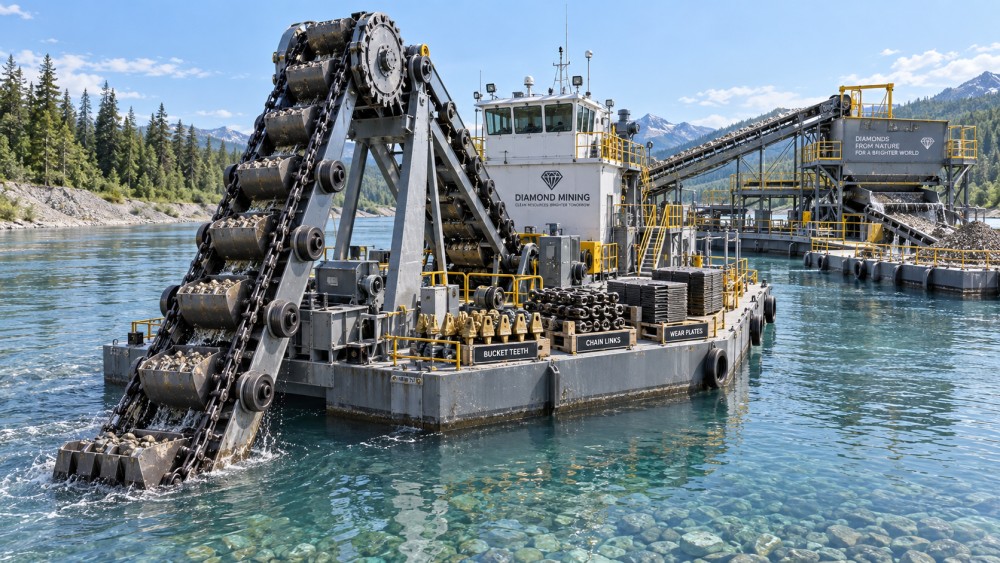
Mapping the failure paths that reduce dredger availability
Uptime is affected by more than bucket wear. In a bucket-chain arrangement, the excavation system, drive train, screening section, recovery plant, electrical or diesel power system, and discharge arrangement are operationally linked. A minor issue in one location can limit throughput across the plant.
A chain that elongates beyond acceptable limits, for example, can affect sprocket engagement and tracking. Poor alignment may accelerate roller and guide wear, create irregular loading, and increase the chance of chain derailment. Replacing only the visibly damaged part without investigating alignment, lubrication, tensioning, and loading conditions can result in repeat failures.
Similarly, excessive bucket wear can reduce effective digging performance before a bucket becomes structurally unsafe. Worn lips and side plates may change how material enters the bucket, while damaged bucket bodies can release material prematurely or create unstable loads on the chain. Where material includes large stones, the risk is not simply abrasion; impact can deform bucket assemblies and overload pins, links, or drive components.
The recovery side needs equal attention in diamond applications. Oversize rejection, washing, screening, and concentration stages must protect valuable stones while controlling clay, gravel, and water flow. A procurement review should not assume that a higher excavation rate produces a better result. If downstream equipment cannot process the delivered material without blinding, excessive turbulence, blockage, or unacceptable losses, the dredger’s practical output may be constrained by the recovery circuit.
Comparing capital price with lifecycle exposure
A low purchase price can be attractive when budgets are tight, but a comparison based only on initial cost often hides different assumptions about wear allowances and spares. One quotation may include a starter set of chain components, bucket wear parts, bearings, seals, and electrical consumables; another may exclude them. One may provide replaceable liners in abrasion zones, while another may depend on repair welding after significant wear has occurred. Neither approach is automatically wrong, but they should not be treated as equivalent.
A useful comparison separates the package into equipment cost, commissioning requirements, recommended commissioning spares, annual operating spares, and contingency items with longer lead times. Buyers can then ask which parts are expected to be replaced during routine maintenance and which failures would require a major shutdown. This creates a more realistic view of exposure than a single “maintenance cost” line.
It is also sensible to consider transport and site conditions. Large bucket-chain systems may require sectional delivery, field assembly, crane access, and accurate alignment at the operating location. A design that is manageable in a well-equipped yard can be difficult to maintain at a remote river site. Procurement teams should clarify transport dimensions, module weights, assembly sequence, required site equipment, and whether replacement components can be shipped and handled safely within local constraints.
When evaluating a bucket chain diamond dredger configuration for mining or waterway work, the buyer should connect the proposed excavation arrangement to the actual material-handling route. The appropriate bucket size, chain duty, screening layout, and discharge method depend on excavation depth, feed character, water conditions, and whether the project is focused on mineral recovery, channel maintenance, or a combination of both.
Questions that expose maintainability before contract award
Technical submissions often describe installed equipment but provide less detail about service procedures. Procurement can reduce ambiguity by requesting a maintenance-oriented response rather than relying only on general brochures or capacity descriptions.
- Which components require routine inspection during normal operation, and how can personnel access them safely?
- What are the recommended checks for chain tension, sprocket condition, roller wear, bucket attachment, and ladder alignment?
- Which wear parts are interchangeable, and which are specific to a particular bucket or chain configuration?
- Can individual buckets, links, rollers, and liners be changed in place, or must larger assemblies be removed?
- What tools, lifting points, jacking arrangements, and alignment procedures are needed for planned maintenance?
- Which parts have the longest manufacturing or shipping lead times?
- What drawings, part numbers, inspection records, and operating manuals will be delivered with the equipment?
These questions are particularly useful when the dredger will be operated by a site team that may not have extensive experience with bucket-chain machinery. Clear part identification and illustrated maintenance documentation can prevent delays caused by ordering the wrong component or dismantling an assembly unnecessarily.
Acceptance should include fit, access, and documentation
Factory inspection and site acceptance should cover more than whether drives rotate and buckets move. Buyers can inspect weld quality visually, verify fastener security, review chain and sprocket alignment, confirm guarding and emergency-stop arrangements, and check that lubrication points are accessible. Where the dredger is delivered in modules, records of mating surfaces, alignment references, and assembly instructions become especially important.
The spare-parts package should be physically reconciled against a detailed packing list. Part numbers should match drawings and manuals, and consumables should be labeled for storage. If parts are supplied in different material grades or dimensions, the distinction needs to be clear. A maintenance team should not have to identify a critical chain pin or bucket liner by visual guesswork months after commissioning.
Balancing mining recovery needs with waterway-project duty
Bucket-chain equipment may be considered for mining activity and for waterway projects, but the procurement priorities can differ. In diamond recovery, the central concern is controlled excavation and effective treatment of valuable-bearing material without creating unnecessary losses or excessive breakage risk. The equipment must also deal with abrasive gravel and variable feed conditions.
In waterway work, production may be measured more directly by excavation volume, channel condition, or material relocation. The feed may include silt, sand, vegetation, debris, and occasional hard obstructions. Environmental permissions, turbidity controls, disposal arrangements, and navigation safety can shape the equipment specification. A mining-oriented recovery circuit may be unnecessary for a pure maintenance-dredging task, while a basic excavation arrangement may be inadequate for a mineral-bearing operation.
Where one machine is expected to serve both roles, procurement should avoid vague “multi-purpose” language. The contract should identify the primary duty, the expected secondary duty, and any required changeover equipment. This is where a plain reference to a bucket chain diamond dredger is useful: it describes a general equipment category, but the final configuration still needs to reflect the intended recovery process, excavation profile, and operating environment.
Building a procurement file that supports later operations
The strongest purchase files translate operating risk into contractual clarity. They identify the material conditions used for design, define what is included in the wear package, require part and assembly documentation, specify inspection and acceptance activities, and distinguish operator maintenance from specialist repair. They also establish how changes will be managed if site conditions differ materially from the original feed assumptions.
Procurement teams should resist treating spare parts as an afterthought. A carefully selected initial stockholding, combined with accessible service design and accurate maintenance records, can have more influence on availability than modest differences in quoted capacity. The practical objective is a dredger whose normal wear can be monitored, planned, and corrected before it develops into a chain, structural, or recovery-system shutdown.