
Related News
- 00
0000-00
How to size heavy-duty loaders for North American mining operations - 00
0000-00
How altitude affects mining excavator performance in Latin America - 00
0000-00
Caterpillar Launches New Cat 6060 and Upgraded Autonomous Mining System - 00
0000-00
When does eco-friendly construction equipment pay for itself? - 00
0000-00
Will a wheel loader quick coupler fit your existing attachments?
Eco friendly construction equipment pays for itself when its cumulative operating savings and verified commercial benefits recover the additional purchase and deployment cost within your planned ownership period. There is no universal payback year: a regularly used electric excavator with dependable charging can have a stronger investment case than a cheaper machine that spends much of its time idle.
The approval problem usually appears when a lower-emission excavator or loader carries an upfront premium, while the supplier’s savings estimate assumes uninterrupted operation. A site with limited electrical capacity, frequent relocation, or demanding attachment work may produce different results. The decision should therefore start with a matched-duty comparison and an incremental cash-flow model—not a general claim that electric or hybrid equipment costs less to run.
Define what “paying for itself” means
For a planned fleet replacement, the relevant question is normally whether the greener option recovers its additional cost compared with the conventional machine you would otherwise buy. Requiring fuel savings to repay the entire purchase price ignores the fact that either replacement requires capital.
Early replacement is different. Compare buying the new machine now against keeping the existing asset, including its remaining maintenance costs, expected downtime, eventual disposal proceeds, and future replacement timing. Historical purchase expenditure is sunk; it should not be treated as a new cash outflow. However, selling the existing machine now rather than later changes the decision cash flow.
Also distinguish three measures:
- Simple payback: when cumulative, undiscounted incremental savings recover the initial premium.
- Discounted payback: when those savings recover the premium after allowing for the time value of money.
- Lifecycle net present value: whether the investment creates value across the full ownership period, including major repairs and disposal.
A machine can show an attractive simple payback but a weak lifecycle result if a major battery expense follows soon afterward. Conversely, residual value can improve lifecycle economics without helping fund the early years. Use payback to assess capital exposure, but use net present value to judge overall financial attractiveness.
Build the comparison around completed work
Compare equipment that can deliver the same required output. Similar operating weight or advertised power does not establish equivalent production. For excavators, assess digging conditions, attachment demand, cycle times, and loading performance. For wheel loaders, match payload, travel distance, gradients, and material-handling cycles.
The primary denominator should be a useful production unit: material moved, trench completed, or area graded to specification. Hourly cost remains useful, but a lower cost per operating hour is not a saving if the machine needs more hours to finish the task.
Agree on the measurement boundary before accepting quotations. Diesel consumption should reflect the relevant work and idle periods. Electric consumption should be measured at the supply point wherever possible, so charging losses are included. Both alternatives need equivalent treatment of transport, operator time, attachment use, and nonproductive hours.
Calculate the premium before estimating savings
The initial incremental investment includes more than the difference between machine quotations. Add the charging equipment, installation, electrical upgrades, commissioning, training, and any additional transport or site preparation required by the lower-emission option. Deduct confirmed incentives only when eligibility, payment timing, and retention conditions are understood.
A shared charger needs careful treatment. If it must be installed solely because of this purchase, its full initial cost belongs in the project cash flow. If several approved machines will use it, allocate costs consistently across the fleet model. Do not reduce the first machine’s investment by assuming later purchases that have not been authorized.
Simple payback = net incremental initial investment ÷ annual net incremental operating benefit.
This shortcut applies only when annual benefits are reasonably stable and positive. Where utilization ramps up, electricity charges vary, or major costs occur in particular years, calculate annual cash flows and identify when their cumulative total becomes positive. If annual operating benefit is zero or negative, operating savings alone will not repay the premium.
For lifecycle analysis, discount each year’s incremental cash flow using the organization’s approved investment rate. Include the difference in terminal disposal proceeds, net of disposal costs. Model incentive receipts in the year they are expected rather than treating a delayed payment as immediate cash.
Where the operating benefit actually comes from
Energy savings must survive the site tariff
Calculate diesel expenditure from measured consumption and the delivered fuel price. Include fuel handling or delivery costs only where the alternative genuinely avoids them. For electricity, use expected metered consumption and the applicable tariff, then add incremental demand charges, fixed charges, or temporary supply costs.
A battery machine charged from an existing site connection has a different cost structure from one dependent on mobile generation. Generator fuel, rental, conversion losses, and logistics can erode the apparent saving. Renewable electricity procurement may support emissions objectives, but it should not be assumed to reduce costs.
Maintenance savings are narrower than “no engine”
Electric equipment can avoid some engine-related servicing, but it still has hydraulic systems, undercarriages or tires, pins, cooling components, and attachments. Obtain service schedules for both machines and price the actual differences. Include specialist diagnostics, software subscriptions where required, and service travel charges.
Do not count lower maintenance expenditure and higher availability as separate benefits unless each is independently supported. Saved parts and labor are one benefit; additional contribution from recovered productive time is another. The latter exists only if work is available and the machine can use that time profitably.
Commercial benefits need a route to cash
Lower noise or zero tailpipe emissions may make equipment suitable for particular indoor, urban, or restricted-access work, subject to site requirements. Count a financial benefit only when it changes a credible contract opportunity, avoids a documented cost, or supports an identifiable price premium.
An emissions reduction is not automatically revenue. Internal carbon pricing can inform approval, but show it separately from cash savings unless a real payment, tax, or contractual charge changes. This keeps the investment case readable when environmental objectives and financial returns differ.
Test charging against the working shift
Charging risk is often a scheduling issue rather than simply a battery-size issue. Map the shift: productive work, travel, attachment use, breaks, charging windows, and turnaround before the next shift. Check whether the required energy can be replenished using the power actually available.
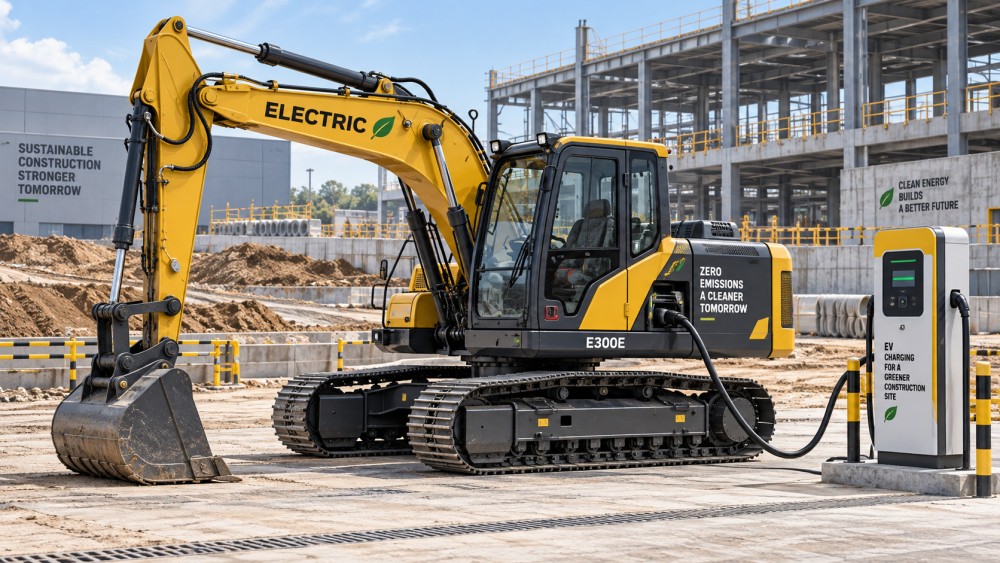
Account for simultaneous demand from other machines and site facilities. A charger’s rated output does not establish what the site connection can deliver. Connection lead times and temporary-power arrangements can also affect when savings begin.
Battery runtime claims should be tested against the intended duty cycle. Continuous heavy hydraulic work, long travel distances, and temperature conditions can change usable runtime. A trial should record completed work, charging interruptions, energy consumed, and any production shortfall—not merely whether the machine lasted until the end of a shift.
Translate shortcomings into cash consequences. An extra rental machine, overtime, delayed loading, or unused operator time belongs in the model when it is attributable to charging or runtime limitations. Do not price every charging minute as lost production if charging occurs during an existing break.
Hybrid equipment requires a different test. Verify that the work pattern allows its energy-recovery or engine-management system to deliver the quoted benefit. Keep fuel savings separate from any additional servicing or component costs; hybrid architecture alone does not establish a financial return.
Find the utilization threshold and stress-test it
High utilization spreads the premium over more productive work, but annual machine hours are not sufficient evidence. Examine how many hours occur on suitable sites, under duties where the measured savings apply. A machine used across scattered short projects may incur repeated charging setup and transport costs.
If the model has a stable net saving per comparable productive hour, estimate the workload required to recover the premium:
Required annual hours = [(net incremental investment ÷ target payback years) + annual incremental fixed costs] ÷ net variable saving per hour.
This simplified threshold excludes discounting and assumes equivalent productivity. Use it as a screening tool, then return to annual cash flows for approval. If savings are measured per production unit, calculate the threshold in that same unit instead.
Test a base case and a downside case using defensible ranges for utilization, energy prices, production rate, charging availability, and maintenance. A combined downside scenario is important: lower workload and higher deployment costs may occur together when projects change.
The result should identify the assumptions that decide approval. If a small reduction in annual workload pushes payback beyond the planned holding period, the investment depends on securing that workload. If electricity demand charges dominate the result, resolve the tariff and charging schedule before negotiating the machine price.
Protect the return after the payback date
Battery warranty should be reviewed alongside expected duty, not treated as a substitute for a replacement estimate. Check capacity-retention conditions, operating limits, exclusions, claim procedures, and whether labor or transport is covered. Where replacement timing is uncertain, model alternative cost and timing scenarios instead of assuming either no replacement or an automatic full replacement.
Residual value deserves similar discipline. Battery health documentation, transferable warranties, service support, and buyer access to charging can affect resale prospects. Without credible evidence, use a conservative terminal assumption and show how much the decision depends on it.
Choose one consistent financing approach. An unlevered project model assesses operating cash flows and investment cost separately from borrowing, using an appropriate discount rate. An equity cash-flow model includes borrowing, repayments, and interest consistently. Do not combine full purchase expenditure with loan repayments in the same calculation, or add financing interest where it is already reflected in the chosen valuation method.
Tax effects can change the result through depreciation allowances, deductible expenses, and incentive treatment. Apply the relevant jurisdiction’s rules to both alternatives consistently rather than assuming that a greener machine receives preferential treatment.
Approval is strongest when verified operating savings recover the premium before disposal, the downside case remains acceptable, and the site can support the required workload without unpriced infrastructure. Where those conditions remain unproven, a matched-duty rental or trial can resolve the specific uncertainty before capital is committed. Set its acceptance criteria around production, metered energy, charging feasibility, and service requirements—the variables that actually determine when the equipment pays for itself.