
Related News
- 00
0000-00
How to size heavy-duty loaders for North American mining operations - 00
0000-00
How altitude affects mining excavator performance in Latin America - 00
0000-00
Caterpillar Launches New Cat 6060 and Upgraded Autonomous Mining System - 00
0000-00
When does eco-friendly construction equipment pay for itself? - 00
0000-00
Will a wheel loader quick coupler fit your existing attachments?
Construction machinery should be matched to the resistance, geometry, sequence, and control requirements of the site—not selected as a set of familiar machine categories. A high-capacity excavator can become inefficient on a constrained utility corridor; a compact skid steer can lose its advantage when haul distances or material density rise; a grader with advanced control cannot compensate for unstable subgrade or poorly defined survey control.
The practical question is not which machine has the highest rated output. It is whether each machine can complete its assigned work within the available access, bearing capacity, production window, and quality tolerance, while still leaving enough contingency for weather, material variation, and maintenance interruptions. For civil engineering works, the correct equipment mix is usually determined by the site’s limiting conditions.
Start with the ground, not the machine category
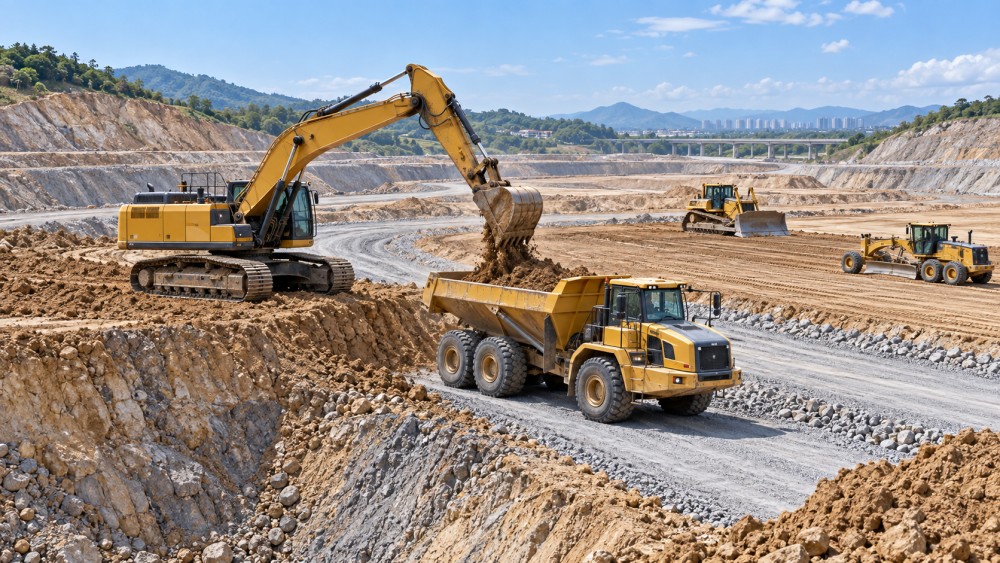
Ground conditions govern traction, flotation, breakout demand, stability, and the risk of becoming immobilized. They should be assessed separately for the active excavation area, haul routes, stockpiles, working platforms, and final grading zones. A site may support a large crawler excavator at the cut face but not a loaded wheeled loader at the edge of an unprepared fill area.
Soft cohesive soils, saturated fills, peat, and recently placed granular layers place a premium on low ground pressure and stable access planning. Tracked excavators and bulldozers generally offer better flotation and drawbar pull than wheeled equipment, but their advantage is reduced when the operating platform itself is weak or uneven. Track width, shoe type, counterweight configuration, and machine mass all need to be considered together. A heavier machine with wider shoes does not automatically impose less effective risk on a marginal platform, particularly during slewing or when working near an unsupported trench edge.
Dense clay, weathered rock, hardpan, and blasted material shift the evaluation toward digging force, attachment durability, hydraulic flow, bucket design, and undercarriage protection. In these conditions, nominal engine power is only one part of the picture. Bucket penetration geometry, tooth system, stick force, hydraulic response under load, and cycle time determine whether an excavator can maintain production without excessive operator inputs or component wear.
For rock excavation, the project should distinguish between material that can be ripped, material that can be broken hydraulically, and material requiring drilling and blasting. Treating all “rock” as one condition leads to costly mismatches. A bulldozer with a ripper may be effective in fractured or weathered formations, while intact competent rock can quickly make ripping uneconomic. Similarly, fitting a hydraulic hammer to an undersized excavator may create poor production and accelerate structural fatigue.
Access constraints often determine the real machine size
Machine dimensions matter before the machine reaches the workface. Gate widths, bridge ratings, internal road radii, overhead utilities, slope transitions, turning areas, and staging space can eliminate otherwise capable equipment. These constraints are particularly important on urban redevelopment, rail-adjacent work, utility installations, and phased infrastructure projects where access changes as construction advances.
Excavator selection should therefore include transport width, tail swing, boom configuration, operating radius, and the room needed to position trucks or spoil containers. Reduced-tail-swing excavators are useful where the counterweight must remain inside a traffic barrier line or excavation boundary. Their compact geometry, however, should not be confused with identical lifting capacity or reach across all sizes. The working envelope must be checked against trench depth, loading height, required reach, and the permitted set-back from excavation edges.
Compact equipment is valuable where access is limited, but the productivity penalty of repeated small loads can become significant on bulk earthworks. A skid steer loader may be the best choice for backfilling around structures, moving pallets, sweeping, trench support tasks, and short-distance material handling. It is rarely the economic answer for sustained loading of large volumes into highway trucks across long, rough travel paths. The machine’s versatility is real, but it should not be used to conceal a missing production plan.
Access also affects serviceability. A machine that can enter a narrow work zone but cannot be safely refueled, inspected, or recovered there creates an avoidable schedule vulnerability. This is especially relevant where night work, limited laydown areas, or confined corridors restrict support vehicles.
Match excavation equipment to the required production cycle
Excavator sizing should be based on the complete cycle: digging, swinging, loading, repositioning, and interaction with haul units. Selecting by bucket capacity alone is unreliable because actual bucket fill depends on material type, moisture, fragmentation, bucket shape, and operator visibility. A large bucket in wet clay may carry less useful volume than expected, while an oversized bucket can overload the boom or create truck-loading inconsistency in dense material.
The excavator and haul fleet must be balanced. If trucks queue under the excavator, capital and labor are waiting. If the excavator repeatedly waits for trucks, its productive utilization falls and the excavation sequence becomes harder to control. The appropriate balance is not always a fixed number of trucks per excavator because haul distance, road condition, loading position, dumping delays, and traffic management can change during the project.
For deep excavations, the machine must also be evaluated against the geometry of the cut. Required digging depth, maximum reach at depth, loading height, and bench arrangement may favor a long-reach configuration, a larger conventional excavator positioned on a bench, or a staged excavation method. Long-reach machines expand reach but generally trade away breakout force and lifting capacity. They are effective when access to the excavation face is constrained, not as a universal substitute for proper bench design.
Attachment requirements should be defined early. Tilt buckets, hydraulic couplers, breakers, compactors, shears, grapples, augers, and screening buckets can reduce machine changes and improve flexibility, but each affects machine weight, hydraulic demand, cycle time, and safety controls. A coupler also introduces compatibility requirements involving hydraulic circuits, attachment mass, load charts, and operator procedures. Attachment capability should be specified by the work to be completed, rather than added as an afterthought because it is available in a supplier catalogue.
Separate material handling from earthmoving assumptions
Wheel loaders are often selected for stockpile management, plant feeding, truck loading, aggregate handling, and site cleanup. Their productivity depends heavily on travel distance and surface condition. Short, repeatable loading cycles on firm ground can favor a loader because of fast travel and efficient bucket loading. As travel distances lengthen, the balance may shift toward articulated dump trucks, rigid haulers, conveyors, or a different material flow arrangement.
Material characteristics change loader requirements. Loose sand, crushed aggregate, wet clay, recycled concrete, and blasted rock demand different bucket profiles, cutting edges, tire choices, and breakout capability. A bucket sized for light aggregate may not be appropriate for dense, wet material because it can exceed payload limits. Conversely, an undersized bucket used in low-density material leaves available capacity unused and increases loading cycles.
Tire selection is not merely a maintenance issue. It affects traction, ride quality, puncture resistance, heat generation, and operating cost. Sharp demolition debris and blasted rock require a different risk assessment from a prepared granular haul road. Where tire damage is likely, the apparent productivity benefit of a wheeled machine must be weighed against downtime and replacement exposure.
Bulldozers should be assigned where pushing, spreading, stripping, and rough shaping are the actual bottlenecks. Their value comes from traction and controlled blade work, not from carrying material over distance. Pushing material too far is a common planning error: dozer cycle times rise sharply as push distance increases, while the machine’s ability to maintain grade and material control declines. Scrapers, loaders with trucks, or intermediate stockpiling may be more suitable once the movement distance exceeds the efficient push range for the planned dozer and material.
Grade tolerance changes the equipment decision
Not all earthworks need the same level of surface control. Bulk cut-and-fill can tolerate broader variation than road subgrade, drainage channels, airport platforms, pavement base, or final formation around structures. The required tolerance should determine when the project moves from high-volume equipment to precision grading equipment.
Motor graders are especially effective where long, continuous surfaces require shaping, camber, crossfall, and fine trimming. Their advantage lies in blade control and surface consistency, not in heavy excavation. A grader cannot efficiently correct large material imbalances or compensate for poorly compacted, pumping, or unstable layers. Before precision grading begins, the formation should have the necessary material condition and compaction readiness; otherwise, repeated passes produce rework rather than accuracy.
Machine-control systems using GNSS, total station, laser, or other site positioning methods can improve repeatability and reduce dependence on repeated staking, but they require a reliable control framework. The design model, coordinate system, benchmarks, site calibration, communications coverage, and update procedures must be governed carefully. A machine receiving an incorrect or outdated surface model can grade accurately to the wrong elevation.
The decision is therefore not simply whether to specify “3D control.” It is whether the work area has enough continuous grading volume, tolerance sensitivity, survey discipline, and trained support to justify the system. On short, interrupted, or heavily obstructed tasks, conventional methods may remain more practical. On extensive linear works or large platforms, precision guidance can have a clearer operational role if the digital workflow is controlled.
Environmental and regulatory constraints are operating conditions
Noise limits, emissions restrictions, dust controls, water protection measures, and working-hour rules can materially affect equipment suitability. In dense urban areas, a machine selected only for output may be unusable during permitted work windows because of noise exposure or local non-road emissions requirements. Requirements vary by jurisdiction and project contract, so compliance should be checked against the applicable rules rather than inferred from machine age or branding.
Electric or hybrid equipment may be relevant where enclosed operation, local emissions constraints, or noise limits dominate the decision. Its suitability depends on duty cycle, charging or power availability, ambient conditions, attachment demand, and the consequences of recharge downtime. The same applies to remote-control or semi-autonomous functions in hazardous zones: they can alter exposure and operating patterns, but only where communications, exclusion zones, maintenance support, and site procedures are in place.
Environmental control also affects the physical plan. Wet-weather access routes, wheel-wash systems, dust suppression points, sediment controls, and designated refueling areas can change travel distances and machine turnaround times. These should be incorporated into production assumptions rather than treated as external constraints with no equipment effect.
Evaluate the fleet as a sequence of handoffs
Civil engineering machinery performs best when each unit receives work in a condition it can handle efficiently. Excavators open and load; dozers spread and rough-shape; loaders manage stockpiles and loading; graders establish finished planes; compactors stabilize layers. The sequence is not rigid, but the interfaces matter. A grading crew waiting for material correction, or a loader repeatedly rehandling spoil because the excavation and haul plan are disconnected, signals a fleet-design problem rather than an individual operator problem.
Selection should test the proposed mix against foreseeable disruptions: rain-softened haul routes, changing excavation depths, variable material, restricted delivery periods, and the loss of one critical machine. A fleet built around a single highly specialized unit may offer excellent theoretical output but weak schedule resilience. In some projects, a smaller backup machine or an attachment-compatible unit provides more practical value than additional headline capacity.
Availability must be assessed beyond the machine specification. Parts access, field service capability, consumables, attachment support, telematics access, operator familiarity, and transport lead times all influence whether planned output can be sustained. For imported or cross-border equipment, documentation, local emissions eligibility, service coverage, and spare-parts logistics deserve review before mobilization—not after a machine is parked with a minor but unavailable component.
A defensible site-based selection record
A useful selection record links each major activity to its controlling conditions: material type and volume, haul or push distance, access envelope, bearing capacity, slope, required finish tolerance, work hours, attachment needs, and environmental restrictions. It should then identify the machine configuration that satisfies those conditions, including bucket or blade specification, track or tire arrangement, guidance system, and support requirements.
This approach avoids two expensive errors: buying or hiring capacity that cannot be used on the site, and choosing compact equipment that appears economical but extends the programme through low cycle output. Construction machinery for civil engineering is not a generic asset category. It is a site-production system. When the ground, geometry, material flow, and finish requirements are assessed together, equipment decisions become more defensible and the project is less exposed to avoidable rehandling, downtime, and grade correction.