
Related News
- 00
0000-00
How to size heavy-duty loaders for North American mining operations - 00
0000-00
How altitude affects mining excavator performance in Latin America - 00
0000-00
Caterpillar Launches New Cat 6060 and Upgraded Autonomous Mining System - 00
0000-00
When does eco-friendly construction equipment pay for itself? - 00
0000-00
Will a wheel loader quick coupler fit your existing attachments?
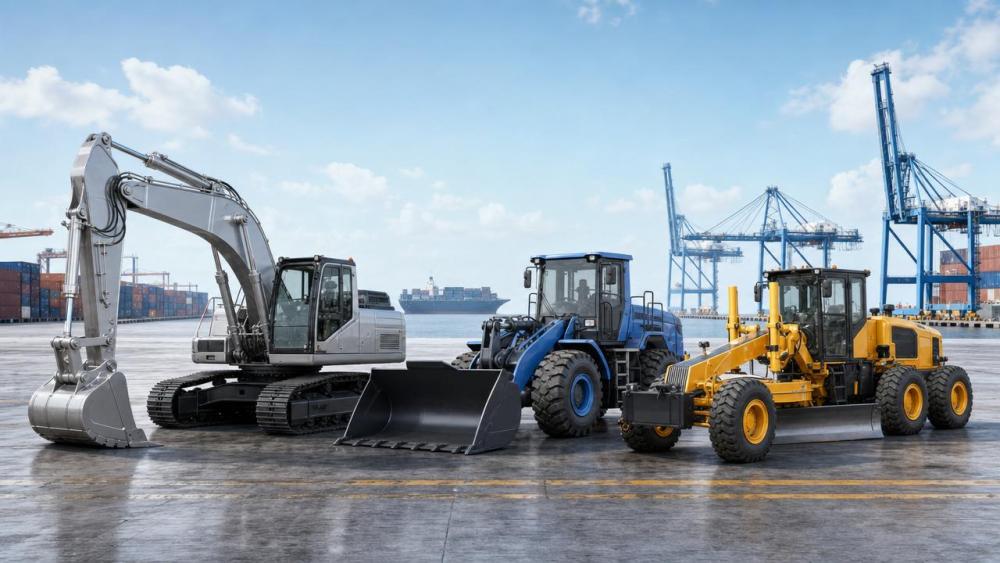
As of March 31, 2026, China’s construction machinery exports reached USD 16.066 billion in the first quarter — a 24.3% year-on-year increase — reflecting accelerated global demand and evolving procurement paradigms in international infrastructure markets.
Confirmed Export Performance Data
According to data released by the China Construction Machinery Association, total export value for January–March 2026 stood at USD 16.066 billion, up 24.3% compared to the same period in 2025. Export volumes of excavators and wheel loaders rose by 36.1% and 38.5%, respectively. The share of high-end and electric-powered equipment in total exports increased, indicating broader adoption of advanced control systems and low-carbon technologies among Chinese manufacturers.
Impact Across Supply Chain Roles
Export-Oriented Trading Enterprises
These firms face heightened demand for technical documentation, lifecycle performance validation, and compliance verification — especially for CE, EPA Tier 4, and regional emissions certifications. Order intake is shifting toward higher-value contracts requiring after-sales service commitments and remote diagnostics support.
Raw Material and Component Procurement Firms
Increased production volumes for electric drivetrains, battery modules, and intelligent hydraulic components are driving revised sourcing strategies. Suppliers must now align with stricter traceability requirements and sustainability reporting expectations tied to EU CBAM and similar frameworks.
Equipment Manufacturing Enterprises
Manufacturers are under growing pressure to integrate embedded telematics, ISO 13849-compliant safety architectures, and modular battery platforms into standard product lines — not just premium variants. Production planning cycles are tightening to accommodate faster certification turnaround times.
Supply Chain Service Providers
Firms offering logistics coordination, customs advisory, and regulatory conformity assessment services report rising requests for pre-shipment technical audits, bilingual test reports (EN/IEC standards), and digital compliance dossiers aligned with UNECE R136 or ISO 26262 functional safety guidelines.
Strategic Priorities for Manufacturers
Accelerate Certification Alignment for Electric and Smart Platforms
With electric excavators and intelligent loaders gaining traction, firms must prioritize type-approval pathways for battery thermal management systems, electromagnetic compatibility (EMC), and cybersecurity (e.g., ISO/SAE 21434 readiness).
Strengthen Lifecycle Documentation Capabilities
Buyers increasingly require validated durability data, energy consumption profiles, and predictive maintenance algorithms — not just static spec sheets. Technical tender submissions now routinely include cloud-based fleet analytics integration plans.
Review Supplier Qualification Protocols
As OEMs scale up electrified production, second-tier suppliers must demonstrate ISO 9001:2015 + IATF 16949 alignment, battery cell sourcing transparency, and adherence to REACH/ROHS substance restrictions — particularly for lithium, cobalt, and rare-earth magnets.
Optimize Export Risk Mitigation Frameworks
Currency volatility, regional import tariff adjustments (e.g., ASEAN AFTA updates), and evolving ESG disclosure mandates necessitate dynamic pricing models and dual-sourcing contingency plans for critical powertrain components.
Industry Observation: From Price-Based to Value-Driven Procurement
Analysis shows that the 24.3% export growth reflects more than volume expansion — it signals a structural shift in global buyer behavior. Observably, procurement decisions are increasingly anchored in total cost of ownership (TCO), uptime guarantees, interoperability with existing fleet management software, and carbon footprint disclosures. It is more appropriate to understand this as a de facto tightening of technical and sustainability thresholds — not merely a market opportunity. What deserves closer attention is how rapidly these expectations are being codified into public tenders, especially in Latin America, Southeast Asia, and the Middle East.
Broader Implications for Industrial Competitiveness
This export performance underscores an inflection point: competitive advantage now hinges less on manufacturing scale and more on integrated capabilities — including real-time remote diagnostics, battery lifecycle analytics, and cross-border regulatory agility. For domestic suppliers, sustained growth will depend on consistent investment in functional safety engineering, cybersecurity architecture, and standardized digital twin deployment — not just hardware iteration.
Source Attribution and Verification Guidance
This article synthesizes the headline, event date (March 31, 2026), and summary provided by the user. It draws exclusively on the stated data from the China Construction Machinery Association. Specific official source links were not provided in the input and should be verified continuously. Stakeholders are advised to monitor upcoming revisions to IEC 62061 implementation guidance, EU Machinery Regulation (EU) 2023/1230 enforcement timelines, and national-level electric equipment certification protocols in key export destinations. Ongoing verification of tender document updates, local conformity assessment body authorizations, and post-sale service network accreditation requirements remains essential.