
Related News
- 00
0000-00
Heavy Construction Equipment Ownership Costs: What Impacts ROI Most - 00
0000-00
Hydraulic Machinery Failures: Common Causes and Practical Fixes - 00
0000-00
Crawler Excavators for Tight Job Sites: Key Specs That Affect Performance - 00
0000-00
Construction Machinery vs Newer Alternatives: What to Compare Before You Invest - 00
0000-00
Construction Equipment Market Outlook 2026: Demand, Pricing, and Regional Shifts
As of May 9, 2026, the China-Europe Railway Express has exceeded 130,000 total train departures, with cumulative cargo value surpassing USD 520 billion. This milestone signals accelerated logistics efficiency for capital goods exporters—particularly in construction machinery, industrial equipment, and cross-border B2B supply chains—making it a key development for manufacturers, freight forwarders, and EU-bound export operations.
Event Overview
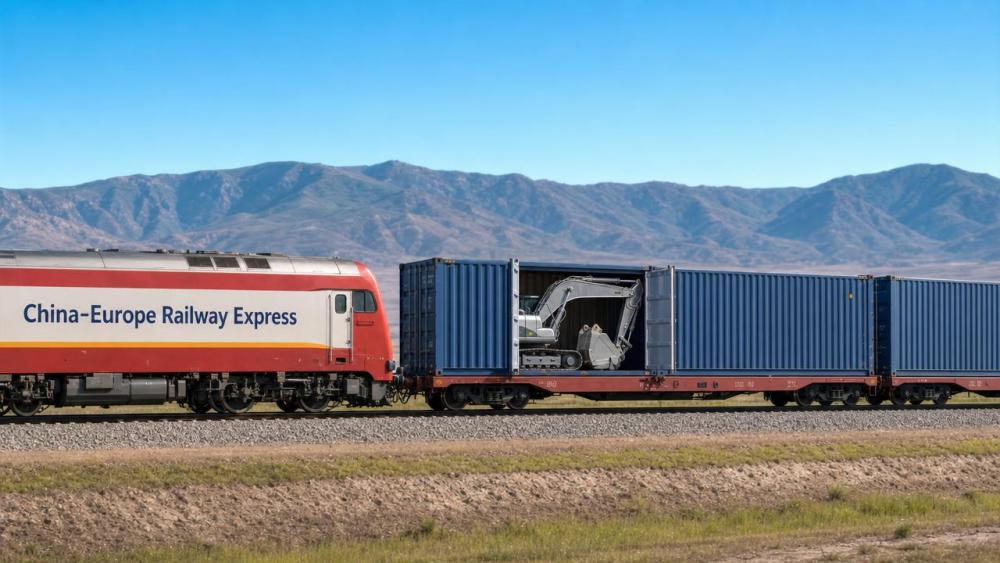
On May 9, 2026, official data confirmed that the China-Europe Railway Express had surpassed 130,000 cumulative departures. The three major hub centers—Zhengzhou, Xi’an, and Chongqing—have jointly optimized dedicated ‘construction machinery trains’. A newly introduced standardized container type now enables mixed loading of complete machines (e.g., hydraulic excavators, wheeled loaders) and their attachments. As a result, average transit time from China to German/Polish rail hubs has been reduced from 35 days to 24–28 days. End-to-end temperature, humidity, and vibration monitoring data are now fully traceable throughout the journey.
Industries Affected
Direct Exporters of Construction Machinery
These enterprises—especially those shipping large, high-value machines—are directly impacted by the shortened transit window and enhanced cargo integrity tracking. Reduced lead times improve order fulfillment predictability, while real-time environmental monitoring lowers risk of damage-related claims and warranty disputes during transit.
Supply Chain Service Providers (Freight Forwarders, Rail Logistics Operators)
Service providers handling multimodal handoffs—from factory loading to European inland distribution—face revised service-level expectations. The new ‘machine + attachment’ mixed-load standard requires updated documentation, container compatibility checks, and integration with digital monitoring platforms for client reporting.
Component & Attachment Suppliers
Suppliers of buckets, rippers, booms, and other OEM-compatible attachments now operate under tighter synchronization requirements. Mixed-loading mandates closer coordination with final-assembler clients to ensure packaging, labeling, and customs classification align with the standardized container format.
EU-Based Distributors & Aftermarket Operators
Distributors receiving direct rail shipments benefit from more stable arrival windows, enabling improved warehouse planning and just-in-time parts allocation. However, they must adapt internal receiving protocols to accommodate integrated machine-attachment deliveries and verify sensor-based condition reports upon unloading.
What Enterprises and Practitioners Should Monitor and Act On
Track official rollout scope beyond pilot hubs
Current improvements are confirmed for Zhengzhou, Xi’an, and Chongqing hubs serving Germany and Poland. Enterprises should monitor whether similar ‘machinery-dedicated’ protocols extend to other departure points (e.g., Chengdu, Wuhan) or EU destinations (e.g., Hungary, Lithuania) in upcoming quarterly updates from China State Railway Group.
Validate container compatibility and documentation requirements
The new ‘machine + attachment’ mixed-load standard implies revised packing lists, customs declarations (e.g., separate HS codes per item type), and container weight distribution rules. Exporters should request technical specifications and pre-shipment checklists from their nominated rail service provider before first use.
Distinguish between operational readiness and policy intent
While transit time reduction is now verified (24–28 days), this reflects optimization of existing infrastructure—not new rail lines or border capacity expansion. Enterprises should treat this as a logistics process upgrade, not a structural shift in Eurasian rail capacity. Planning assumptions around volume scalability or frequency increases remain unconfirmed.
Prepare for sensor data integration in quality assurance workflows
Traceable temperature, humidity, and vibration logs introduce a new data stream for post-arrival inspection. Companies should assess whether their current quality control SOPs include thresholds for acceptable transit-induced stress—and whether ERP or TMS systems can ingest and archive such telemetry.
Editorial Perspective / Industry Observation
Observably, this milestone reflects maturation—not expansion—of the China-Europe Railway Express as a premium service layer for high-value industrial goods. The focus on standardized containers, integrated loading, and condition monitoring suggests a strategic pivot toward reliability over raw volume growth. Analysis shows this is less a broad-based infrastructure breakthrough and more a targeted capability upgrade for specific verticals: heavy machinery, power equipment, and modular industrial systems. From an industry perspective, it signals growing institutional capacity to support complex, time-sensitive exports—but does not yet indicate systemic de-risking of alternative routes (e.g., maritime or air) for low-margin or highly time-flexible cargo. Continued attention should be paid to whether these enhancements become codified in bilateral rail agreements or remain hub-specific pilots.
In summary, the 130,000-train milestone marks a functional inflection point—not a market transformation—for industrial exporters reliant on overland Eurasian rail. Its significance lies in demonstrable improvements to transit time consistency and cargo condition visibility, rather than in scale or geographic reach. Currently, it is best understood as an operational enabler for select high-value equipment segments, not a wholesale substitute for diversified logistics strategies.
Source: Official announcement released May 9, 2026, by China State Railway Group Co., Ltd.; supplementary operational details confirmed via Zhengzhou, Xi’an, and Chongqing International Land Port authorities. Note: Expansion to additional origin/destination nodes remains under observation and is not yet confirmed.