
Related News
- 00
0000-00
How to size heavy-duty loaders for North American mining operations - 00
0000-00
How altitude affects mining excavator performance in Latin America - 00
0000-00
Caterpillar Launches New Cat 6060 and Upgraded Autonomous Mining System - 00
0000-00
When does eco-friendly construction equipment pay for itself? - 00
0000-00
Will a wheel loader quick coupler fit your existing attachments?
Heavy Construction Equipment Ownership Costs: What Impacts ROI Most
For finance approvers, the true ROI of heavy construction equipment goes far beyond the purchase price.
Fuel burn, utilization rates, maintenance cycles, operator productivity, residual value, and compliance costs shape long-term ownership economics.
That is why a smart buying decision starts with total cost visibility, not a headline quote.
In practice, heavy construction equipment delivers strong returns only when capital cost, machine performance, and lifecycle risk stay aligned.
This guide breaks down the ownership cost drivers that matter most and shows how to evaluate ROI with fewer blind spots.
Why Purchase Price Tells Only Part of the Story
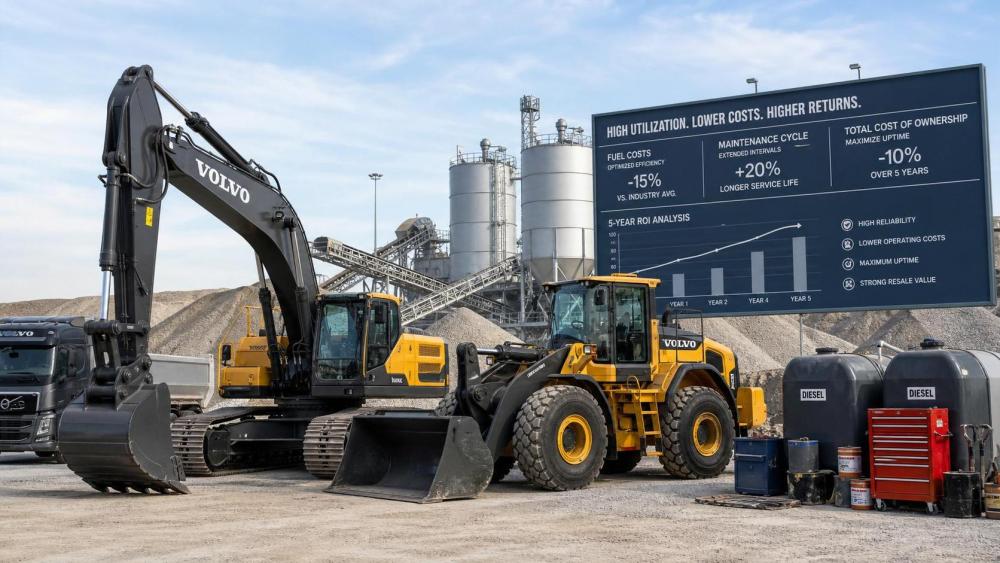
A lower upfront quote can look attractive, especially during budget pressure.
But for heavy construction equipment, ownership cost usually compounds in operating hours, downtime, and end-of-life value.
Two similar machines can produce very different returns over five years.
The gap often comes from fuel efficiency, attachment compatibility, service access, and resale strength.
This is even more visible in crawler excavators, wheel loaders, bulldozers, motor graders, and skid steer loaders.
In each category, capital cost matters, but utilization quality matters more.
A better ROI lens for heavy construction equipment
- Acquisition cost sets the starting point, not the final return.
- Operating cost determines how fast margins erode.
- Downtime risk affects revenue, crew efficiency, and project penalties.
- Residual value can materially improve whole-life economics.
The Cost Drivers That Usually Impact ROI the Most
When evaluating heavy construction equipment, several cost categories usually drive the biggest financial outcome.
Some are easy to quantify early.
Others only show up after months of field use, which is why they are often underestimated.
1. Utilization rate
Utilization is often the biggest ROI lever.
An expensive machine with high productive hours can outperform a cheaper unit that sits idle.
This also means equipment sizing must match real workload, not optimistic demand forecasts.
2. Fuel and energy consumption
Fuel burn is a major ownership expense in heavy construction equipment fleets.
Small differences per hour become large cost gaps over thousands of operating hours.
Hydraulic efficiency, idle control, load sensing, and operator habits all influence this line item.
3. Maintenance and wear parts
Preventive service cost is predictable.
Unexpected failures are not.
Undercarriages, cutting edges, tires, buckets, ground engaging tools, and hydraulic components can reshape ROI fast.
Machines working in abrasive material or severe duty cycles typically need a tighter maintenance model.
4. Downtime and service responsiveness
A stopped machine rarely creates a single cost.
It can also delay crews, disrupt haul cycles, and trigger schedule overruns.
Dealer parts availability and field technician response times are often more valuable than a small upfront discount.
5. Operator productivity
Heavy construction equipment ROI depends on output, not just ownership cost.
Cycle times, control precision, visibility, automation support, and operator comfort affect how much work gets done each shift.
Over time, better productivity can offset a higher purchase price.
How Residual Value Changes the Investment Case
Residual value is often underweighted in procurement reviews.
Yet it can be one of the strongest drivers of true heavy construction equipment ROI.
Brands with strong dealer networks, broad parts support, and proven reliability usually defend resale better.
Specification choices matter too.
Common attachments, standard configurations, and documented service history improve remarketing options.
From a capital efficiency perspective, this reduces depreciation pressure and supports cleaner asset turnover planning.
What protects resale value
- Recognized brand acceptance in active used equipment channels.
- Clear maintenance records and telematics-backed operating history.
- Emission compliance in target resale markets.
- Balanced operating hours relative to age and machine condition.
Compliance, Technology, and Hidden Ownership Costs
From recent market shifts, a clearer signal is emerging.
Heavy construction equipment decisions now carry more regulatory and technology risk than before.
That includes emissions rules, operator safety systems, telematics subscriptions, and software support lifecycles.
These costs may appear secondary during sourcing.
In real operations, they can influence fleet flexibility and future upgrade cost.
Common hidden costs to review early
- Emission aftertreatment servicing and DEF-related costs.
- Paid telematics platforms and data integration fees.
- Software updates tied to guidance, automation, or remote diagnostics.
- Training time for new control systems and advanced assist features.
- Insurance implications for higher-value digital equipment packages.
A Practical Framework for Comparing Heavy Construction Equipment ROI
In actual buying decisions, a simple comparison sheet is rarely enough.
A stronger framework compares total ownership cost against expected production value.
This keeps heavy construction equipment evaluation tied to business outcomes, not assumptions.
Key evaluation factors
Questions worth asking before approval
- Will this machine be used enough to justify ownership over rental or lease?
- Is the specification optimized for actual work, not edge-case preferences?
- How much margin is exposed if downtime exceeds plan?
- Does dealer support reduce operational risk in the regions that matter?
- What is the expected resale path after the target holding period?
Where Better Market Intelligence Improves ROI Decisions
Better heavy construction equipment decisions depend on better context.
This is where sector intelligence becomes useful, especially when equipment categories are evolving quickly.
Global Earth-Mover Dynamics tracks the machinery shifts shaping ownership economics across excavators, loaders, graders, bulldozers, and skid steers.
Its coverage links machine performance, regulatory change, automation progress, and commercial demand signals.
That helps procurement teams judge whether a lower-cost option is truly cheaper over time.
It also helps identify when a premium specification is justified by stronger utilization, uptime, or resale outcomes.
Final Takeaway: Focus on Lifetime Value, Not Just Asset Price
The biggest ROI mistake in heavy construction equipment buying is treating ownership cost as a one-time event.
In reality, ROI is shaped by utilization, fuel efficiency, maintenance discipline, uptime, operator output, compliance burden, and resale strength.
A machine with a higher initial price can still produce better returns if it works harder, fails less, and exits the fleet well.
That is the more practical way to evaluate heavy construction equipment in a cost-sensitive market.
Before the next approval decision, build the comparison around total lifecycle economics.
Then test each assumption against real operating conditions, service capacity, and expected disposal value.
That approach lowers risk, improves capital efficiency, and leads to more defensible equipment investments.