
Related News
- 00
0000-00
How to size heavy-duty loaders for North American mining operations - 00
0000-00
How altitude affects mining excavator performance in Latin America - 00
0000-00
Caterpillar Launches New Cat 6060 and Upgraded Autonomous Mining System - 00
0000-00
When does eco-friendly construction equipment pay for itself? - 00
0000-00
Will a wheel loader quick coupler fit your existing attachments?
Tags
Effective June 1, 2026, U.S. Customs and Border Protection (CBP) has initiated a pilot program requiring carbon footprint labeling for imported mini excavators — the first application of its kind to off-road mobile machinery. This regulatory shift introduces new compliance obligations for exporters, particularly impacting supply chain readiness, customs clearance timelines, and documentation protocols for manufacturers and importers.
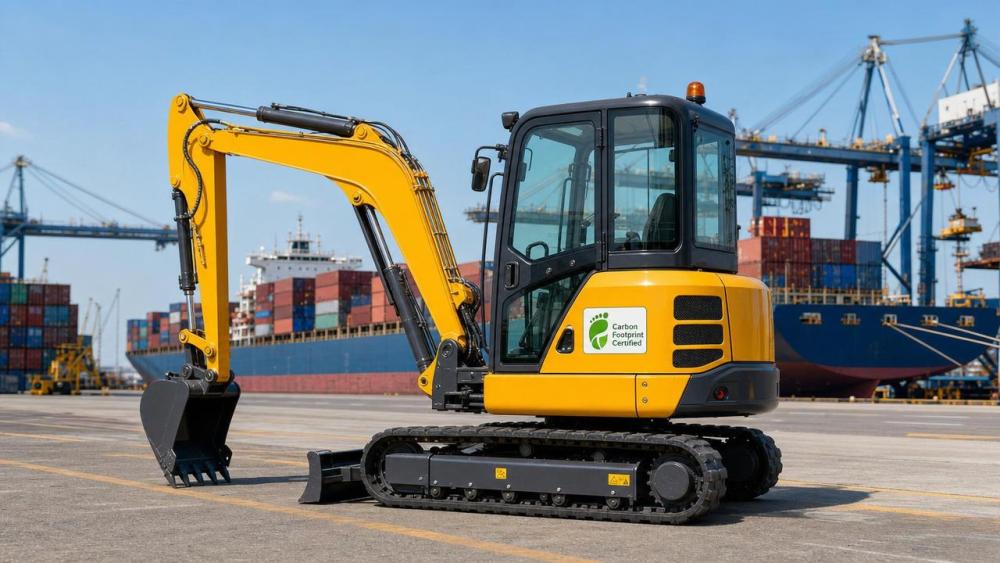
Key Regulatory Requirements Effective June 2026
Starting June 1, 2026, CBP mandates that importers of mini excavators submit a certified Life Cycle Assessment (LCA) report concurrently with their customs entry documentation. The LCA report must be conducted in accordance with ISO 14040 and ISO 14044 standards. This requirement applies exclusively under the ongoing pilot program for off-road machinery and is not yet extended to other equipment categories. Non-compliant shipments may face port detention, mandatory re-submission of documentation, or return to origin.
Impact Across Supply Chain Roles
Direct Trading Enterprises
Importers and trading companies handling mini excavator shipments into the U.S. must now integrate LCA reporting into their pre-clearance workflows. Delays in obtaining valid reports directly affect release timing at the border, increasing demurrage exposure and cash flow pressure. They must also verify upstream supplier documentation to ensure traceability and audit readiness.
Raw Material Suppliers
Suppliers of steel, hydraulics, batteries, and other critical components will see heightened demand for environmental data — including embodied carbon metrics, energy source disclosures, and material recycling content. Their ability to provide ISO-aligned input data determines whether OEMs can complete compliant LCAs efficiently.
Manufacturing Enterprises
Chinese OEMs exporting mini excavators must redesign internal product data collection systems to capture energy use, transport emissions, manufacturing inputs, and end-of-life assumptions across all production sites. Compliance is no longer limited to final assembly but spans the entire value chain — from casting foundries to final testing facilities.
Supply Chain Service Providers
Third-party LCA consultants, certification bodies, and logistics documentation platforms are experiencing increased demand for verification support, technical translation of environmental datasets, and integration with U.S. ACE (Automated Commercial Environment) filing systems. Service providers must demonstrate ISO 14040/44 competency — not just general sustainability expertise.
Strategic Priorities for Export-Oriented Manufacturers
Align LCA Documentation with CBP Filing Deadlines
LCA reports must be finalized and validated prior to shipment — not post-arrival. Importers cannot rely on provisional submissions; CBP requires full, third-party-certified reports at time of entry. This shifts documentation responsibility upstream and compresses pre-shipment planning windows.
Verify Supplier Environmental Data Transparency
OEMs must audit Tier 1–3 suppliers for carbon intensity data quality, especially for high-impact materials like cast iron, hydraulic fluid, and lithium-based powertrains. Inconsistent or missing upstream data remains the most common cause of LCA rejection during pilot reviews.
Update Technical Specifications and Tender Responses
New procurement tenders from U.S. construction firms and rental fleets are beginning to reference CBP’s pilot requirements. Manufacturers must revise technical bids to include verified carbon performance statements, clearly distinguishing between cradle-to-gate and cradle-to-grave boundaries per ISO 14044.
Reassess Lead Times and Inventory Planning
Obtaining ISO 14040/44-compliant LCA reports typically requires 6–10 weeks, depending on data maturity. Exporters must extend order-to-shipment cycles and avoid just-in-time inventory models for U.S.-bound mini excavators to accommodate assessment timelines.
Industry Implications Beyond Compliance
Analysis shows this pilot signals a structural shift — not merely a documentation update. It institutionalizes lifecycle thinking into U.S. trade enforcement, moving environmental criteria from voluntary ESG reporting into binding import conditions. From an industry perspective, it accelerates the convergence of environmental regulation and trade policy, particularly for capital goods with long service lives and complex global supply chains. What deserves closer attention is how quickly similar requirements may extend to other off-road equipment classes — such as skid-steer loaders and compact track loaders — given CBP’s stated intent to scale the pilot based on initial outcomes.
What This Means for the Global Construction Equipment Sector
This initiative marks a foundational step toward embedding decarbonization accountability into cross-border equipment trade. Rather than representing a short-term administrative hurdle, it reflects an emerging norm where product-level environmental intelligence becomes as essential as safety certifications or tariff classifications. For manufacturers, early adaptation offers competitive differentiation — especially in public infrastructure procurement, where low-carbon procurement policies are gaining traction nationwide.
Source Attribution and Ongoing Monitoring
This article was generated based solely on the user-provided title, event date (2026-06-01), and summary description. Specific official source links were not provided in the input and should be verified continuously. Stakeholders are advised to monitor forthcoming CBP guidance documents, updates to the Harmonized Tariff Schedule annotations for heading 8429, and evolving interpretations of ISO 14040/44 applicability by accredited certification bodies. Industry feedback, pilot evaluation reports, and potential expansion announcements remain key watchpoints over the coming 12 months.