
Related News
- 00
0000-00
How to size heavy-duty loaders for North American mining operations - 00
0000-00
How altitude affects mining excavator performance in Latin America - 00
0000-00
Caterpillar Launches New Cat 6060 and Upgraded Autonomous Mining System - 00
0000-00
When does eco-friendly construction equipment pay for itself? - 00
0000-00
Will a wheel loader quick coupler fit your existing attachments?
Even advanced earthmoving technology can undermine grading results when operators rely on poor calibration, outdated site data, or inconsistent machine control settings. For users and equipment operators, small mistakes in setup and execution often lead to costly rework, uneven surfaces, and lost productivity. Understanding these common errors is the first step toward achieving tighter grading accuracy and more reliable jobsite performance.
Operators searching for help with earthmoving technology usually want practical answers, not theory. They need to know why grade accuracy slips, which mistakes cause the biggest problems, and how to prevent rework fast.
The core issue is simple: machine control, sensors, and software only improve grading when the setup, site model, and operating habits are correct. If those basics fail, even premium equipment can produce poor surfaces.
For equipment users and operators, the biggest concerns are usually repeatability, confidence in grade readings, time lost checking work manually, and avoiding expensive corrections after compaction or paving starts.
This article focuses on the mistakes that matter most on active jobsites. It emphasizes field setup, operator workflow, calibration discipline, and site data quality rather than broad discussions about technology trends.
The Biggest Grading Accuracy Problem: Trusting Technology Without Verifying the Basics
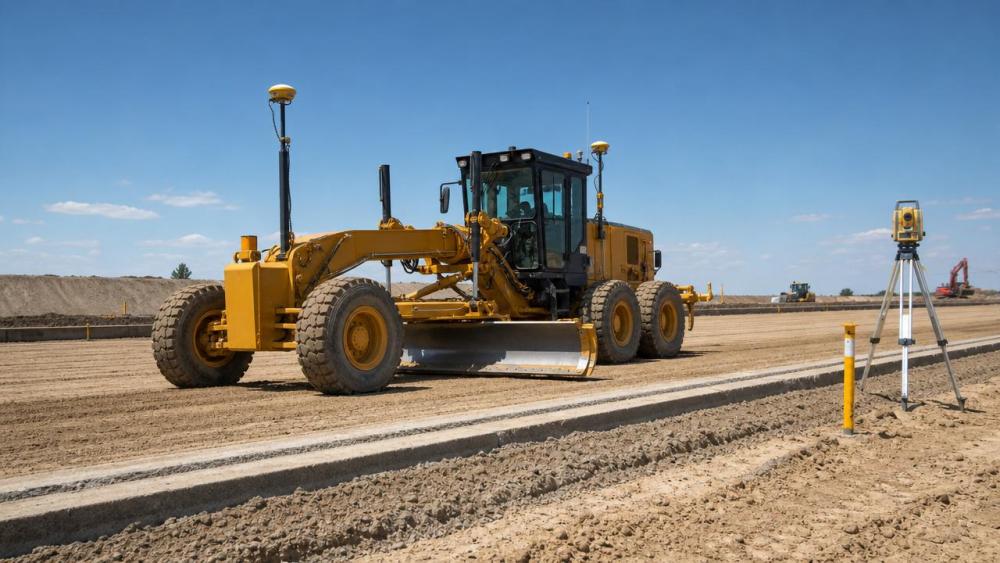
One of the most common earthmoving technology mistakes is assuming that a machine-controlled dozer, grader, or excavator is automatically accurate because the screen shows a clean design surface.
In reality, grading accuracy depends on a chain of conditions. The GNSS receiver, total station setup, blade sensors, site localization, design file, and machine calibration all have to agree.
If even one part of that chain is wrong, the machine may grade consistently to the wrong elevation. That is often more dangerous than obvious instability because operators may trust bad numbers for hours.
Good operators treat digital grade information as a tool that must be validated, especially at shift start, after machine transport, after blade impact, or when site conditions change sharply.
Mistake #1: Skipping Daily Calibration and Control Checks
Many grading errors begin before the machine even starts productive work. Operators under schedule pressure may skip calibration checks, assuming yesterday's settings are still reliable today.
That shortcut creates risk because blade wear, sensor drift, undercarriage movement, hydraulic response changes, and rough transport can all affect the machine's grading reference.
On a motor grader or dozer, even a small calibration error can translate into measurable elevation loss across a long pass. On fine grading work, that margin disappears very quickly.
A better routine is to perform quick but disciplined checks at the start of each shift. Confirm mast positions, blade sensor readings, benchmark agreement, and machine orientation before chasing production numbers.
Operators should also recheck calibration after replacing cutting edges, servicing hydraulic components, adjusting tires, or working after a heavy strike with buried rock or concrete debris.
Mistake #2: Working From Outdated, Incorrect, or Incomplete Site Models
Earthmoving technology is only as good as the digital terrain model behind it. If the file loaded into the machine is outdated, incomplete, or poorly converted, grading accuracy suffers immediately.
This happens often on fast-moving projects where revised plans are issued but not distributed correctly to all operators. One machine may be working from the latest surface, another from an old version.
The result is confusion, uneven transitions, and avoidable rework between crews. Operators may think the machine is drifting, when the real problem is conflicting design information across the site.
Before work begins, confirm the file version, coordinate system, units, and design limits. Make sure the machine is using the approved model for that phase of excavation, subgrade, or finish grading.
It also helps to understand where the model is weak. Breaklines, slope transitions, drainage features, and tie-in zones are common places where small data errors become visible in the field.
Mistake #3: Ignoring Poor GNSS Conditions and Signal Limitations
Satellite-based machine control can deliver excellent results, but only when signal conditions support it. Operators sometimes continue grading as usual even when GNSS quality has degraded.
Trees, high walls, buildings, bridges, and active haul traffic can interrupt visibility or create multipath errors. In those conditions, the grade display may look stable while positional accuracy is weakening.
This is especially risky on narrow road work, urban infrastructure, ramps, and edge details where small horizontal errors affect elevation and cross slope at the same time.
Operators should watch correction status, satellite health, and warning messages instead of focusing only on the cut-fill number. If signal quality drops, verify with a benchmark or switch workflow.
Where site conditions regularly block GNSS, total station guidance, laser reference systems, or a hybrid control approach may deliver better grading accuracy than satellite-only operation.
Mistake #4: Using Inconsistent Machine Control Settings Across Crews
Another overlooked problem is inconsistency. Different operators may use different sensitivity settings, offsets, control modes, or target tolerances on similar machines working the same area.
That inconsistency creates irregular surfaces even when each operator believes the machine is performing correctly. The issue is not always the hardware; often it is a workflow standardization problem.
For example, one operator may run aggressive automatic blade response for production stripping, while another uses smoother settings for finish trimming. Mixing those methods without coordination affects the final surface.
Standard jobsite settings should be defined for each task: rough grade, subgrade, trim pass, slope finishing, and drainage work. That gives operators a repeatable baseline before making small personal adjustments.
Supervisors and lead operators should also document offsets clearly. Unlabeled temporary offsets are a frequent source of mystery errors that appear later as unexplained overcut or undercut.
Mistake #5: Relying on Automation While Neglecting Blade Control Fundamentals
Advanced earthmoving technology does not eliminate the need for skilled operating. Some users become too dependent on automatic mode and stop paying attention to blade load, machine balance, and pass strategy.
Automation can hold a target, but it cannot fully compensate for poor approach angles, excessive speed, unstable material flow, or repeated bouncing across rough sections.
If a grader enters a pass too fast, or a dozer carries inconsistent load, the machine may fight itself. The control system reacts, but the finished surface still loses smoothness and uniformity.
Strong operators combine digital guidance with disciplined machine handling. They control speed, overlap passes consistently, manage material rolling ahead of the blade, and avoid abrupt hydraulic corrections.
This matters even more in wet soil, mixed fill, and rocky material, where surface response changes constantly. Technology helps, but operating technique still determines finish quality.
Mistake #6: Failing to Match Technology Settings to Actual Ground Conditions
Many grading systems are configured for ideal conditions, but jobsites are rarely ideal. Soft subgrade, vibration, ruts, loose lift thickness, and changing moisture all affect how accurately a machine can trim.
Operators who do not adapt to ground conditions may chase false readings or cut too aggressively. The machine may indicate target grade while the material later settles, deflects, or tears unevenly.
On weak or pumping ground, repeated verification is critical. The issue may not be sensor error at all. It may be the surface moving under machine weight during the pass.
In these situations, a slower finish pass, reduced machine disturbance, or a change in sequence can improve results more than repeated recalibration. The correct fix is often operational, not digital.
Understanding the material under the machine is essential. Good grade control depends not just on coordinates, but on how the soil actually behaves when cut, spread, and compacted.
Mistake #7: Not Verifying Accuracy at Control Points During the Shift
Some crews only check grade at the start of the day and assume everything remains correct until shutdown. That is risky on long shifts, complex sites, or jobs with constant machine movement.
Vibration, impacts, temperature change, and minor mounting movement can slowly affect accuracy. By the time the error becomes visible, a large section may already need rework.
Periodic verification against known control points is one of the most effective habits for protecting grading quality. It provides a simple reality check before small drift becomes a large problem.
These checks do not need to stop production for long. A short validation at planned intervals can save hours of corrective trimming, survey review, and schedule disruption later.
Operators should especially verify after moving between work zones, changing attachments, or transitioning from rough grading to finish work where tolerance requirements tighten significantly.
Mistake #8: Poor Communication Between Survey, Site Management, and Operators
Not every grading problem begins in the cab. Many come from weak communication between survey teams, foremen, project engineers, and machine operators using the technology in the field.
If operators are not told about updated benchmarks, revised drainage intent, changed offsets, or tolerance expectations, they may complete accurate work that is wrong for the current plan.
This disconnect often shows up in tie-ins, curb approaches, pavement transitions, and utility zones where the design intent changed but the machine file or operator briefing did not.
A short pre-shift coordination routine can prevent many of these mistakes. Confirm revised surfaces, active work limits, grade-critical zones, and who is responsible for approving file changes.
Clear communication is especially important when multiple brands of equipment and different control platforms are working on the same project under tight sequencing pressure.
How Operators Can Improve Grading Accuracy Immediately
The fastest improvement usually comes from tightening routine, not buying more hardware. Better habits often unlock more value from existing earthmoving technology than another system upgrade.
Start each shift with a documented check: control point confirmation, sensor condition, design file version, offsets, correction status, and machine calibration. Make this standard, not optional.
During operation, monitor warning indicators, surface behavior, and pass consistency instead of watching only one digital cut-fill number. The machine display is important, but it is not the whole jobsite.
When results look suspicious, stop and verify early. Operators who pause for a five-minute check usually lose less time than crews who continue grading with growing uncertainty.
Finally, treat technology as part of a system. Survey control, site updates, operator skill, and material behavior all influence grade quality. Accuracy improves when those parts work together.
What Good Earthmoving Technology Use Looks Like in Practice
On a well-run site, operators do not blindly trust automation, but they also do not fight it. They understand what the system can do, what can distort it, and when to verify manually.
They know the current design file, recognize weak-signal zones, recheck after impacts, and use machine control settings suited to the task instead of leaving one setup for every condition.
They also communicate quickly when readings do not match the surface. That prevents hidden errors from spreading across the site and turning a manageable issue into a costly correction cycle.
In that environment, earthmoving technology becomes a productivity multiplier. It reduces staking dependence, supports smoother passes, shortens rework loops, and helps crews hit tighter tolerances with confidence.
The technology itself is powerful. The real difference comes from disciplined use, validated data, and operators who understand how digital control and real ground conditions interact.
Conclusion
Most grading accuracy problems linked to earthmoving technology are not caused by the concept of machine control itself. They come from skipped checks, poor data, inconsistent settings, and overconfidence in automation.
For operators and equipment users, the practical takeaway is clear: verify the basics, trust but confirm digital guidance, and match machine setup to the actual jobsite environment.
When calibration is disciplined, site models are current, settings are standardized, and operating technique stays sharp, grading technology delivers the precision and productivity it promises.
That is how users reduce rework, improve surface consistency, and get more reliable performance from every grading pass.