
Related News
- 00
0000-00
How to size heavy-duty loaders for North American mining operations - 00
0000-00
How altitude affects mining excavator performance in Latin America - 00
0000-00
Caterpillar Launches New Cat 6060 and Upgraded Autonomous Mining System - 00
0000-00
When does eco-friendly construction equipment pay for itself? - 00
0000-00
Will a wheel loader quick coupler fit your existing attachments?
For aftersales maintenance teams, downtime rarely starts with a dramatic failure—it often begins with overlooked wear in critical construction machinery components. Hydraulic pumps, undercarriage parts, cooling systems, sensors, and electrical connectors can quietly erode machine availability long before operators notice performance loss. Understanding which components create the highest downtime risk helps service teams prioritize inspections, stock the right parts, and prevent costly field stoppages across excavators, loaders, graders, dozers, and skid steers.
Why Do Certain Construction Machinery Components Create More Downtime Risk?
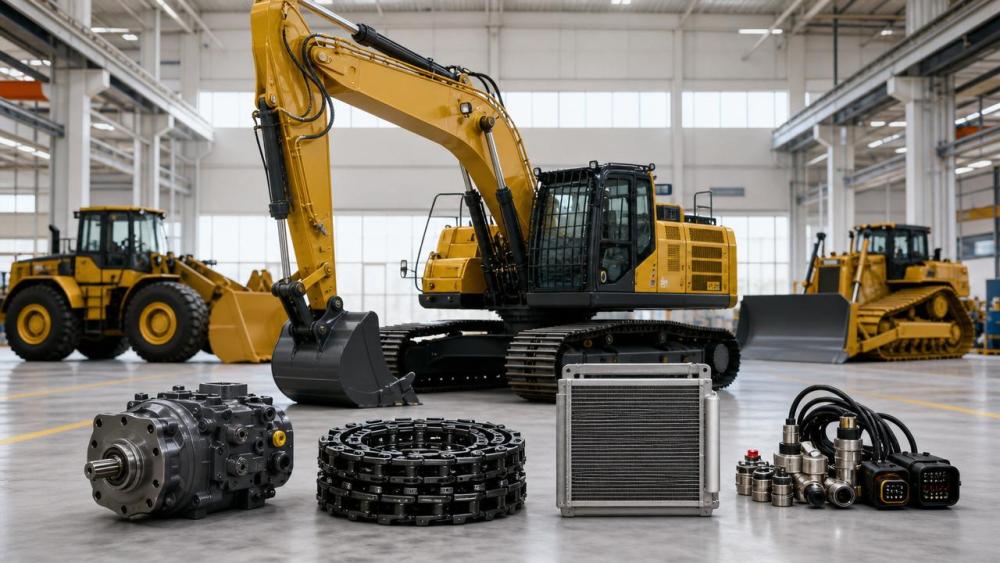
Downtime risk rises when one component affects several machine functions at once. A weak hydraulic pump may slow boom movement, increase heat, and contaminate valves with metallic particles.
Aftersales teams also face pressure from tight delivery windows, limited field access, and mixed fleets. One repair decision may affect excavators, wheel loaders, graders, bulldozers, and skid steers differently.
The most critical construction machinery components are usually exposed to high load, heat, vibration, contamination, or electronic signal instability. They fail gradually, then stop work suddenly.
Common Patterns Behind Field Stoppages
- Hydraulic leakage or pressure loss reduces digging force, blade control, lift cycle speed, and attachment response under heavy operation.
- Undercarriage wear increases fuel use, vibration, track derailment probability, and operator complaints on abrasive ground.
- Cooling system degradation causes derating, aftertreatment stress, premature oil oxidation, and repeated fault codes.
- Sensor drift or connector corrosion creates intermittent faults that are difficult to reproduce during workshop inspection.
For EMD’s intelligence work, these risks sit at the intersection of hydraulic breakout force, precision control, uptime economics, and the industry shift toward low-emission and autonomous machines.
Which Construction Machinery Components Should Maintenance Teams Inspect First?
A practical inspection sequence should begin with components that can immobilize the machine, spread secondary damage, or require long lead-time parts.
The following table helps aftersales teams rank construction machinery components by failure mode, machine impact, and recommended inspection focus.
This ranking is not a replacement for OEM manuals. It gives service planners a faster way to protect availability when machines operate far from central workshops.
Hydraulic Components: The Fastest Path From Wear to Lost Production
Hydraulic systems control the business end of earthmoving. On crawler excavators, pump efficiency directly affects digging cycle time and breakout performance.
On wheel loaders and skid steers, hydraulic issues reduce lift speed, attachment responsiveness, and operator confidence during repetitive loading work.
Key warning signs include foaming oil, slow warm response, pump whine, rising case drain flow, and unexplained actuator drift under load.
Undercarriage Components: High Cost, High Exposure, High Neglect
Tracks, rollers, idlers, sprockets, and final drives work in abrasive soil, rock, slurry, and demolition debris. Wear is expected, but uncontrolled wear is expensive.
For bulldozers and excavators, undercarriage construction machinery components can represent a major lifecycle cost. Poor tensioning accelerates chain and sprocket damage.
How Do Machine Types Change Component Risk Priorities?
The same failure mode does not carry the same business impact across all equipment. A sensor fault on a motor grader can threaten grading precision more than mobility.
EMD tracks five machine families because aftersales decisions must reflect different load cycles, duty profiles, and customer expectations.
Application-Based Risk Map
Use this comparison when building parts kits, service schedules, or inspection templates for mixed fleets in infrastructure, mining, roadwork, and urban construction.
The table shows why a single parts policy rarely works. Reliable aftersales planning depends on component criticality, operating soil, operator behavior, and repair access.
What Parameters Help Identify Risk Before Failure?
Maintenance teams need measurable triggers, not vague impressions. Parameters make it easier to decide whether to repair, replace, monitor, or escalate.
Many construction machinery components show early weakness through pressure, temperature, vibration, contamination, electrical resistance, or movement tolerance.
Recommended Field Indicators
- Hydraulic oil cleanliness should be checked against OEM requirements and relevant ISO 4406 cleanliness codes where applicable.
- Coolant quality should be reviewed for concentration, contamination, corrosion protection, and compatibility with the machine’s engine design.
- Electrical connectors should be checked for moisture ingress, pin deformation, loose locking tabs, and strain near bend points.
- Track tension should be measured under the correct ground condition because over-tight tracks create avoidable load on final drives.
The following reference points are general maintenance indicators. Final limits should always be verified against the OEM service documentation.
Trend data is more valuable than a single reading. A component moving steadily toward failure deserves attention even if it still operates today.
How Should Aftersales Teams Select Replacement Construction Machinery Components?
Replacement decisions are rarely simple. Teams must balance machine age, customer urgency, budget, warranty position, and local parts availability.
The right approach is not always the cheapest option. A low-cost component can become expensive if it causes repeat labor, contamination, or calibration problems.
Procurement Checklist for High-Risk Parts
- Confirm machine model, serial range, operating hours, attachment configuration, and any software or control system updates.
- Check whether the component affects safety, emissions control, telematics, grade control, or autonomous operation logic.
- Compare genuine, approved equivalent, remanufactured, and repair options using downtime cost instead of purchase price only.
- Verify lead time, packaging protection, core return conditions, test documentation, and field installation requirements.
- Review whether special tools, calibration equipment, hydraulic flushing, or software parameter setting will be needed.
When Is Remanufacturing a Sensible Option?
Remanufactured components can fit mature fleets when the failure is predictable, core condition is acceptable, and service history is available.
However, remanufacturing is less suitable when contamination spread is unknown, electronic calibration is complex, or the machine supports high-precision grading work.
What Common Mistakes Increase Repeat Failures?
Repeat failure often comes from treating symptoms instead of root causes. Replacing a pump without flushing contaminated lines may simply damage the new pump.
Aftersales teams should look beyond the failed part and investigate the system around it, especially on electronically controlled hydraulic machinery.
Mistakes to Avoid During Field Repair
- Ignoring oil analysis after hydraulic failure, leaving abrasive particles inside tanks, hoses, valves, and actuators.
- Replacing electrical sensors before testing connectors, grounds, supply voltage, and harness movement under vibration.
- Using unsuitable seals or hoses in high-temperature zones, causing leakage after short service intervals.
- Skipping calibration after replacing grade control, position sensing, or electro-hydraulic proportional components.
- Stocking parts only by past usage volume rather than failure criticality, lead time, and fleet operating environment.
A disciplined repair process reduces repeat visits. It also protects customer trust when equipment is tied to road completion, quarry output, or urban utility work.
FAQ: Practical Questions About Construction Machinery Components
How often should high-risk construction machinery components be inspected?
Inspection intervals depend on hours, application severity, and OEM guidance. Harsh mining, demolition, and heavy pushing work require shorter checks than light utility work.
For critical hydraulic, cooling, and undercarriage components, aftersales teams should combine scheduled service with condition-based checks using trends and fault history.
What should be stocked locally to reduce emergency downtime?
Fast-moving seals, filters, hoses, connectors, sensors, belts, wear pins, and electrical repair kits are common local stock candidates.
For larger construction machinery components, consider stocking only when lead time, failure impact, and fleet population justify capital tied in inventory.
Are electronic components now as critical as mechanical parts?
Yes. Modern machines rely on controllers, sensors, telematics, GPS, laser systems, and electro-hydraulic logic to deliver productivity and precision.
A small connector fault can stop automatic grading, remote-control operation, or emissions management. Electrical diagnostics are now central to uptime.
How can maintenance teams justify replacing a part before it fails?
Use downtime cost, mobilization cost, safety exposure, project penalty risk, and secondary damage probability. Preventive replacement is easier to justify with measured trends.
Trends That Will Change Component Maintenance Decisions
Electrification, autonomy, stricter non-road emissions rules, and remote-controlled machinery are changing how service teams evaluate component risk.
Electric drive systems reduce some fluid maintenance, but they introduce battery thermal control, high-voltage safety, software diagnostics, and new connector requirements.
What This Means for Aftersales Planning
- Technicians need stronger skills in data interpretation, CAN communication, calibration, insulation checks, and software-supported troubleshooting.
- Parts departments must classify construction machinery components by uptime impact, not only by historical sales frequency.
- Service managers should connect telematics alerts with field inspection routines to prevent avoidable emergency repairs.
- Precision grading equipment will require tighter control of sensor mounting, firmware compatibility, and calibration documentation.
For EMD, the direction is clear: machinery reliability will depend on both rugged hardware and intelligent maintenance decisions.
Why Choose EMD for Component Risk Intelligence and Aftersales Decisions?
EMD helps aftersales maintenance teams look beyond isolated failures and evaluate construction machinery components within real operating systems.
Our intelligence focus covers crawler excavators, wheel loaders, motor graders, bulldozers, and skid steer loaders across hydraulic, mechanical, electronic, and precision-control domains.
What You Can Consult With Us
- Parameter confirmation for hydraulic pumps, cooling systems, undercarriage parts, sensors, connectors, and control-related components.
- Replacement strategy comparing genuine, equivalent, remanufactured, repair, and emergency field-service options.
- Parts stocking recommendations based on fleet type, lead time, duty cycle, failure impact, and project risk.
- Support for delivery cycle discussion, sample evaluation, compliance expectations, and service process planning.
- Technical insight into electrification, autonomy, precision grading, and remote-control maintenance implications.
Contact EMD when your team needs clearer selection logic, more reliable component risk evaluation, or a structured discussion before the next costly field stoppage.