
Related News
- 00
0000-00
What determines equipment durability on airport construction sites? - 00
0000-00
How terrain and dealer support shape machinery selection in Latin America - 00
0000-00
How market insight content analysis reveals shifts in equipment demand - 00
0000-00
When do OEM heavy machinery parts justify their higher cost? - 00
0000-00
What to compare among construction equipment manufacturers in North America
In 2026, excavator technology sits at the center of jobsite efficiency. It no longer shapes only digging speed. It influences fuel strategy, labor allocation, uptime, safety, and bid competitiveness across earthmoving operations.
That shift matters because infrastructure spending remains uneven, emissions rules are tightening, and project schedules leave little room for avoidable downtime. The result is simple: machine capability is now a management decision, not only an equipment decision.
For companies tracking heavy equipment through sources such as EMD, the real question is not whether innovation is arriving. It is which trends in excavator technology will create measurable gains on actual jobsites.
Why excavator technology is moving from hardware to system intelligence
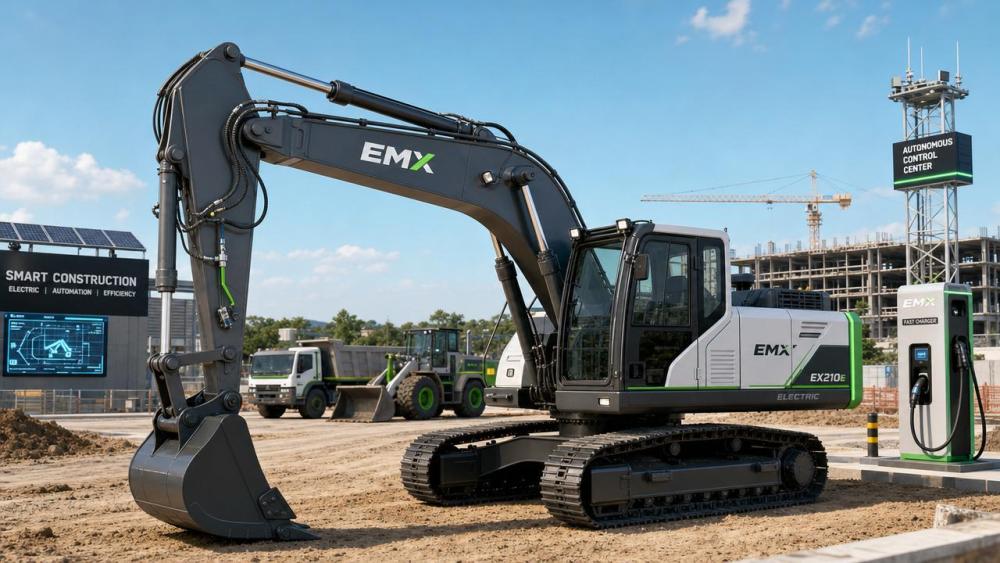
An excavator was once judged mainly by bucket force, cycle time, and durability. Those factors still matter. Yet in 2026, the machine is increasingly part of a connected operating system.
Modern excavator technology combines hydraulics, digital controls, onboard sensors, remote diagnostics, and machine guidance. The value appears when those layers work together instead of operating as isolated features.
This is especially relevant on complex sites. Excavators must coordinate with wheel loaders, dozers, graders, and haul fleets. A faster machine alone does not guarantee a faster project if the overall flow remains inefficient.
EMD has long framed crawler excavators as the crown jewel of construction machinery. That view fits 2026 well. Excavators now represent a critical point where hydraulic power, spatial precision, and low-carbon transition meet.
The main trends shaping excavator performance in 2026
Several trends are driving the current wave of excavator technology. They affect different machine classes, but together they change how productivity is defined and measured.
Electrification is becoming a practical fleet question
Battery-electric excavators are no longer limited to pilot discussions. They are becoming viable for urban infrastructure, indoor demolition, utility work, and controlled operating cycles.
The benefit is not only lower tailpipe emissions. Electric excavator technology can reduce noise, simplify maintenance, and support work in regulated zones where diesel restrictions are becoming more common.
Still, electrification is not universal. Runtime, charging access, attachment power demand, and residual value must be examined carefully. The strongest business case usually appears in predictable duty cycles.
Electro-hydraulic control is improving precision and repeatability
Advanced electro-hydraulic systems are changing machine feel and job quality. Operators gain finer control over boom, arm, and swing functions, which helps reduce over-digging and unnecessary rework.
That matters in trenching, finish grading support, and utility projects where every correction adds labor and material cost. Better control logic also supports attachment performance and smoother multifunction movements.
From a portfolio viewpoint, this is one of the most practical forms of excavator technology because it affects daily output without requiring a fully autonomous site.
Automation is expanding beyond guidance
2D and 3D machine guidance are already familiar on leading sites. In 2026, more systems add semi-autonomous digging, swing assist, payload monitoring, and automated grade protection.
These features do not replace field judgment. They reduce variability. The strongest gain comes when less experienced operators can achieve consistent results faster and with fewer corrections.
Telematics is shifting from tracking to decision support
Fleet data used to answer where a machine was. Now it helps explain why productivity changed. Fuel burn, idle time, hydraulic load patterns, fault alerts, and work mode usage reveal where margins are being lost.
For organizations managing mixed fleets, telematics-driven excavator technology supports replacement timing, maintenance planning, and site-level benchmarking. It also strengthens discussions with dealers and OEMs.
What these changes mean on real jobsites
The impact of excavator technology becomes clearer when viewed through jobsite outcomes rather than feature lists. Productivity gains usually come from fewer delays, better motion control, and more predictable machine behavior.
In practice, excavator technology affects more than excavation. It can influence hauling balance, grading readiness, spoil handling, and even traffic planning on tight sites.
That is why EMD’s wider view across loaders, graders, bulldozers, and skid steers is useful. Excavator gains are most valuable when they improve the whole earthmoving chain.
Where the strongest returns are likely to appear
Not every project benefits equally from every upgrade. The return on excavator technology depends on duty cycle, site conditions, labor availability, and reporting requirements.
Urban and regulated environments
Compact and medium excavators with low-noise operation, zero-emission capability, and advanced safety monitoring are gaining value in city work and public infrastructure projects.
Large earthmoving and infrastructure packages
On major civil sites, the priority is often system coordination. Here, excavator technology that supports payload tracking, guidance integration, and reduced idle time can outperform headline power figures.
Hazardous or remote operations
Remote-control architecture and low-latency communication are becoming more relevant in mines, unstable ground zones, and other high-risk settings. Safety and continuity drive the value case.
How to evaluate excavator technology without overbuying
The market is full of feature claims. A better approach is to connect each technology choice to a measurable operating constraint. That keeps investment logic grounded.
- Map actual duty cycles before comparing electric and diesel platforms.
- Review idle ratios, attachment use, and rework frequency from telematics data.
- Check whether 3D guidance fits existing survey and grading workflows.
- Measure service response, software support, and update pathways from suppliers.
- Compare operator adoption risk, not only equipment specifications.
This is also where independent market intelligence matters. EMD’s focus on decarbonization, hydraulic efficiency, and control architecture reflects the issues that will shape asset value over time, not just at purchase.
A strong decision framework asks whether the chosen excavator technology lowers total operating friction. If the answer is unclear, the feature may be impressive but not yet essential.
A practical view of the next move
By 2026, excavator technology is no longer a future concept. It is an active lever for efficiency, compliance, and fleet resilience. The most effective strategies will balance innovation with site reality.
The next step is not to chase every new capability. It is to build a clearer link between machine data, project demands, and replacement planning. That often reveals which upgrades deserve immediate attention.
For teams following market direction through EMD and similar intelligence sources, the opportunity lies in judging excavator technology as part of a broader earthmoving ecosystem. That perspective supports smarter capital timing and more durable jobsite gains.