
Related News
- 00
0000-00
What determines equipment durability on airport construction sites? - 00
0000-00
How terrain and dealer support shape machinery selection in Latin America - 00
0000-00
How market insight content analysis reveals shifts in equipment demand - 00
0000-00
When do OEM heavy machinery parts justify their higher cost? - 00
0000-00
What to compare among construction equipment manufacturers in North America
Construction equipment technology is now shaping the pace of the jobsite
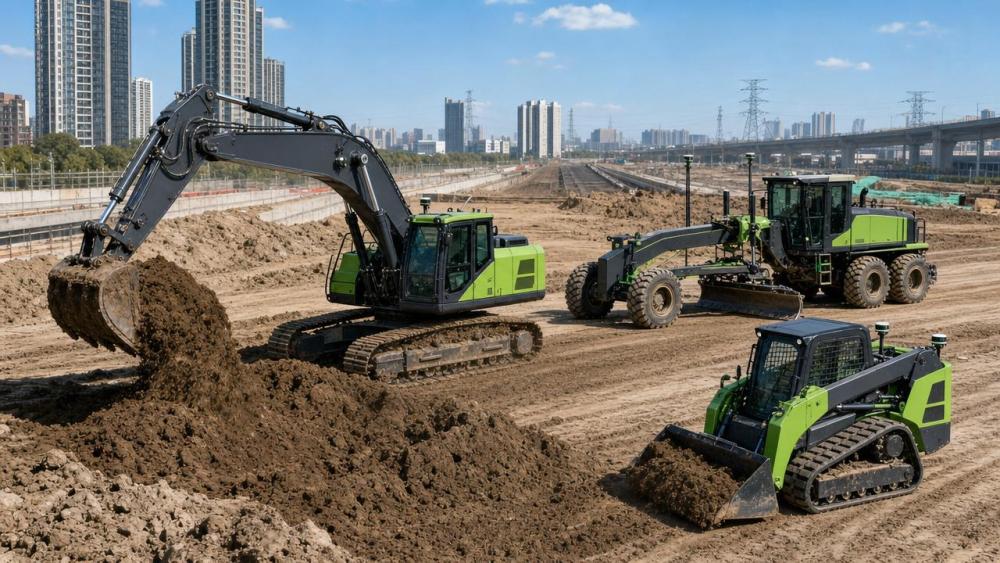
In 2026, construction equipment technology is no longer a background upgrade.
It is becoming a visible driver of output, uptime, and bid competitiveness across infrastructure, mining, roads, and urban works.
The shift is especially clear in crawler excavators, wheel loaders, graders, bulldozers, and skid steer loaders.
These machines are gaining smarter controls, cleaner power systems, and tighter links to digital planning.
What matters is not the presence of new features alone.
What matters is that efficiency gains are becoming measurable at fleet level, not just at machine level.
This is why construction equipment technology now sits closer to capital strategy, project risk control, and lifecycle margin protection.
For platforms such as EMD, this moment is significant because machine performance is being redefined by both force and intelligence.
Extreme hydraulic breakout force still matters, but so do 3D spatial algorithms, remote diagnostics, and lower-emission operating profiles.
Why the change feels sharper in 2026
The market has talked about digitalization for years, yet the recent shift feels more decisive.
One reason is that margins are under pressure from labor scarcity, energy costs, and tighter project timelines.
Another reason is regulatory momentum.
Non-road emissions rules are steadily raising the cost of staying with older operating models.
At the same time, infrastructure programs are becoming more data-intensive.
Owners increasingly expect traceable grading accuracy, fuel visibility, maintenance predictability, and safer remote work options.
This is pushing construction equipment technology beyond optional innovation.
It is becoming part of baseline qualification for large projects and premium tenders.
The biggest gains are coming from connected machine intelligence
Among all current shifts, connected intelligence is changing jobsite efficiency fastest.
Modern construction equipment technology now links machine sensors, control software, and site models in near real time.
For excavators, that can mean smoother electro-hydraulic response and more precise bucket path control.
For motor graders, it means tighter blade positioning using GPS, laser, and inertial references.
For dozers and loaders, it often means better traction management, cycle optimization, and reduced idle time.
The effect is cumulative.
A few seconds saved per loading cycle or fewer corrective passes across a runway project can reshape project economics.
EMD’s coverage of hydrostatic transmission efficiency and proportional control logic reflects this broader reality.
Performance now depends on how mechanical strength and software behavior work together under variable site stress.
Where this shift becomes visible first
- Bulk earthmoving, where cycle-time compression directly lifts daily output
- Roadbuilding, where precision guidance reduces overcut, rework, and material waste
- Hazardous mining zones, where remote-controlled systems improve continuity and safety
- Urban jobsites, where compact equipment benefits from attachment intelligence and tighter maneuvering data
Electrification is becoming an efficiency discussion, not only a compliance one
A more noticeable signal in 2026 is how electrification is being evaluated.
It is no longer framed only around sustainability goals or emissions policy.
It is increasingly judged by utilization stability, maintenance simplification, and site access flexibility.
That matters most in compact and medium-duty segments, including mini excavators and skid steer loaders.
These machines often work in noise-sensitive or low-emission zones where diesel constraints are becoming stricter.
Still, the real question is not whether electric machines are coming.
The real question is where the duty cycle supports them without sacrificing output.
This is why construction equipment technology decisions now require energy modeling alongside machine selection.
In larger crawler excavators and heavy dozers, hybridization and power-management improvements may deliver faster practical returns than full electrification.
Precision is expanding from specialist equipment to fleet-wide expectation
There was a time when precision guidance felt limited to top-tier grading projects.
That boundary is fading.
Construction equipment technology now brings positioning, sensing, and semi-automated control into more routine operations.
Motor graders remain central because surface tolerance directly affects road life, drainage performance, and material efficiency.
But excavators are also benefiting through smarter depth control and machine guidance for trenching and utilities.
The business impact is wider than accuracy alone.
Precision reduces dependence on repeated manual checking and shortens the path from design intent to finished surface.
In a tighter labor market, that has become a structural advantage.
What to monitor when comparing precision-ready fleets
- Sensor fusion quality across GPS, laser, IMU, and hydraulic feedback
- Calibration speed after transport, attachment change, or site reset
- Software interoperability with project modeling and survey workflows
- Operator interface design during long shifts and mixed terrain conditions
The impact is spreading beyond the machine itself
One common mistake is to judge construction equipment technology only by purchase price or headline specifications.
The larger effect often appears in scheduling confidence, service coordination, and asset utilization across the project chain.
A loader with stronger cycle analytics can improve haul coordination.
A dozer with better traction intelligence can reduce fuel drift in difficult ground conditions.
An excavator with remote diagnostics can cut the delay between fault detection and repair action.
This is also why intelligence portals such as EMD matter in the current market.
The value lies in connecting macro infrastructure cycles, emissions regulation, hydraulic evolution, and digital control architecture into one decision frame.
Without that broader view, fleets risk adding technology that looks advanced yet underperforms in actual deployment.
The next smart move is disciplined adoption, not indiscriminate upgrading
The strongest performers in 2026 are unlikely to chase every new feature.
They will align construction equipment technology with jobsite realities, contract types, and maintenance capabilities.
From recent deployment patterns, a practical approach is becoming clearer.
- Map which assets lose the most time through rework, idle hours, or avoidable service events
- Prioritize technologies that improve measurable bottlenecks, not just machine image
- Review emissions exposure and energy infrastructure before expanding electrified fleets
- Check whether data platforms can support mixed fleets across brands and machine classes
- Build phased training around control logic, calibration, and digital workflow adoption
This kind of sequencing matters because technology payback depends on operating discipline as much as engineering capability.
Construction equipment technology is clearly reshaping jobsite efficiency in 2026.
The more durable advantage will go to those who track the right signals, test by application, and adjust fleet strategy before the market makes the decision for them.