
Related News
- 00
0000-00
How terrain and dealer support shape machinery selection in Latin America - 00
0000-00
How market insight content analysis reveals shifts in equipment demand - 00
0000-00
When do OEM heavy machinery parts justify their higher cost? - 00
0000-00
What to compare among construction equipment manufacturers in North America - 00
0000-00
How a supplier solution database reduces sourcing risk
Earthmoving technology is nearing a practical turning point in 2026. The biggest shifts are unlikely to arrive as dramatic breakthroughs. They are more likely to appear in fleet data, emissions compliance, machine control, and remote operating models.
That matters because heavy equipment decisions now shape project margins, asset utilization, and long-term competitiveness. In roadbuilding, mining support, utilities, airports, and urban infrastructure, small gains in cycle time or grading accuracy can materially change outcomes.
Across crawler excavators, wheel loaders, motor graders, bulldozers, and skid steer loaders, the same question is emerging: what will change first, and what should be watched before capital is committed?
Why 2026 feels different
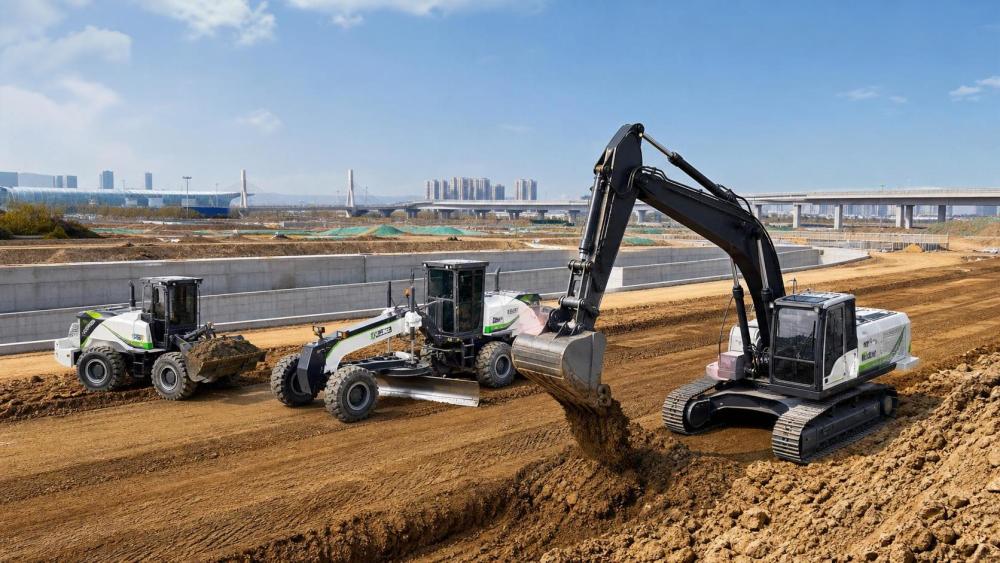
The earthmoving technology conversation has matured. It is no longer centered on prototypes alone. It now sits at the intersection of emissions policy, labor constraints, digital planning, and the need for more predictable project execution.
Non-road equipment regulations are tightening in several markets. At the same time, contractors and infrastructure investors expect higher uptime and clearer return on equipment spending. This creates pressure for machines that are cleaner, smarter, and easier to manage across mixed fleets.
EMD has tracked this shift closely through equipment intelligence, from excavator electro-hydraulic response to low-latency remote-control architectures in hazardous environments. The signal is consistent: the first changes will be operational before they become fully transformative.
The first wave will be smarter control, not full autonomy
When people discuss autonomy, they often imagine fully driverless earthmoving fleets. That future is developing, but 2026 is more likely to reward assisted operation than complete independence.
In practical terms, earthmoving technology will advance through machine guidance, automated blade and bucket functions, collision awareness, and semi-autonomous workflows tied to site models. These features reduce rework faster than full autonomy can scale.
Motor graders are a clear example. GPS and laser-based systems already support millimeter-level surface control. What changes next is tighter integration between machine positioning, digital terrain data, and operator assistance.
Crawler excavators will follow a similar path. Precision digging, swing control, and payload-aware hydraulic management are likely to improve first, especially on projects where productivity depends on repeatable cycles rather than improvisation.
What this means in real operations
- Less overcut and undercut in excavation and trenching work.
- Fewer passes in grading and finishing applications.
- More consistent cycle times in loading and stockpile work.
- Lower dependence on individual operator variability.
Electrification will expand selectively
Another major trend in earthmoving technology is electrification, but the adoption curve will not be uniform. Smaller machines and urban applications will move first because duty cycles, charging windows, and noise rules make the business case clearer.
Skid steer loaders and compact excavators are positioned well for this shift. Zero-radius maneuverability, frequent stop-start work, and indoor or dense urban jobsites create strong conditions for battery-electric platforms.
Large bulldozers and heavy wheel loaders face a different reality. High tractive effort, long shifts, and remote project locations still favor diesel, hybrid, or transitional powertrain strategies. In these categories, efficiency gains may arrive sooner through hydraulics and power management than through full electrification.
Remote operation becomes a serious business tool
One of the most underestimated areas in earthmoving technology is remote operation. It will not replace all on-site work, but it is becoming more credible in mines, demolition zones, unstable slopes, and hazardous environments.
The enabling factor is not only hardware. It is communication quality, response latency, and control logic. If signal stability improves, remote dozing, excavating, and material handling become easier to justify where safety exposure is high.
This is especially relevant for organizations managing geographically dispersed projects. A remote-ready machine architecture can extend labor access, reduce risk concentration, and support standardized operating practices across regions.
Where remote capability creates value first
- Hazardous mines and quarries with unstable conditions.
- Disaster recovery sites with restricted access.
- Large linear projects needing centralized oversight.
- Night operations where staffing flexibility matters.
Data quality will matter more than data volume
By 2026, most serious equipment platforms will generate more information than before. The competitive difference will not come from dashboards alone. It will come from whether machine data can improve decisions about maintenance, deployment, and job sequencing.
This is where earthmoving technology becomes a management issue, not just an engineering issue. Telematics, payload tracking, fuel trends, idle time, and attachment utilization only create value when they are tied to action.
Wheel loaders in bulk material transfer illustrate the point well. A fleet may already report cycle counts and idle hours. The more useful next step is linking that data to haul patterns, loader-vehicle matching, and maintenance windows.
EMD’s intelligence model reflects this broader view. Technical insight is most powerful when it connects machine behavior, market demand, emissions rules, and investment timing into one decision framework.
The equipment categories will not move at the same speed
A common mistake is to treat earthmoving technology as one uniform trend. In reality, each machine category has a different path because tasks, energy loads, and jobsite constraints are different.
Crawler excavators are likely to gain from electro-hydraulic refinement and operator assistance. Wheel loaders will benefit from productivity analytics and powertrain optimization. Motor graders will continue to push precision control deeper into mainstream use.
Bulldozers remain critical where traction and pushing force dominate. Their next advances may look less flashy, but hydrostatic efficiency, control smoothness, and remote functionality can still produce meaningful returns.
Skid steer loaders may be the fastest adapters in mixed urban environments. Their attachment flexibility makes them ideal for testing how electrification, compact telematics, and smart hydraulic tools work under frequent task changes.
How to evaluate change without chasing hype
The best response to emerging earthmoving technology is disciplined evaluation. The question is not whether a feature looks advanced. The question is whether it changes project economics, risk exposure, or equipment utilization in a measurable way.
- Check whether the technology solves a recurring site constraint.
- Compare energy, maintenance, and uptime effects over full duty cycles.
- Assess software compatibility with surveying, planning, and fleet systems.
- Review network and remote-support requirements before deployment.
- Separate pilot-stage claims from scalable operating evidence.
Usually, the strongest early investments are not the most dramatic ones. They are the upgrades that reduce rework, stabilize output, and improve machine availability across multiple projects.
What to watch next
The first visible changes in 2026 will likely come from assisted control, targeted electrification, better remote readiness, and more useful machine intelligence. These are not isolated developments. Together, they reshape how equipment is selected, deployed, and supported.
For anyone tracking the next phase of earthmoving technology, the most practical move is to map trends against actual operating conditions. Look at job mix, site risk, regulatory exposure, energy access, and digital maturity before drawing conclusions.
That approach makes it easier to spot where change will arrive first, where it will pay back fastest, and where waiting may still be the smarter decision.