
Related News
- 00
0000-00
How to size heavy-duty loaders for North American mining operations - 00
0000-00
How altitude affects mining excavator performance in Latin America - 00
0000-00
Caterpillar Launches New Cat 6060 and Upgraded Autonomous Mining System - 00
0000-00
When does eco-friendly construction equipment pay for itself? - 00
0000-00
Will a wheel loader quick coupler fit your existing attachments?
Return on equipment spend is strongest when a machine is placed in work that fully uses its force, reach, cycle speed, or grading accuracy for most of the shift. On infrastructure projects, weak ROI usually comes from the opposite pattern: oversized machines waiting on trucks, precision equipment used for rough bulk movement, or attachments chosen for convenience rather than soil, rock, or finish tolerance. The highest-value infrastructure equipment applications are usually found where machine output directly controls schedule exposure, rework risk, fuel burn, and material handling time.
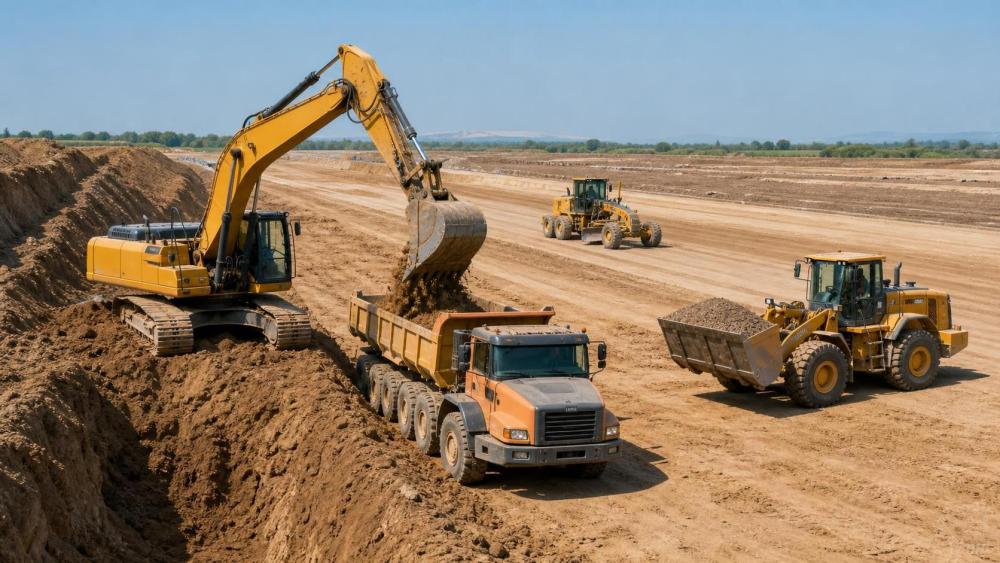
Excavation and trench production often sit near the top of that list. A crawler excavator earns back its cost fastest when the site demands continuous digging in variable ground, repeated truck loading, utility trenching with controlled sidewalls, or mass cut operations where breakout force and hydraulic stability matter every hour. In these conditions, bucket fill factor, stick reach, tail swing profile, undercarriage wear life, and attachment flow settings all affect cost far more than a purchase decision based only on operating weight. If the machine must shift between pipe trenching, rock breaking, and foundation excavation, the better ROI usually comes from a unit with auxiliary hydraulics sized for planned attachments, a quick coupler already approved for site use, and a boom configuration that avoids repeated repositioning.
Excavators lose financial advantage when they spend too much time performing loader work at short travel distances, idling while haul units queue poorly, or carrying oversized buckets in dense material that reduces cycle consistency. In soft subgrade, a wider track shoe may reduce sinkage, but on abrasive ground it may also alter wear behavior and transport considerations. The most profitable application is rarely the broadest one; it is the one where the machine can maintain productive cycles without constant compromise.
Bulk Loading Delivers ROI When Material Flow Is the Constraint
Wheel loaders generally deliver their best return where stockpile reclaim, aggregate handling, plant feeding, and short-load-haul cycles dominate daily output. In quarry support, road base production, concrete batching yards, port materials handling, and large spoil management zones, the loader becomes a throughput machine. Here, transmission response, breakout force at the pile face, tire selection, bucket edge protection, and visibility into hopper or truck body geometry all influence how many useful cycles fit into a shift.
A common purchasing mistake is selecting capacity from nominal bucket volume alone. Dense crushed aggregate, wet sand, reclaimed asphalt, and loosely blasted overburden behave differently in the bucket, at the pile face, and during travel. If pile penetration is poor, cycle time rises even when engine power appears sufficient on paper. If truck match is off by one pass, loading rhythm deteriorates across the fleet. The strongest ROI appears where loader size, bucket type, and haul-unit body capacity are matched so that pass count stays consistent and spillage remains low. That matters more than headline size.
On some job sites, a wheel loader also carries return on the maintenance side. If service access is clean, cooling packs can be opened without special disassembly, and wear components are stocked locally, downtime becomes easier to contain. A loader may look cheaper at purchase but become expensive if cutting edges, tires, pins, or hydraulic hose routing create frequent service interruptions during peak material movement windows.
Fine Grading Pays Back Where Rework Is Expensive
Motor graders tend to produce the best ROI on road formation, sub-base trimming, shoulder shaping, drainage profiling, and airfield surface preparation, especially where finished tolerance determines the next trade’s speed. The value of a grader rises sharply when the cost of correction is high. Reworking a pavement section because crown, slope transition, or elevation drifted beyond tolerance can consume far more money than the difference between a basic setup and a machine configured for guidance-ready operation.
In these infrastructure equipment applications, blade control accuracy is only one part of the equation. Circle wear, articulation stability, moldboard length, front axle support, and the quality of machine calibration all affect whether the grader can hold line over a long pass. If the project includes GPS control, total station support, or laser-based grade reference, the return depends on more than the technology package itself. Base station placement, file management, surface model revisions, and daily verification routines must be stable, otherwise the site pays for precision it does not consistently receive.
Graders are often underused when brought in too early for rough movement that a dozer or loader could handle with less wear and lower hourly cost. Their stronger economic position is usually later in the sequence, once the surface is ready for shaping, tolerance control, and finish continuity. Used in the wrong phase, the grader becomes a transportable cost center. Used at the right handoff point, it protects downstream productivity.
Dozers Show Their Value in Push Distance and Ground Resistance
Bulldozers deliver strong ROI where the site requires repeated pushing through resistant material, slot dozing, landfill spreading, haul road maintenance, embankment shaping, and initial platform establishment on unstable or steep ground. Their value is easiest to see when traction, not loading, is limiting progress. A dozer can outperform more versatile equipment when the work involves sustained blade load, difficult underfoot conditions, and minimal need for material lift.
The most favorable applications usually have push distances that suit the machine class and blade arrangement. If distances extend too far, a loading and haul system may be more efficient. If the material is too loose and shallow, a loader may move it with less track wear. But when the site has compacted fill, mixed debris, sticky clay, or weathered rock fragments that resist movement, the dozer’s mass and track contact patch can keep production moving when wheeled machines begin to lose efficiency.
ROI improves further when procurement accounts for undercarriage consumption instead of treating it as background maintenance. Track chain wear, roller life, sprocket condition, shoe choice, and guarding requirements should be tied directly to the planned surface: blasted rock, abrasive haul roads, demolition residue, or wet cohesive soils all stress the machine differently. On jobs where contamination or impact damage is likely, robust guarding may preserve uptime even if it raises upfront specification cost.
Tight Urban Work Often Rewards Compact Versatility
Skid steer loaders usually return value fastest on dense urban infrastructure, utilities reinstatement, streetscape work, indoor demolition support, and confined service corridors where transport simplicity and attachment flexibility matter more than absolute digging power. Their strongest applications are often fragmented tasks that would otherwise require multiple specialty units: palletized material movement in the morning, cold planer support at midday, sweeper attachment work before handover, and auger drilling in restricted access zones.
That versatility only pays if the hydraulic package, coupler interface, lift path, and tire or track arrangement match the actual attachment schedule. A machine bought for general utility can become expensive if high-flow attachments are later added but the auxiliary circuit cannot support them properly. Likewise, a vertical lift path may suit loading and pallet handling, while a radial lift configuration may be acceptable for grading attachments and lighter material movement. The better application is the one that reduces machine swapping and trailer moves without forcing a compact unit into heavy excavation it cannot sustain.
Compact equipment also changes logistics economics. Access through finished neighborhoods, ramps, tunnels, or partially completed structures may allow a skid steer to start revenue-generating work sooner than larger machines that require more elaborate delivery windows or surface protection measures. In that case, the return comes from reduced setup friction as much as from the machine itself.
Where Mixed Fleets Create Better ROI Than Single-Machine Thinking
Some of the best job-site returns do not come from choosing the strongest standalone machine, but from removing idle dependencies between machine types. An excavator with the right bucket and truck match may produce excellent numbers in isolation and still underperform financially if haul units are undersupplied. A grader with advanced control can still wait behind poor subgrade preparation. A dozer can burn hours cleaning material placement errors created upstream by loading inconsistency.
That is why infrastructure equipment applications should be evaluated as production chains. Material must be cut, loaded, moved, spread, shaped, and finished with minimal interruption. When one machine is specified without considering the next handoff, hidden cost appears in queue time, double handling, and corrective passes. A more balanced fleet often yields better return than a flagship unit surrounded by mismatched support equipment.
Transport and assembly constraints belong in the same evaluation. Some sites favor equipment that can be mobilized without escort complexity, detached counterweight procedures, or repeated permit coordination. On remote projects, a unit with simpler field service and easier parts access may generate better overall economics than a technically superior machine that is harder to support. Installation of guidance components, calibration after transport, and recommissioning after long moves can also affect when the machine truly becomes productive.
Application-Specific Risks That Distort the Cost Picture
Several recurring misjudgments weaken ROI even when machine quality is high. One is buying excess size to cover rare peak conditions. Unless those peak conditions dominate the schedule, oversized equipment often carries higher transport burden, reduced agility, and unnecessary fuel use. Another is underestimating attachment wear. In trenching, rock excavation, or reclaimed material processing, tooth systems, cutting edges, side cutters, and wear plates can materially change operating cost and downtime frequency.
Another problem appears when maintenance assumptions are copied from one application into another. Sealed surfaces, fine grading, quarry loading, utility trenching, and demolition support do not consume the same components at the same rate. Cooling systems, filtration, hose protection, articulation points, and underbody exposure should be reviewed against actual site contamination and impact risk. Published specifications rarely describe the full maintenance consequence of mud packing, abrasive fines, or repeated reversing in confined areas.
Release risk also matters when new machine control, remote operation, or low-emission powertrains are introduced into jobs that have little tolerance for commissioning delays. The issue is not whether the technology is valid. The issue is whether site support, technician familiarity, and spare component planning are mature enough for the intended phase of work. A feature can be valuable and still be mistimed for a particular rollout.
Where the Best ROI Usually Appears
Across most infrastructure equipment applications, the strongest return tends to appear in four conditions: when the machine is used close to its intended duty cycle for most of the shift, when its configuration matches the material and finish requirement, when fleet handoffs are aligned, and when transport and maintenance realities were priced in before delivery. Excavators usually excel in sustained digging and controlled loading. Wheel loaders perform best where repeated short-cycle material transfer drives output. Graders pay back where precision prevents costly rework. Dozers win when traction and pushing resistance govern production. Skid steers become highly economical where access constraints and attachment changes would otherwise fragment the workflow.
On a job site, the most expensive equipment is often not the machine with the highest purchase price, but the one assigned to work that does not fit its real capability. Matching application to machine remains the clearest path to durable ROI.