
Related News
- 00
0000-00
How to size heavy-duty loaders for North American mining operations - 00
0000-00
How altitude affects mining excavator performance in Latin America - 00
0000-00
Caterpillar Launches New Cat 6060 and Upgraded Autonomous Mining System - 00
0000-00
When does eco-friendly construction equipment pay for itself? - 00
0000-00
Will a wheel loader quick coupler fit your existing attachments?
It often happens at the least convenient moment: a machine is scheduled for delivery, the project team wants immediate release, and someone asks for the safety file just before approval. The paperwork looks complete at first glance, but a closer look raises questions. The certificate format seems unfamiliar. The test report references a model code that does not exactly match the machine on site. A declaration is signed, but the issuing body is unclear. When that happens, approval stops being a routine step and turns into a risk decision.
For heavy equipment, that decision matters. Excavators, wheel loaders, bulldozers, graders, and compact machines may cross borders, pass through dealers, be modified after manufacture, or arrive with mixed document sets from different jurisdictions. If equipment safety certifications are accepted without proper verification, the result may be delayed mobilization, failed audits, insurance disputes, or, worse, unsafe operation under the assumption that compliance has already been checked. Many approval problems begin not with an obviously fake document, but with small inconsistencies that are easy to miss under time pressure.
The practical question is not whether a certificate exists. It is whether the certificate is valid for the exact machine, the intended use, and the site or market where approval is being granted. That requires a repeatable review method rather than a quick scan of a PDF.
Where approval reviews usually go wrong
A common mistake is treating all certification documents as interchangeable. In reality, a test report, a declaration, a certificate of conformity, a factory inspection record, and a product label do different jobs. One may support another, but one does not automatically replace the rest. Another mistake is focusing only on logos. A familiar mark can create false confidence, even when the scope, dates, standards, or model designation do not match.
There is also a workflow problem that shows up in many organizations. Procurement checks that a supplier has “sent the documents.” Operations assumes technical review has already happened. Quality checks serial numbers only after the equipment arrives. Safety review starts when the machine is already needed for work. By then, everyone feels pressure to approve fast, which is exactly when weak verification slips through.
For imported or highly configured machinery, one more issue is easy to overlook: attachments, optional control systems, guarding changes, emission packages, telematics hardware, and local retrofit kits can affect whether the original certification still applies as presented. Even when the base machine is properly documented, the final delivered configuration may not be.
Start with the machine, not the paperwork
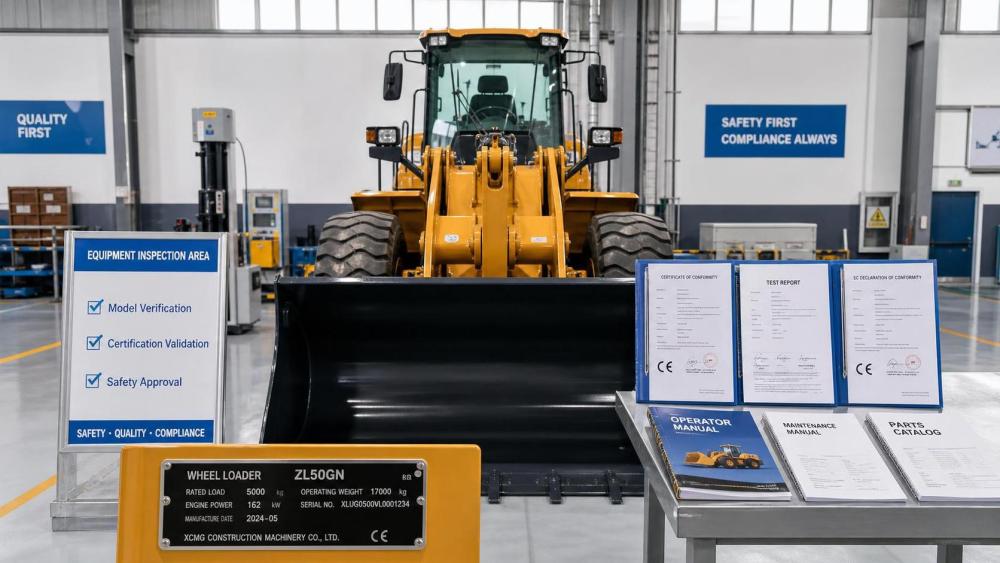
The most reliable way to verify equipment safety certifications is to anchor the review to the physical equipment first. Before reading any certificate, record the manufacturer name, exact model, product family, serial number, manufacturing date if available, rated capacity or operating weight where relevant, installed attachments, and any visible modifications. Photograph the data plate and major labels if your process allows it.
This sounds basic, but it prevents one of the most common failures in approval work: reviewing a valid document package for the wrong configuration. A model family certificate may cover several variants, but not always every engine option, guarding package, control architecture, or market-specific version. If the machine identity is not fixed first, the document review becomes guesswork.
Once the equipment profile is clear, group the received records into four categories:
- Identity documents tied to the exact machine or product family
- Safety compliance documents, such as declarations or certificates
- Supporting technical documents, including manuals, test reports, and drawings when available
- Markings and labels physically present on the machine
Separating them this way makes gaps easier to spot. A machine may have a declaration but no traceable model reference. It may have labels on the body but no supporting issuer details in the file. It may have a strong test package for one market but nothing proving acceptance in the destination jurisdiction.
Key points to verify in the document set
When reviewing a certificate or declaration, avoid reading it like a brochure. Read it like a chain of evidence. The first point is document identity. Check the document number, issue date, revision status, and issuer details. If the issuer is a certification body, test lab, or notified organization, make sure the name is complete and traceable. If the document is a manufacturer declaration, confirm the legal entity and authorized signatory are clearly identified.
The second point is scope. A certificate may apply to a product category, a limited range of models, or a specific standard under specific conditions. The model designation on the document should match the machine exactly or match it through a clearly stated family scope. Be cautious with near matches. A single suffix may indicate a regional variant, a safety package, a different cab arrangement, or a different engine installation.
The third point is standard reference. The listed standard or directive should be identified clearly enough to understand what was assessed. You do not need to memorize every technical requirement, but you do need to know whether the document references a current and relevant framework for your market and application. If the paperwork cites a standard with no indication of edition, amendment status, or connection to the machine’s safety functions, further review is justified.
The fourth point is validity. Some documents remain acceptable unless design changes occur, while others are tied to surveillance cycles, production controls, or defined periods. A document with an old issue date is not automatically invalid, but it does require context. Ask whether the machine design, control system, guarding, emissions package, or intended market has changed since issuance.
The fifth point is consistency across documents. The manufacturer name on the declaration should not conflict with the name on the rating plate unless there is a clear brand or legal-entity explanation. The model in the manual should align with the model on the certificate. The serial number or batch reference should connect logically to the delivered unit where applicable. Mismatches do not always prove a problem, but they should never be ignored.
How to confirm the issuer and document authenticity
If something feels off, slow the process down and verify the source directly. A professionally designed certificate can still be outdated, incomplete, or issued for a different product. The fastest practical check is to confirm whether the issuing body actually exists, whether its contact details are legitimate, and whether the document number can be validated through an official register or direct inquiry.
Do not rely only on phone numbers or email addresses printed on the certificate. Use independent contact details from an official website or recognized directory. If a public database exists, search the document number, certificate number, or company name there. Where databases are not public, request confirmation in writing from the issuer or manufacturer.
There are several signs that deserve extra caution:
- Unclear or generic issuer name with no verifiable legal identity
- Missing scope details or missing standards reference
- Formatting inconsistencies across pages
- Scanned signatures with no signatory name or title
- Document dates that do not fit the machine’s production timing
- Labels on the machine that do not reflect the same compliance pathway shown in the file
None of these points alone proves fraud. In many cases the issue is poor document control rather than deliberate misrepresentation. Still, approval should wait until the discrepancy is explained.
Check the physical machine against the file
Document review is only half of verification. The machine itself must support the file. Inspect the rating plate, warning decals, operator instructions, emergency stop devices where applicable, access systems, guards, and any required compliance markings. Make sure the machine delivered is the machine documented.
This is especially important for used equipment, dealer-prepared inventory, and machines that have been fitted with additional hydraulic tools, quick couplers, cabs, camera systems, remote-control kits, or localized guarding. Those changes may be legitimate, but they can affect the original compliance basis. If the machine has visible modifications not reflected in the paperwork, ask for the engineering justification, updated declaration, or modification assessment before approval.
One practical habit helps here: compare three items side by side during review—the machine plate, the main certificate or declaration, and the operating manual cover or specification page. If those three do not align on identity, there is usually a deeper file problem behind it.
When the market of use changes the answer
Approval decisions often become difficult when equipment moves from one regulatory environment to another. A supplier may provide documents that were perfectly acceptable in the country of origin but incomplete for the country or project where the equipment will operate. This does not always mean the equipment is unsafe. It means the approval basis may not be transferable without additional review.
For that reason, verification should include a simple internal question: approved for where, and approved for what use? A machine entering a mine, tunnel, refinery, airport project, or public infrastructure site may face different expectations than the same machine on a private yard. Site rules, client specifications, insurance conditions, and local regulations may require more than the minimum manufacturer paperwork.
Where internal teams need support, industry intelligence sources can help frame the review by tracking machinery regulation changes, equipment evolution, and non-road compliance trends across markets. Used carefully, that kind of reference material is useful not as proof of certification, but as context for identifying when a document package no longer fits the equipment category or operating environment being assessed.
A practical approval path when documents are incomplete
Not every file arrives complete. The important thing is to avoid turning incomplete into accepted by default. If the machine is urgently needed but the evidence is weak, move it into a controlled hold status rather than a verbal approval. Record what is missing, who must provide it, and what operational restrictions apply in the meantime.
A sensible escalation path usually looks like this:
- Identify the exact mismatch or missing item
- Request corrected or supporting documents from the supplier or manufacturer
- Verify the issuer independently if authenticity is in doubt
- Inspect the machine for modifications or label inconsistencies
- Escalate to engineering, compliance, or legal review if the gap affects safety basis or regulatory acceptance
This matters because many delays come from vague feedback. Saying “documents not acceptable” often leads to another incomplete resubmission. Saying “model suffix on declaration does not match rating plate” or “certificate scope does not mention installed remote-control package” leads to faster correction.
Building a process that prevents repeat problems
If you regularly review equipment safety certifications, the long-term fix is process discipline, not just sharper eyes. Require document submission before shipment or before site arrival. Define which documents are mandatory by equipment type. Make one person responsible for identity matching and another for compliance review if your team structure allows it. Keep approved document versions in a controlled repository so older files do not reappear in later reviews.
It also helps to create an internal decision rule for common outcomes: approved, approved with restrictions, pending clarification, or rejected. That avoids the gray area where a machine is informally accepted because no one wants to stop operations. A short review record noting the exact basis for approval makes later audits much easier and protects the team when questions arise months after mobilization.
For heavy machinery fleets, the biggest improvement usually comes from standardizing review questions around equipment identity, issuer validity, scope, market relevance, and physical configuration. When those points are checked in the same order every time, approvals become faster and more defensible.
In practice, verification is less about chasing perfect paperwork and more about proving that the machine in front of you is the same machine described in the certification trail, under the same conditions the documents were meant to cover. When that link is clear, approval is straightforward. When it is not, pausing the release is not a delay for its own sake. It is the control that keeps a documentation gap from becoming a safety problem later.