
Related News
- 00
0000-00
How to size heavy-duty loaders for North American mining operations - 00
0000-00
How altitude affects mining excavator performance in Latin America - 00
0000-00
Caterpillar Launches New Cat 6060 and Upgraded Autonomous Mining System - 00
0000-00
When does eco-friendly construction equipment pay for itself? - 00
0000-00
Will a wheel loader quick coupler fit your existing attachments?
It often starts with a quotation that looks acceptable on paper. The unit price seems competitive, the lead time appears manageable, and the supplier says they can build to print. Then the internal review begins. Engineering notices a tolerance note that may require additional machining. Quality asks who pays for first article inspection and rework if samples fail. Logistics points out the packing method is unclear for overseas movement. By the time everyone has added their concerns, the original quote no longer reflects the real buying decision.
This is a common problem in equipment OEM sourcing, especially for heavy machinery and related assemblies where parts are not simple commodities. A purchasing decision made on piece price alone can later create cost through scrap, line stoppages, delayed launches, field issues, warranty exposure, and expensive corrective action. The hard part is not knowing that hidden cost exists. The hard part is identifying it early enough to compare suppliers fairly.
Many teams only realize this after a few painful sourcing rounds. A low quote can be tied to thin process control, incomplete packaging, unstable raw material assumptions, or an unrealistic interpretation of the drawing. None of those items are obvious if the evaluation stays at the header line of a spreadsheet. The better approach is to break total cost into the decisions that create it and force those decisions into the sourcing conversation before supplier nomination.
Why the quoted price and the real cost drift apart
In industrial equipment, especially where hydraulic, structural, and wear-critical components are involved, the supplier is not just selling a part. They are selling a manufacturing path. That path includes tooling choices, fixture design, machining sequence, weld control, coating method, test coverage, packaging, documentation, and delivery reliability. Two suppliers can quote the same drawing and still be pricing very different execution risks.
That is why total cost should be read as the cost to launch, receive, inspect, assemble, operate, and support the item over time. If a sourced component reaches your dock cheaply but requires extra incoming inspection, repeated clarification with engineering, and emergency shipments to keep production running, the savings disappear quickly. For procurement, the real task is not finding the lowest number. It is finding the lowest controllable cost with an acceptable level of supply risk.
The cost drivers that usually get missed first
A frequent mistake is to treat all indirect costs as minor. In practice, some of them decide whether a sourcing program stays stable or becomes a recurring fire drill.
Tooling and process setup
Tooling is not only the obvious hard cost of molds, dies, jigs, or fixtures. It also includes whether the chosen process is mature enough for repeatable output. In equipment components, custom fixtures for welding, machining references, and inspection gauges can affect dimensional stability and throughput. If these items are under-scoped at RFQ stage, the supplier may recover the gap later through change requests, slower output, or quality variation.
Procurement should ask early whether tooling is dedicated or shared, who owns it, what maintenance responsibility exists, and whether replacement cost has been considered. A quote that excludes these realities is not necessarily wrong, but it is incomplete.
Material volatility and specification interpretation
For fabricated and machined equipment parts, material can dominate cost. Steel grade, thickness range, hardness requirement, heat treatment route, and traceability expectations all shape the final number. Problems appear when the drawing is technically correct but commercially open to interpretation. One supplier may assume a readily available grade and another may price a harder-to-source equivalent because they read the application risk differently.
When this happens, sourcing comparisons become distorted. The buyers may think they are comparing suppliers, while in reality they are comparing assumptions. That is why a pre-quote technical alignment meeting often saves money even if it adds a short delay upfront.
Quality cost that sits outside the purchase order
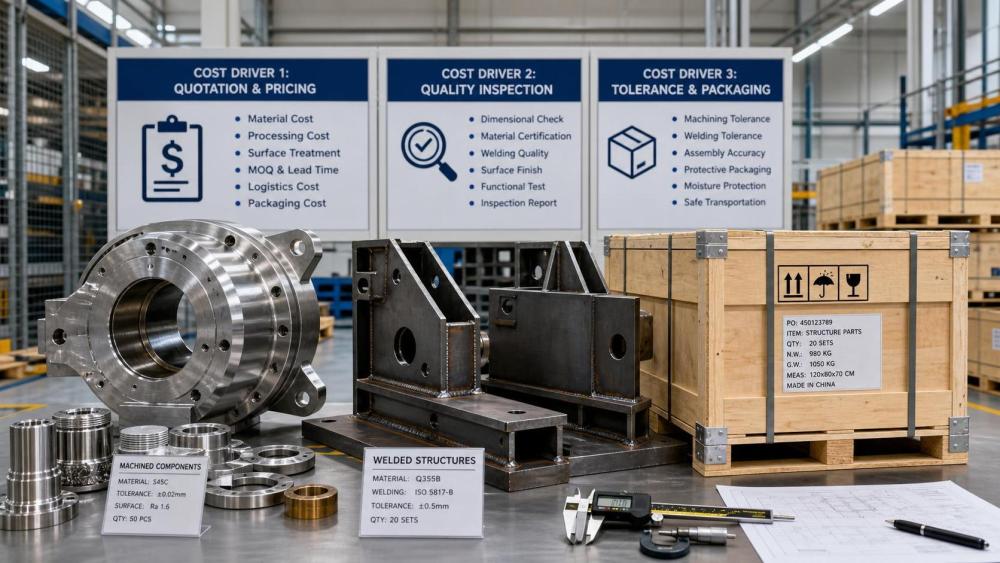
Quality cost is where many low-cost sourcing decisions become expensive. First article inspection, PPAP-style documentation where applicable, weld qualification records, coating thickness verification, dimensional reports, nonconformance handling, containment activity, and sorting all take time and money. If these items are not clearly assigned, they do not disappear. They simply surface later during launch or after the first rejected lot.
Incoming quality burden also matters. Some suppliers ship with strong process discipline and stable documentation, allowing your receiving team to reduce intervention. Others require constant follow-up, more sampling, more re-inspection, and more internal communication. That labor rarely sits inside the quoted price, but it absolutely belongs in total cost.
Freight, packaging, and damage exposure
In heavy machinery supply chains, packaging is not a minor afterthought. Large weldments, machined surfaces, cylinders, pins, castings, and painted components each need different levels of protection. A quote can look attractive until rust, edge damage, dented surfaces, or mixed-lot identification problems begin showing up after transport.
Freight cost itself is only one layer. There is also container utilization, export packing, corrosion prevention, rack return logic if reusable systems are used, and the cost of unloading inefficiency at destination. Packaging that fails once can create replacement freight, premium shipping, line disruption, and claim administration. That is why packaging review belongs in commercial evaluation, not only in shipping preparation.
Compliance and documentation effort
Depending on the component type and destination market, documentation can carry meaningful administrative cost. Material declarations, country-of-origin records, test certificates, process sheets, and technical files can all consume supplier and buyer resources. If the expected document set is vague during sourcing, one supplier may quote lean while another builds in the required effort. Again, the comparison becomes misleading.
After-sales and service impact
Not every sourced item goes directly into a one-time assembly with no follow-up. For service parts, attachments, wear components, and critical subassemblies, the sourcing decision may affect field availability and replacement lead time. If a component is difficult to replenish or has inconsistent interchangeability, the downstream cost can show up in service support, dealer frustration, or excess safety stock. That is part of total cost even if it does not appear in the first PO.
Where procurement teams usually get trapped
One common trap is assuming engineering completeness equals sourcing completeness. A released drawing is necessary, but it does not answer every commercial and operational question. It may not define acceptable cosmetic variation, preferred weld sequence, packing density, spare tooling expectation, or lot traceability rules. If those issues are left open, suppliers fill the gaps differently.
Another trap is splitting cost review into isolated functions. Engineering studies manufacturability, quality studies control plans, supply chain studies freight, and purchasing studies price. Each group sees part of the risk. No one sees the total unless the sourcing process forces those views together. This is why a “cheap” supplier can survive early review and still become expensive after nomination.
A third trap is overvaluing sample performance. A supplier may produce acceptable prototypes through manual effort that does not scale economically. The true question is not whether they can make a few parts. It is whether they can repeat the process at the required volume, lead time, and consistency without hidden intervention.
A more practical way to evaluate total cost before award
When teams want better control over equipment OEM sourcing, they usually do not need a dramatic new system. They need a tighter decision path. The following approach is often more useful than chasing a perfect spreadsheet model.
Start with a “same assumption” RFQ package
Before requesting final quotes, make sure suppliers are responding to the same scope. That means the latest drawing, revision status, annual and peak volume assumptions, packaging expectation, inspection level, documentation requirement, Incoterm basis, and launch timing should be explicit. If optional items exist, separate them clearly instead of letting them hide inside quoted price.
This step matters because many cost disputes begin with silent differences in scope rather than bad intent. Clarifying assumptions early makes supplier comparison more honest.
Ask suppliers to explain process, not only price
A short cost breakdown is helpful, but process visibility is often more valuable. Ask how the part will be made, where critical dimensions are controlled, whether subcontracting is involved, and what capacity constraints may affect lead time. If a supplier cannot explain the route clearly, the risk usually reappears later as cost.
For heavy equipment components, this is especially important for weldments, machined housings, hydraulic interfaces, undercarriage-related parts, wear components, and painted structures. The manufacturing route shapes the cost of consistency.
Convert hidden work into visible commercial items
If first article support, gauge creation, sample freight, export packaging, preservation oil, special labeling, or document packages will be required, treat them as explicit quote elements. Even if some are eventually negotiated into piece price, listing them separately prevents misunderstanding. It also helps the team decide which costs are one-time, recurring, volume-sensitive, or avoidable through specification changes.
Review total landed cost with a realistic disruption lens
Landed cost should go beyond freight plus duty. Include expected receiving effort, inventory buffering needs, payment terms impact, likely premium freight exposure, and the internal labor needed to stabilize supply. This does not mean building a complicated financial model for every part. It means asking whether the low quote remains low after the likely operating burden is considered.
Test the supplier’s response quality during sourcing
One of the best early indicators of future cost is how a supplier handles open questions before award. Do they identify ambiguous notes? Do they challenge unsuitable tolerances? Do they respond clearly on packaging, change control, and traceability? Good sourcing performance is not proof of perfect execution, but poor sourcing discipline often predicts later cost escalation.
Different sourcing situations need different cost priorities
Not every category should be judged the same way. A simple fabricated bracket with non-critical dimensions can tolerate a more price-driven approach than a hydraulic interface component, a structural weldment under fatigue load, or a precision-machined part used in grading or control systems.
If you are sourcing standard or low-risk items, market pricing, logistics efficiency, and order flexibility may dominate the decision. If you are sourcing application-critical parts for excavators, loaders, graders, bulldozers, or compact equipment, process capability and documentation discipline often matter more than a small initial price gap. For service-sensitive items, replenishment stability may outweigh small unit savings.
This is where teams often improve outcomes simply by classifying sourced items more carefully. The goal is not to make every RFQ complex. It is to reserve deep scrutiny for the parts where failure creates expensive consequences.
Using industry intelligence without turning it into noise
When buyers are under pressure, they often gather more data than they can use: raw material headlines, freight trends, supplier claims, regional policy updates, and broad market commentary. Useful intelligence should support a sourcing decision, not distract from it.
For equipment categories tied to earthmoving, loading, grading, and related machinery, it helps to monitor a few things consistently: changes in demand cycles that may tighten capacity, supply shifts in hydraulic and structural component chains, logistics bottlenecks affecting bulky equipment parts, and evolving technical expectations around emissions-related systems, electrification, or automation interfaces where relevant. Used properly, this context can improve timing and negotiation. Used poorly, it becomes background noise that never changes the RFQ package.
A better question to ask before choosing a supplier
Instead of asking, “Who gave the best price?” a more useful question is, “Which quote gives us the most controllable total cost for this part category?” That wording changes the conversation. It pushes the team to examine assumptions, process maturity, packaging, quality burden, and service impact before the award decision locks them in.
In equipment OEM sourcing, cost control rarely comes from one dramatic negotiation move. More often it comes from preventing predictable leakage: unclear material assumptions, weak packaging, under-scoped quality work, unstable process routing, and supplier selection based on sample success rather than repeatable production readiness. When those items are surfaced early, procurement gains something more valuable than a lower initial number. It gains a sourcing decision that is easier to defend and less likely to become expensive later.
If you are reviewing supplier quotes right now and something feels “too low to understand,” that instinct is usually worth following. The answer may not be to reject the supplier. It may simply be to slow the decision long enough to expose the missing cost elements. In this kind of buying, a careful question asked early is often cheaper than a corrective action issued later.