
Autonomous construction equipment price is usually settled long before a machine reaches the site gate. The visible line item is the carrier machine, yet the real cost is built from control architecture, perception hardware, integration work, operating envelope, and the support burden created by the job itself. A crawler excavator prepared for repetitive trenching in a controlled corridor will be priced very differently from a dozer expected to work near mixed traffic, changing stockpiles, and unstable haul roads. Two machines with similar engine power and bucket or blade class can therefore land in very different commercial ranges once autonomy is added.
The first major driver is the autonomy level being purchased. A machine that only includes assist functions such as grade hold, obstacle alerts, or semi-automatic boom and bucket movements carries a different cost structure from a unit expected to start, navigate, dig, dump, and recover from interruptions with limited human intervention. Every step away from operator-assist and toward supervised autonomy adds hardware channels, software logic, validation time, and fault handling requirements. Price rises because the machine must sense more, decide more, and fail more safely. In commercial terms, that means additional controllers, redundant communication paths in some configurations, and a larger commissioning package.
Sensor content is often underestimated during budget review. The base machine may already have hydraulic pressure sensors, encoders, GNSS antennas, and standard machine health telematics, but autonomous operation typically needs a denser and cleaner perception stack. That can include lidar, radar, stereo or monocular cameras, inertial measurement units, wheel or track motion references, and high-accuracy positioning components. The equipment itself is only part of the cost. Mounting brackets must resist vibration, dust sealing has to be validated, cable routing must survive articulation and service access, and protective housings must avoid blocking the sensor field of view. On mining and quarry sites, impact protection and frequent contamination can push the price further because the sensor package has to remain functional under abrasive conditions.
Positioning accuracy is another strong price lever, especially on graders, dozers, and excavators working to tight tolerances. If the task can tolerate basic path repeatability, a simpler positioning arrangement may be acceptable. When the machine must hold a finished surface or dig to a digital design with limited rework, the system may require higher-grade GNSS receivers, correction services, local base infrastructure, or additional sensing to maintain accuracy when satellite visibility drops. The cost does not sit only in the antenna or receiver; it also appears in calibration, site setup, survey coordination, and the ongoing management of digital terrain files.
Software integration usually creates more commercial variation than the machine frame. Autonomous equipment does not operate as an isolated asset. It may need to consume design surfaces, work orders, geofences, dispatch instructions, payload rules, and maintenance alerts. If a fleet already uses mixed telematics protocols, legacy grade control files, or site management tools from different vendors, integration effort grows quickly. Interfaces have to be mapped, exception handling defined, and update responsibility assigned. A lower machine quote can become expensive if the software layer requires custom middleware, repeated field debugging, or restrictions on how data can be exchanged across the fleet.
Hydraulic and drive-by-wire conversion work also shapes autonomous construction equipment price in ways that are easy to miss in an early comparison. Some machines are designed with electronic control valves, steer-by-wire capability, and control units ready for automation. Others need retrofit packages to translate digital commands into physical motion. Retrofit work is rarely just a bolt-on exercise. It may involve replacing valve groups, adding actuator feedback, modifying wiring harnesses, changing cab controls, and validating emergency stop behavior. On track machines, fine motion control at low speed and under heavy load can require additional tuning time because the autonomy stack must work with hydraulic lag, track slip, and varying ground resistance.
Safety design has a direct and often substantial effect on price. Autonomous earthmoving equipment must be able to detect unsafe states, stop in a controlled way, and communicate machine status clearly to surrounding crews and adjacent assets. This introduces costs for emergency stop circuits, perimeter awareness devices, visible and audible signaling, remote intervention functions, and sometimes segregated work zones marked by digital or physical barriers. A site with pedestrian access, subcontractor traffic, and constantly shifting work fronts usually requires a more conservative safety architecture than a closed, repetitive operating area. That difference shows up in both equipment configuration and commissioning labor.
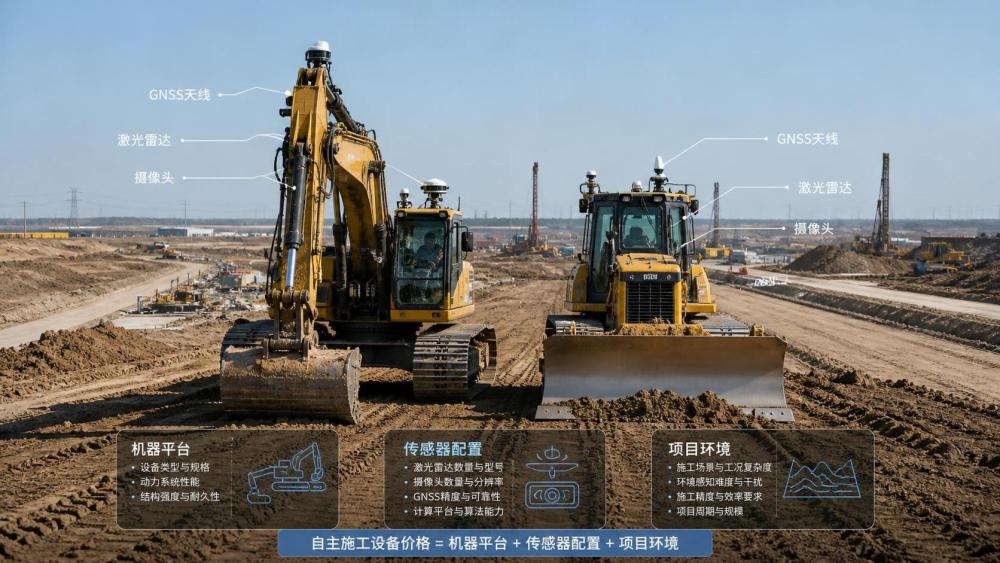
Environmental conditions change the bill of materials. Dust, fog, vibration, heat soak, corrosive materials, and poor lighting all affect sensor reliability and enclosure design. In a clean demonstration yard, a camera-heavy system may perform well and remain competitively priced. On a live earthmoving project with mud splash, reflective water, uneven bench edges, and intermittent visibility, additional sensor fusion and cleaning provisions may be needed. Heated enclosures, air purging, wipers, reinforced connectors, and redundant sensing channels increase cost because they are intended to preserve usable autonomy when the site stops looking like a lab.
Site geometry matters as much as machine type. Broad, repetitive haul patterns support simpler autonomous behavior than confined urban excavations, narrow trench corridors, or airport rehabilitation windows where multiple machines work close to one another. A wheel loader cycling between a stockpile and a hopper on a fixed route can be easier to automate than a skid steer changing attachments inside a dense utility zone. That difference affects not only software complexity but also the amount of mapping, rule setting, and boundary maintenance needed throughout the project. If work areas move every few days, the recurring cost of remapping and revalidation can outweigh savings expected from the machine itself.
Attachments can quietly change the pricing equation. A bucket, blade, ripper, fork frame, or grading attachment alters kinematics, visibility, load response, and the machine’s control requirements. Autonomous digging with one bucket geometry may need recalibration when the bucket profile changes. A skid steer carrying multiple hydraulic attachments can demand extra control logic, coupler sensing, and work tool identification. When quotations appear comparable, it is worth examining whether the autonomy package covers only the base machine or also includes validated operation with the full attachment mix planned for the contract.
Uptime commitments often separate a low initial quote from a durable commercial offer. An autonomous machine depends on software updates, sensor health monitoring, calibration discipline, and troubleshooting capability that many conventional fleets do not yet maintain internally. If the project requires tight production continuity, the price may include remote diagnostics, field service response windows, spare sensor kits, replacement controllers, or resident support during startup. These items can look expensive in the purchase stage, yet excluding them may shift risk into idle equipment, unplanned handover to manual mode, and schedule pressure during critical earthworks.
Training and operational handoff are real cost components even when no line item uses that exact label. Autonomous equipment still requires people around it to understand exclusion zones, restart logic, manual takeover, sensor cleaning routines, and what alarms actually require stopping work. The cost goes up when the workflow requires coordination among survey, fleet dispatch, maintenance, and site supervision. If the machine arrives before digital models are mature, traffic rules are unresolved, or service staff are not prepared for software-based fault tracing, additional commissioning days are likely. Those days may not change the sticker price, but they change the project cost attached to the machine.
Transport and installation can also be more involved than with conventional iron. Sensor masts, antennas, edge computing hardware, and roof-mounted perception units can affect shipping height, protection requirements, and reassembly steps. A machine may need controlled installation conditions to complete calibration correctly after transport. This is especially relevant where equipment crosses borders, changes lowboy configurations, or moves between remote regions and dealer yards before final deployment. The machine can arrive physically intact yet still need a careful setup sequence before autonomy is released for production work.
One recurring mistake in commercial comparison is treating autonomous construction equipment price as a single machine-to-machine number without defining the operating package. A quote may include hardware only, while another includes site calibration, software licenses, digital map preparation, and support during the first production phase. Another frequent misread is assuming that a retrofit and a factory-prepared autonomous machine are equivalent because both reach the same headline function. Retrofit paths can work well in the right fleet, but the hidden variables are usually control response consistency, wiring maturity, service documentation, and the time needed to stabilize performance under load.
Lifecycle service deserves close attention because autonomy introduces components with a different aging pattern than structural steel or hydraulic cylinders. Cameras lose clarity, connectors suffer contamination, firmware versions diverge, calibration drifts, and compute hardware can become obsolete faster than the undercarriage or front linkage. A strong commercial evaluation looks at replacement intervals, compatibility across model updates, field repairability, and whether fault logs are readable without specialist intervention. Machines that are inexpensive to acquire can become difficult assets if every sensor issue requires a specialist visit and the project schedule cannot absorb waiting time.
Data ownership and cybersecurity may also influence price, particularly where machines connect to fleet systems, dispatch software, or remote operating centers. If a site requires stricter network segmentation, local data storage, restricted remote access, or formal software approval steps, deployment effort rises. The price increase is not abstract; it comes from extra gateway hardware, controlled update procedures, additional validation, and sometimes limits on using standard cloud-based features. Projects in hazardous or strategically sensitive locations often discover this late, when the desired autonomy package must be adapted to local information handling rules.
Commercial terms can distort comparison if they are not tied to acceptance criteria. An autonomy package should be evaluated against a defined task, terrain condition, material behavior, and intervention threshold. Excavation in uniform spoil is one thing; rock fragments, sticky clay, or changing moisture can produce a very different machine response. If acceptance language is vague, the apparent price may look attractive because difficult conditions have been left outside the supplier’s obligation. Clear boundaries around payload type, slope limits, weather interruptions, and manual override frequency make the commercial number more honest.
In real projects, the most reliable reading of autonomous construction equipment price comes from following the machine through its full working chain: machine platform, sensor stack, control conversion, software interfaces, site preparation, safety design, service coverage, and the friction created by the actual ground conditions. Once those layers are separated and compared on equal terms, the expensive option sometimes proves simpler to own, while the cheapest entry can carry the largest unresolved cost.