
Related News
- 00
0000-00
How to size heavy-duty loaders for North American mining operations - 00
0000-00
How altitude affects mining excavator performance in Latin America - 00
0000-00
Caterpillar Launches New Cat 6060 and Upgraded Autonomous Mining System - 00
0000-00
When does eco-friendly construction equipment pay for itself? - 00
0000-00
Will a wheel loader quick coupler fit your existing attachments?
How Engineers Can Compare Equipment Solutions for Site-Specific Needs
Selecting earthmoving equipment is rarely a matter of choosing the machine with the highest headline horsepower, largest bucket, or lowest purchase price. A crawler excavator that performs well in stable quarry benches may be the wrong answer for soft utility corridors. A motor grader with advanced machine control may be hard to justify on a short access road, yet indispensable on a runway or long-haul road project where rework quickly becomes expensive.
A useful equipment solution reference for engineers starts with the site, not the brochure. Technical evaluators need to understand what the machine must do repeatedly, what can stop it from doing that work, and which compromises are acceptable. Ground bearing pressure, cycle time, hydraulic response, attachment requirements, operator skill, local emissions rules, service access, and digital control compatibility all shape the decision. The right machine is the one that delivers predictable output under the actual constraints of the jobsite.
This is particularly important in earthmoving, where equipment categories overlap more than procurement documents often suggest. A skid steer can handle grading and loading in confined areas. A compact excavator may replace several manual tasks around utilities. A wheel loader may be more productive than an excavator for stockpile handling, but less adaptable when the material face changes. Good comparison work separates nominal capability from usable capability.
Start With the Work Sequence, Not the Equipment Category
Before comparing brands or configurations, map the job into its real operating sequence. Ask what happens at the beginning, middle, and end of each shift. Is the machine stripping topsoil, digging trench runs, loading haul trucks, pushing rockfill, trimming final grade, or moving between scattered tasks? A machine may appear suitable when judged against one activity but become inefficient once travel, repositioning, attachment changes, and waiting time are included.
For example, trench excavation is not simply a question of digging depth. The evaluation should include trench width, spoil placement, pipe-lifting needs, swing clearance, underground-service risk, and the frequency of moves between locations. A long-reach excavator may satisfy reach requirements while sacrificing breakout force and lifting stability. A heavier conventional excavator may dig faster but create access issues or exceed permitted ground loading near existing structures.
The same discipline applies to loading equipment. Wheel loaders are often assessed by bucket capacity alone, but the material itself determines much of the outcome. Loose aggregate, wet clay, blasted rock, recycled demolition material, and high-density ore do not behave the same way in a bucket. Payload control, tire selection, rim-pull characteristics, axle durability, and visibility around the loading face can matter more than a nominal capacity comparison.
Define the site constraints engineers cannot negotiate away
A practical comparison sheet should distinguish between preferences and non-negotiable conditions. Some constraints are obvious, such as transport width, lifting requirement, maximum tail swing, or required grading tolerance. Others are discovered only after a site walk: an access road that becomes impassable after rain, a narrow bridge with weight restrictions, poor satellite reception near high structures, limited fuel delivery, or a maintenance area without lifting equipment.
Ground conditions deserve special attention. Soft, saturated, or recently placed fill can turn a productive machine into a recovery problem. Track width, undercarriage design, machine weight distribution, and shoe selection affect flotation and traction, but wider shoes are not automatically better. They can reduce ground pressure while increasing side load concerns in some digging conditions. On abrasive ground, an undercarriage choice that works mechanically may create a very different wear profile than expected.
Where slopes are involved, evaluators should look beyond stated gradeability. A machine may climb a slope under ideal conditions but still be unsuitable for repeated cross-slope work, loaded travel, or operation on loose material. Stability depends on the attachment, payload position, surface condition, operator practice, and the route actually used—not one specification line.
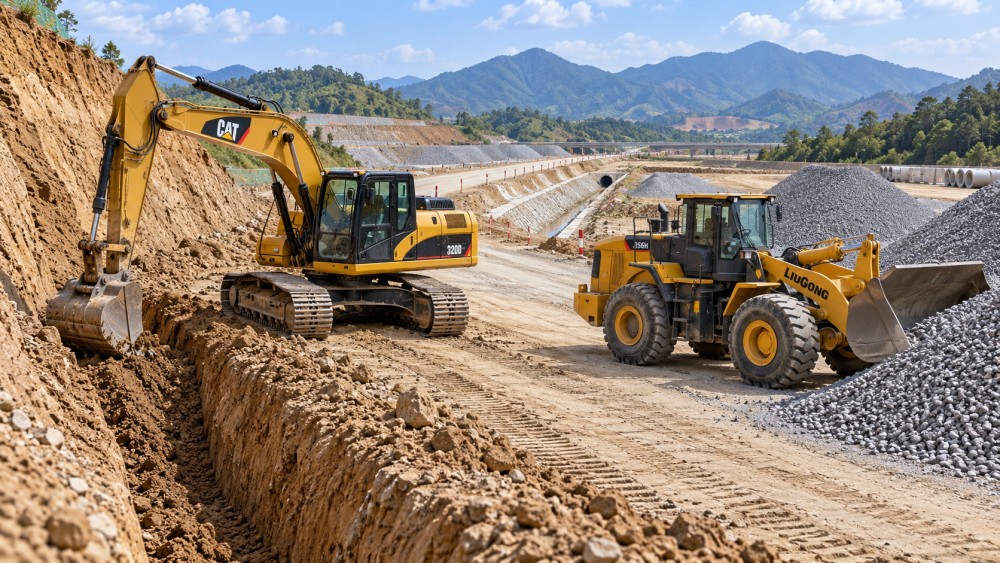
Compare the Systems That Control Real Productivity
Engine output remains relevant, but it is only one part of the productivity picture. On excavators, the useful question is how the hydraulic system responds when several functions are demanded at once. Can the operator boom down, stick in, curl the bucket, and swing smoothly without an obvious loss of control? Does the machine maintain fine control around utilities while still having sufficient hydraulic power for hard digging? Those behaviors are more revealing than a peak hydraulic-flow figure viewed in isolation.
For attachment-intensive work, auxiliary hydraulic circuits require the same scrutiny as the base machine. Breakers, compactors, mulchers, augers, grapples, tiltrotators, cold planers, and other tools have different flow, pressure, cooling, and return-line needs. It is worth confirming whether the quoted configuration supports the intended attachment continuously, rather than merely being able to connect it. A machine that needs frequent flow adjustment or thermal derating may create avoidable downtime in demanding applications.
Bulldozer assessment should focus on more than blade size and drawbar pull. Blade configuration, undercarriage type, transmission behavior, machine balance, and control response all influence pushing efficiency. Hydrostatic drivetrains can offer precise speed and direction control in finish work, while a particular heavy-push application may place greater emphasis on sustained traction and durability. The appropriate choice depends on material, haul distance, slope, and the required finish—not on a general claim that one drivetrain suits every site.
Motor graders require an even more application-specific view. If the project involves road formation, drainage shaping, base-course finishing, or airport work, the articulation range, moldboard control, front axle arrangement, visibility, and automation interface can materially affect quality. Precision grading systems can reduce repeated passes when their sensors, GNSS correction source, digital design files, and site workflow are properly managed. They are not a substitute for sound setup, competent operators, or verified control points.
A Comparison Matrix That Avoids Spec-Sheet Traps
Technical teams often need a structured way to compare alternatives without pretending that every criterion has equal weight. The matrix below is not a scoring formula by itself. It is a reminder to test each machine against the conditions that can change project performance or risk.
The matrix becomes more useful when the team records assumptions beside each rating. If a loader is expected to work in a stockpile, note the expected material condition and whether it will load trucks, feed a hopper, or simply rehandle material. If an excavator is compared for lifting, identify the radius, attachment, lift point, travel orientation, and whether a lifting mode or approved lifting arrangement is required. Generic ratings without these assumptions are difficult to defend later.
Emissions, Electrification, and Automation Need a Site Readiness Check
Non-road emissions requirements vary by market, project owner, and operating location. Engineers should verify the applicable requirements early, especially when equipment may be transferred across regions or used on publicly funded, urban, tunnel, port, or environmentally sensitive projects. The question is not simply whether an engine is described as compliant. It is whether the supplied configuration, fuel quality, service support, and operating duty cycle match the applicable local conditions.
Electric and hybrid equipment should be assessed with the same practical discipline. Duty cycle, charging windows, grid capacity, cable management, ambient temperature, and backup plans can determine whether an electric machine is a sensible choice. In enclosed or noise-sensitive work, its operational advantages may be compelling. On remote, high-utilization jobs without dependable charging infrastructure, the same machine may need a different deployment strategy. The technology decision should follow the energy plan, not lead it.
Automation and remote operation deserve similar caution. Grade-control systems, payload monitoring, telematics, collision-awareness functions, and remote-control architectures can improve decision-making and reduce exposure in hazardous areas. Yet their value depends on data quality, communications reliability, operator training, and clear site procedures. A hazardous mine or unstable demolition zone may justify robust low-latency remote-control planning; a small intermittent site may gain more from simple, reliable machine guidance and disciplined daily inspection.
Look at Lifecycle Cost Through Downtime and Utilization
Purchase price is visible; lost utilization is usually less visible until the project is underway. A proper lifecycle review should consider fuel or energy use, consumables, ground-engaging tools, tires or undercarriage wear, scheduled service intervals, diagnostics, attachment compatibility, transport requirements, and expected resale conditions. It should also account for the operational cost of a machine that is too large, too small, or too specialized for most of its assigned hours.
Serviceability is frequently underestimated during technical evaluation. Ask whether routine checks can be carried out safely at ground level, whether filters and cooling packs are accessible, whether technicians can retrieve fault information promptly, and whether the local support organization can respond with the parts that commonly matter for the machine’s intended application. A well-designed maintenance plan does not eliminate downtime, but it makes downtime more predictable.
For fleet decisions, commonality can be valuable. Standardizing selected attachments, control interfaces, operator practices, diagnostic tools, or consumables may simplify operations. That said, fleet commonality should not become an excuse to force one equipment class into work it is poorly suited to perform. The cost of a separate specialist machine can be justified when it removes a persistent bottleneck.
Use Technical Intelligence, Then Validate It in the Field
Industry intelligence is most valuable when it helps evaluators ask better questions. The Global Earth-Mover Dynamics perspective is useful here because it treats crawler excavators, wheel loaders, graders, bulldozers, and skid steers as parts of an evolving operating system rather than isolated products. Hydraulic breakout force, proportional control response, hydrostatic transmission behavior, 3D grading workflows, and remote-operation communications all matter—but only when tied back to the task sequence and project conditions.
The final comparison should therefore include a site-representative demonstration whenever practical. Observe the machine with the proposed attachment, operator, material, and loading or grading pattern. Check visibility at the work face, cab ergonomics over a realistic shift, ease of daily inspection, response under combined hydraulic demand, and the behavior of the control systems in the actual terrain. A short test will not answer every lifecycle question, but it often exposes assumptions that a specification table cannot.
The strongest equipment decision is rarely the one with the most impressive individual specification. It is the one whose limits are understood, whose support requirements are realistic, and whose configuration fits the work that will occur every day after the procurement meeting is forgotten.