
Related News
- 00
0000-00
What determines equipment durability on airport construction sites? - 00
0000-00
How terrain and dealer support shape machinery selection in Latin America - 00
0000-00
How market insight content analysis reveals shifts in equipment demand - 00
0000-00
When do OEM heavy machinery parts justify their higher cost? - 00
0000-00
What to compare among construction equipment manufacturers in North America
Heavy Machinery Parts That Fail Most and How to Prevent Downtime
When critical heavy machinery parts fail, the cost is measured in lost hours, missed deadlines, and rising repair bills.
Knowing what usually breaks first helps maintenance planning become faster, cleaner, and far more predictable.
Across excavators, loaders, graders, bulldozers, and skid steers, failure patterns are surprisingly consistent.
The same high-stress systems keep absorbing shock, contamination, heat, and poor lubrication.
This article breaks down the heavy machinery parts that fail most often and shows how to prevent avoidable downtime.
Why Certain Heavy Machinery Parts Fail Again and Again
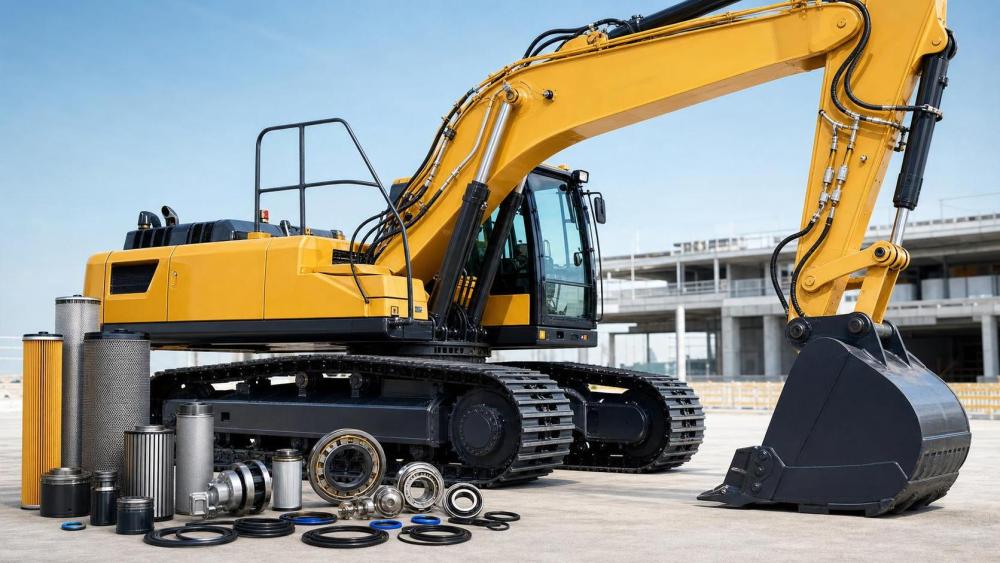
Most heavy machinery parts do not fail because of one dramatic event.
They usually fail because small issues stack up over weeks or months.
Contaminated oil, missed inspections, overloading, misalignment, and heat are the usual triggers.
In real jobsite conditions, dust, mud, vibration, and operator habits speed everything up.
That also means downtime prevention starts long before a machine stops moving.
The best teams treat failure-prone heavy machinery parts as monitored assets, not consumables to replace late.
The Heavy Machinery Parts That Fail Most Often
1. Hydraulic Hoses and Seals
Hydraulic hoses are among the most exposed heavy machinery parts on any machine.
They face pressure spikes, abrasion, bending, UV exposure, and constant vibration.
Seals fail when heat rises, fluid degrades, or contamination scratches sealing surfaces.
Early signs include sweating fittings, slow cylinder drift, pressure loss, and oily dust buildup.
- Inspect hose routing weekly and correct rubbing points immediately.
- Replace clamps and protective sleeves before outer layers wear through.
- Track hose age, not only visible condition.
- Use clean hydraulic oil and strict contamination control during service.
2. Undercarriage Components
For crawler equipment, the undercarriage contains some of the costliest heavy machinery parts.
Track chains, rollers, sprockets, idlers, and shoes wear fast in abrasive ground conditions.
Poor track tension is a common reason wear accelerates across the whole system.
A track that is too tight raises load and friction.
A track that is too loose increases impact, slippage, and derailment risk.
- Check track tension according to surface and climate conditions.
- Measure wear by component, not by rough visual judgment.
- Clean packed mud and debris before they harden around moving surfaces.
- Rotate machines when possible to balance wear patterns across fleets.
3. Filters
Filters look simple, but they protect many expensive heavy machinery parts at once.
Air, fuel, hydraulic, and engine oil filters all fail differently.
When service intervals are stretched too far, dirt reaches pumps, injectors, bearings, and turbochargers.
That single delay often creates a much larger repair later.
- Adjust filter intervals for dust load and duty cycle.
- Cut open used filters when troubleshooting repeat contamination.
- Do not mix low-grade filters with high-pressure hydraulic systems.
- Record differential pressure trends where monitoring is available.
4. Pins, Bushings, and Linkages
On excavators, loaders, and dozers, these heavy machinery parts absorb repeated shock loads.
Once grease pathways clog, metal-to-metal contact begins quickly.
The first clue is often looseness at the bucket, blade, or lift arm.
If ignored, bore damage follows and repair scope expands fast.
- Grease at the right interval for the actual working environment.
- Use purge observation to confirm grease reaches the correct point.
- Measure play before operators start compensating with harder impacts.
- Repair small bushing wear before structure damage develops.
5. Bearings and Rotating Assemblies
Bearings fail quietly at first, which makes them risky heavy machinery parts to ignore.
Wheel hubs, fan drives, alternators, pumps, and swing systems all depend on clean lubrication.
Water ingress, over-greasing, under-greasing, and misalignment are common causes of failure.
Noise, heat, and fine metallic debris are the warning signs to catch early.
6. Electrical Connectors, Sensors, and Wiring
Modern heavy machinery parts include far more sensors and control wiring than many teams expect.
A failed connector can mimic major hydraulic or engine faults.
Moisture, corrosion, rubbing, poor grounding, and vibration usually sit behind these faults.
Intermittent codes should never be dismissed as harmless glitches.
How to Prevent Downtime Before Failures Spread
Preventing downtime is less about one perfect inspection and more about disciplined routine.
The strongest approach combines condition checks, trend tracking, and parts planning.
Build a Failure Pattern List by Machine Type
Not all heavy machinery parts fail equally across all fleets.
Crawler excavators may burn through undercarriage and attachment linkage components.
Wheel loaders often show faster wear in pins, bushings, cooling systems, and axle-related parts.
A machine-specific history gives better results than generic schedules alone.
Watch for Small Symptoms
Most failure-prone heavy machinery parts give warnings before they break.
A warmer bearing, a slow hydraulic function, or a fresh rub mark matters.
These details are easy to miss during busy service windows.
They are also the cheapest moments to intervene.
Standardize Lubrication and Cleanliness
Many heavy machinery parts fail early because lubrication control looks good on paper, but not in practice.
Wrong grease, dirty containers, and inconsistent intervals create hidden damage.
The same is true for hydraulic oil handling and filter replacement discipline.
Use Simple Condition Monitoring
You do not always need complex systems to protect heavy machinery parts.
Oil sampling, infrared checks, pressure readings, and wear measurements already add strong value.
What matters is consistency and trend comparison over time.
Practical Inspection Priorities for High-Risk Heavy Machinery Parts
The easiest way to reduce downtime is to focus daily attention where failure risk is highest.
A Smarter Parts Strategy Reduces Repairs and Delays
Parts strategy matters just as much as wrench time.
When high-risk heavy machinery parts are not stocked, small failures become schedule-breaking events.
The best stock lists are built from failure history, lead time, and machine criticality.
For many fleets, that means keeping fast-moving hoses, seal kits, filters, pins, sensor connectors, and wear items ready.
This is especially important in remote sites, mines, and infrastructure projects with no easy resupply.
From a broader industry view, this is where intelligence platforms like EMD become useful.
Tracking equipment trends, component evolution, and operating risk helps service decisions stay proactive rather than reactive.
Final Takeaway
The heavy machinery parts that fail most are rarely a mystery.
Hydraulic hoses, seals, undercarriage components, filters, pins, bushings, bearings, and electrical items deserve the closest attention.
When inspections are short, consistent, and based on actual wear patterns, downtime drops noticeably.
Start with the parts that fail most, track the warning signs, and tighten the routines that prevent repeat breakdowns.
That is usually the fastest path to better machine availability, lower repair costs, and stronger service performance.