
Related News
- 00
0000-00
How an earthmoving equipment portal helps vet factory capabilities - 00
0000-00
How to assess equipment specifications against applicable standards - 00
0000-00
How Middle East climate conditions should shape heavy equipment selection - 00
0000-00
Can an industrial equipment sourcing supplier directory improve vendor selection? - 00
0000-00
How earthmoving equipment is applied in canal construction
Heavy machinery industry ROI delays usually start before the machine arrives
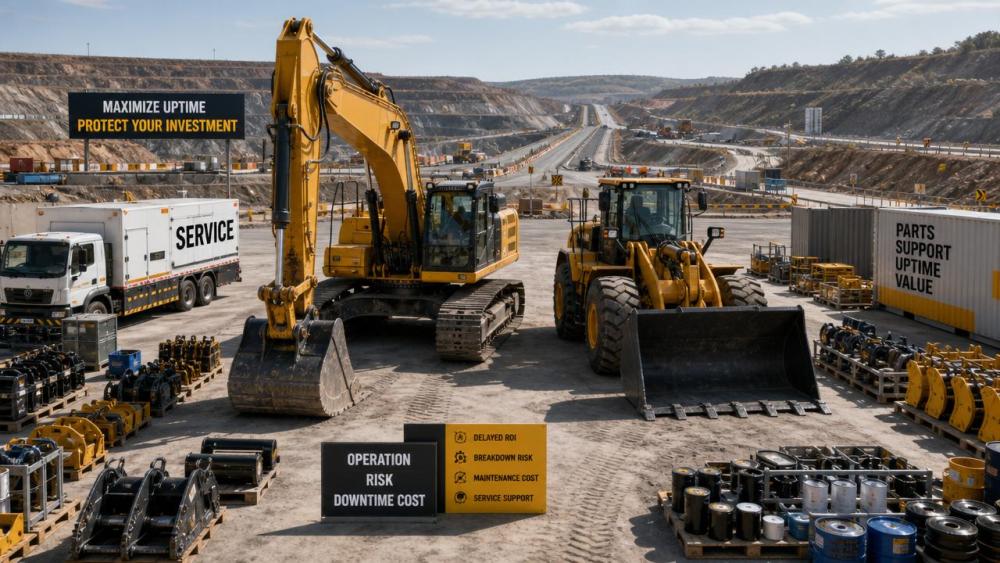
In the heavy machinery industry, return on investment slips for reasons that rarely appear on the first quotation sheet.
A lower purchase price can still lead to slower payback if utilization, service access, compliance, or operator readiness were estimated too optimistically.
That matters even more for crawler excavators, wheel loaders, motor graders, bulldozers, and skid steer loaders used in capital-heavy projects.
The more advanced the fleet becomes, the more ROI depends on fit, uptime, and data discipline rather than sticker price alone.
EMD tracks this shift closely through intelligence on hydraulic performance, grading precision, emissions rules, autonomy, and real-world asset utilization.
So the practical question is not only which machine costs less today, but which risk profile delays value tomorrow.
Is purchase price still the main ROI risk in the heavy machinery industry?
Usually, no. Price matters, but it is often the easiest cost to measure and the least likely to surprise later.
More disruptive costs appear after delivery. Idle time, attachments that are rarely used, slow parts supply, and weak resale value can stretch payback by quarters.
In practical terms, a machine with stronger dealer support may outperform a cheaper model with longer downtime exposure.
This is common in the heavy machinery industry when equipment is deployed across remote mines, roadwork corridors, or large infrastructure packages.
The hidden issue is timing. ROI assumptions often treat every operating month as equally productive, which is rarely true.
Early ramp-up delays are expensive because they hit revenue generation before the asset has stabilized.
A useful way to test the business case is to separate visible acquisition cost from exposure costs that emerge during year one.
This is where many heavy machinery industry decisions go off course. The wrong machine is not always underpowered; sometimes it is simply over-assumed.
What kinds of hidden downtime most often push equipment ROI off schedule?
The obvious answer is breakdowns, but hidden downtime is broader than mechanical failure.
Machines lose earning time during transport bottlenecks, attachment change delays, software calibration issues, operator handover gaps, and waiting periods for authorized service.
For motor graders and GPS-guided equipment, even sensor alignment delays can reduce productive hours at the worst project stage.
For excavators and bulldozers, hydraulic performance may remain within specification while cycle efficiency still drops because of jobsite conditions or poor matching.
In other words, technical availability and commercial availability are not the same thing.
A machine can be operable, yet still fail to generate the output assumed in the approval model.
A more reliable review asks three questions before purchase:
- How many days could be lost to commissioning, integration, and transport between sites?
- Which parts have long lead times, and are they local or imported?
- What jobsite dependencies must be ready before the machine can produce billable output?
EMD’s intelligence focus on fleet reliability, remote-control architecture, and electro-hydraulic response is useful here because downtime is increasingly a systems issue.
The heavy machinery industry now ties performance to sensors, software, training, and regulatory setup as much as steel and hydraulics.
Are utilization forecasts in the heavy machinery industry often too optimistic?
Quite often, yes. Forecasts tend to assume smooth deployment, stable operator coverage, and project sequencing that rarely survives the field.
This happens when projected hours are copied from ideal production cases rather than site-specific operating realities.
A skid steer loader in urban infrastructure, for example, may look versatile on paper but spend more time waiting for space access than expected.
A wheel loader may be sized correctly for peak throughput, yet remain oversized during most of the project cycle.
The better approach is to model utilization in layers instead of one annual number.
- Base-case hours under normal site constraints
- Ramp-up hours during the first 90 to 180 days
- Weather, permit, or logistics disruption exposure
- Redeployment probability after the initial contract
This layered view is especially important in the heavy machinery industry because many assets are approved for one project but justified by a longer fleet strategy.
If secondary deployment is weak, the ROI model becomes fragile.
That is why EMD’s coverage of urbanization demand, mine applications, and precision grading trends matters beyond engineering interest. It sharpens redeployment judgment.
How do maintenance overruns and compliance shifts change the real cost picture?
They change it faster than many approval models expect.
Maintenance overruns are not limited to major repairs. Filters, undercarriage wear, tires, cutting edges, telematics subscriptions, fluids, and technician travel can quietly widen total ownership cost.
For crawler machines and bulldozers, undercarriage economics alone can materially reshape ROI timing when terrain assumptions prove wrong.
Compliance risk is also becoming more immediate across the heavy machinery industry.
Non-road emissions rules, low-emission zones, mine safety communication standards, and reporting obligations can all affect usable life and permitted locations.
A machine that meets today’s need may become costly if the region tightens standards before the expected payback window closes.
That is one reason EMD emphasizes decarbonization, extreme reliability, and autonomy trends rather than only model launches.
The strategic value lies in seeing whether an asset will remain productive, compliant, and redeployable across changing market conditions.
A quick decision check before approval
When does advanced technology improve ROI, and when does it delay it?
Technology improves ROI when it removes a measurable bottleneck.
That could mean grade control reducing rework, telematics improving preventive maintenance timing, or remote-control capability expanding safe operating windows.
It delays ROI when premium features are acquired without matching workflows, trained operators, or digital reporting discipline.
This pattern is increasingly visible in the heavy machinery industry as autonomy, electrification, and precision systems move from pilot status to commercial procurement.
A motor grader with advanced 3D control can transform output on a data-ready road project.
The same machine may underdeliver if site files are inconsistent, crews are untrained, or field calibration support is limited.
A grounded test is to ask whether the feature shortens cycle time, reduces labor dependency, lowers rework, or protects compliance in a way that can be audited.
If the answer stays abstract, the ROI case is probably too soft.
What is the best next step before committing capital?
Start with a risk-adjusted ROI sheet, not a price comparison sheet.
That means testing the equipment against uptime exposure, realistic utilization, maintenance intensity, compliance horizon, and redeployment options.
In the heavy machinery industry, the strongest decisions usually come from linking technical fit with commercial resilience.
It helps to compare at least three scenarios: expected case, delayed ramp-up case, and constrained utilization case.
Then review whether each machine category still works under those conditions.
- Check service reach before checking optional features.
- Validate operating hours with project sequencing, not just annual targets.
- Review emissions and site rules across the full payback window.
- Confirm whether digital functions will actually be used and measured.
- Use sector intelligence to test resale and redeployment assumptions.
That is where informed market reading becomes practical. EMD’s coverage across excavators, loaders, graders, bulldozers, and skid steers can support a more durable approval logic.
The goal is simple: reduce surprise costs early so equipment ROI arrives when the business case says it should.