
Related News
- 00
0000-00
How to size heavy-duty loaders for North American mining operations - 00
0000-00
How altitude affects mining excavator performance in Latin America - 00
0000-00
Caterpillar Launches New Cat 6060 and Upgraded Autonomous Mining System - 00
0000-00
When does eco-friendly construction equipment pay for itself? - 00
0000-00
Will a wheel loader quick coupler fit your existing attachments?
Why earthmoving machinery sourcing gets judged in the field, not on paper
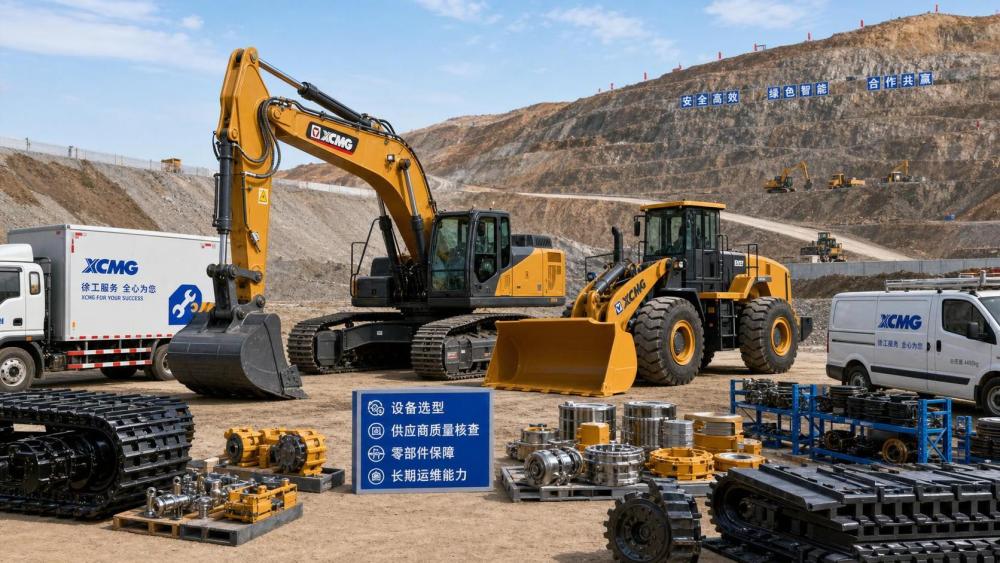
Earthmoving machinery sourcing looks straightforward until machines meet real ground conditions, permit rules, and uptime targets.
A crawler excavator for quarry stripping faces different pressure than a skid steer loader working inside dense urban redevelopment.
That difference changes what should be checked first.
In practice, the most expensive sourcing mistakes rarely come from headline horsepower or bucket capacity.
They come from unstable supplier quality, slow parts support, weak emissions documentation, or control systems that do not match the jobsite.
For a platform such as EMD, which tracks excavators, loaders, graders, bulldozers, and compact equipment across global infrastructure cycles, this is where sourcing risk becomes operational risk.
The current market adds more complexity.
Decarbonization rules, electro-hydraulic controls, remote diagnostics, and autonomous functions all raise the importance of supplier checks.
Earthmoving machinery sourcing now requires a broader view: machine fit, supplier resilience, and long-term serviceability.
Different jobs create different supplier risks
The same sourcing method does not work across every machine category.
A highway grading program values calibration stability and positioning accuracy.
A mine loading fleet cares more about structural durability, thermal management, and fast component replacement.
This is why earthmoving machinery sourcing should begin with operating context, not catalog comparison.
EMD’s industry lens is useful here because it follows both machine mechanics and infrastructure demand shifts.
That matters when sourcing decisions must account for emissions upgrades, telematics compatibility, and future fleet standardization.
The pattern is clear.
Different applications change both machine requirements and supplier evaluation logic.
On heavy excavation and pushing jobs, production consistency matters more than headline specs
For crawler excavators and bulldozers, spec sheets often hide the real sourcing risk.
Two machines may show similar breakout force, operating weight, or blade capacity.
Field performance can still diverge sharply because of hose quality, valve response, weld control, and undercarriage sourcing.
On dam, port, and overburden projects, downtime compounds quickly.
A supplier with weak batch consistency creates hidden exposure even when the prototype unit tests well.
A more useful check is to compare serial production records, failure trends, and supplier control over hydraulic components.
Where outsourced assemblies dominate, ask how incoming parts are validated and how design changes are tracked.
This matters even more when electro-hydraulic systems are involved.
Response smoothness, pump efficiency, and software logic can shift fuel burn and cycle times more than nominal engine output.
What to verify before committing
- Whether key hydraulic pumps, valves, and seals stay consistent across production lots.
- How undercarriage wear is documented under abrasive soil, rock, or mixed terrain.
- Whether the supplier offers root-cause reporting instead of simple warranty replacement.
- How fast field service can reach remote projects where stoppages are expensive.
In grading and precision work, software readiness can outweigh mechanical similarity
Motor graders introduce a different earthmoving machinery sourcing challenge.
Mechanical strength still matters, but precision work depends on control accuracy, sensor reliability, and interface stability.
On airport pavements or high-spec road projects, a grading error becomes a schedule problem, not just a finish issue.
This is where many sourcing reviews stay too mechanical.
They compare moldboard dimensions and engine ratings, yet overlook GNSS support, software update policy, and local calibration capability.
EMD’s attention to 3D spatial algorithms reflects a practical shift in the market.
The supplier is no longer judged only by iron and hydraulics.
The supplier is also judged by digital reliability.
In this setting, a useful check is whether machine controls integrate cleanly with existing site workflows.
If guidance systems, correction signals, or operator training depend on third parties, clarify accountability before the order is placed.
For loaders and compact equipment, parts depth often decides lifetime value
Wheel loaders and skid steer loaders are often sourced into high-cycle environments.
That changes the economics of risk.
A modest price advantage disappears quickly if wear parts, quick couplers, or hydraulic attachments become difficult to source.
Urban projects create one type of pressure.
Space limits, noise rules, and low-emission zones make compact dimensions and compliance documents essential.
Mining support and bulk handling create another.
There, cooling systems, bucket pin life, and drivetrain service intervals carry more weight.
A practical earthmoving machinery sourcing review should test the supplier’s spare parts structure, not just inventory claims.
Ask which parts are regionally stocked, which remain factory-order items, and which assemblies require software coding after replacement.
That last point matters more as compact equipment gains smart controls and attachment management systems.
The checks that separate a usable supplier from a risky one
Across machine types, several supplier checks repeatedly prove decisive.
They deserve more weight than polished brochures or trade show visibility.
- Compliance depth: emissions files, safety certification, and export paperwork should match the target market exactly.
- Production traceability: serial tracking, revision control, and supplier audit records show whether quality is managed or assumed.
- After-sales structure: local technicians, remote diagnostics, and escalation paths matter more than warranty duration alone.
- Parts resilience: confirm stocking policy for fast-moving wear items and high-value hydraulic or electronic modules.
- Technology support: autonomous functions, telematics, and control software need a defined update and troubleshooting process.
In earthmoving machinery sourcing, these checks help distinguish a supplier that can sustain operations from one that only wins the tender.
Where sourcing decisions are often misread
One common mistake is treating similar jobs as identical.
A crawler excavator for utility trenching and one for rock excavation may look close in size, yet need different protection, control tuning, and attachment support.
Another is focusing on purchase price while ignoring commissioning time.
This becomes costly when software activation, operator familiarization, or hydraulic setup delays fleet entry.
A third misread is assuming regulatory compliance is static.
Non-road emissions rules, safety requirements, and digital reporting obligations are moving targets in many regions.
EMD’s focus on decarbonization and autonomy is relevant here because future readiness affects current sourcing value.
A machine that meets today’s price target but lacks upgrade pathways may shorten its useful commercial window.
A practical way to reduce uncertainty before the order is placed
A stronger earthmoving machinery sourcing process starts by grouping equipment needs by actual operating conditions.
Separate heavy excavation, bulk loading, precision grading, and compact urban work before comparing suppliers.
Then define which failures would hurt most in each case.
For one fleet, that may be undercarriage wear.
For another, it may be software downtime or attachment incompatibility.
From there, supplier checks become more useful and more defensible.
Review factory quality records, ask for application-specific references, verify compliance documents line by line, and map service response against project geography.
Where intelligent controls are involved, confirm update support and data compatibility before relying on future automation claims.
That approach fits the way global infrastructure equipment is evolving.
It also aligns with the broader view EMD brings to the sector: performance, reliability, and strategic fit should be judged together.
The next useful step is to build a sourcing checklist around site conditions, service reach, compliance exposure, and component traceability.
That is usually where better equipment decisions begin.