
Related News
- 00
0000-00
How terrain and dealer support shape machinery selection in Latin America - 00
0000-00
How market insight content analysis reveals shifts in equipment demand - 00
0000-00
When do OEM heavy machinery parts justify their higher cost? - 00
0000-00
What to compare among construction equipment manufacturers in North America - 00
0000-00
How a supplier solution database reduces sourcing risk
Construction machinery components: which parts really drive repair costs higher?
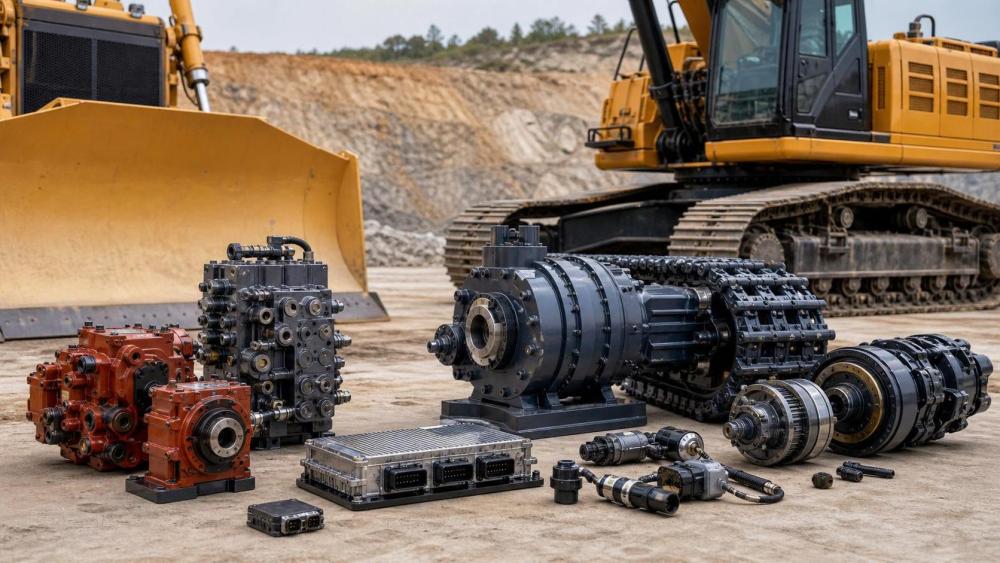
Repair budgets rarely fail because of one dramatic breakdown. More often, costs rise through a few construction machinery components that wear fast, fail expensively, or trigger long downtime.
That matters across crawler excavators, wheel loaders, motor graders, bulldozers, and skid steer loaders, where uptime is tied directly to project margins and delivery schedules.
A useful way to judge cost is not only part price. It is part price, labor intensity, machine stoppage, and the risk of secondary damage.
EMD often tracks this pattern across heavy earthmoving fleets. High breakout force, tighter tolerances, smarter controls, and harsher duty cycles all make some components far more influential than others.
So which parts deserve the closest attention when comparing suppliers and total lifecycle cost? The answer usually starts with systems, not single bolts.
Why do hydraulic components so often become the biggest repair-cost driver?
In most heavy equipment, hydraulic components combine pressure, heat, contamination sensitivity, and precision control. That alone makes them some of the costliest construction machinery components to ignore.
A failed pump is expensive. A contaminated hydraulic circuit is worse, because the repair can spread to valves, cylinders, hoses, seals, and filtration hardware.
Crawler excavators show this clearly. Their productivity depends on stable flow, fast response, and controlled breakout force. When electro-hydraulic balance drifts, performance drops before failure becomes obvious.
The same pattern appears in bulldozers with full-hydraulic systems and in skid steers using multiple attachments. Attachments often change flow demand, which stresses pumps and valves in unpredictable ways.
In practical sourcing, the real question is not whether hydraulic parts are costly. It is whether the supplier can prove cleanliness control, seal quality, pressure stability, and field support.
- Ask for contamination tolerance data and filtration recommendations.
- Check whether pumps and valves are matched to the machine duty profile.
- Confirm seal materials for heat, dust, and fluid compatibility.
- Review rebuild options, not only full replacement pricing.
When these checks are skipped, hydraulic construction machinery components often turn a manageable maintenance event into a long and expensive shutdown.
Is the undercarriage still the fastest way for repair costs to escalate?
For tracked equipment, usually yes. Undercarriage parts may not look as complex as smart controls, yet they consume budget with remarkable speed in abrasive conditions.
Track chains, rollers, idlers, sprockets, shoes, and tensioning elements wear together. Replacing one item too late often shortens the life of the rest.
Bulldozers face heavy pushing loads and constant shock. Excavators encounter mixed terrain, rotation stress, and travel wear that many buyers underestimate during initial comparison.
The cost problem is simple. Undercarriage damage is frequent, visible, and cumulative. It also affects fuel efficiency, stability, travel speed, and operator control.
More common than dramatic breakage is uneven wear caused by poor track tension, mismatched metallurgy, or low-grade hardening processes.
That is why price-per-piece is a weak buying metric. A lower purchase price can still produce a higher cost per operating hour.
This kind of comparison gives a better picture of repair exposure than catalog pricing alone.
How much risk now sits in sensors, controllers, and other electronic construction machinery components?
More than many fleets expected a few years ago. Electronic construction machinery components have moved from convenience features to mission-critical systems.
Motor graders rely on GPS, laser, and positioning inputs for fine grading accuracy. Remote-ready equipment in mines depends on low-latency communication and stable control logic.
When one sensor drifts, the machine may still run, but not correctly. That creates rework, slower cycles, and misdiagnosed part replacement.
Electronic failures also behave differently from mechanical wear. The damaged part may be inexpensive, but troubleshooting time becomes the real cost center.
EMD’s coverage of autonomy and precision systems shows a clear shift. Software support, wiring integrity, sealed connectors, and calibration tools now influence ownership cost almost as much as hardware quality.
Before approving these construction machinery components, it helps to ask a few grounded questions.
- Can fault codes be accessed without a proprietary bottleneck?
- Is firmware support guaranteed across multiple service years?
- Are sensors protected against vibration, moisture, and dust ingress?
- Can local technicians calibrate the system after replacement?
If the answer is unclear, future repair costs are also unclear. That uncertainty alone should affect supplier scoring.
Which “small” parts quietly create large repair bills later?
Not every costly failure begins with a major assembly. Pins, bushings, seals, hoses, bearings, harnesses, and couplings often start the chain.
These construction machinery components are sometimes treated like routine consumables. In reality, their quality determines whether larger systems stay aligned, lubricated, and protected.
Take excavator linkage points. If pin and bushing tolerances drift too far, bucket geometry changes, impact loads rise, and surrounding structures wear faster.
Or consider a loader hose assembly. A weak outer layer may survive normal inspection but fail under repeated flexing and contamination exposure.
The smarter judgment is to rank these parts by consequence, not by size. A low-cost item with high failure impact deserves stricter qualification than a cheap spare would suggest.
A practical review list usually includes:
- Seal life under temperature swings and dirty environments.
- Hose routing, bend radius, and abrasion protection.
- Bushing hardness and lubrication channel design.
- Connector retention and harness shielding quality.
Many repeat repairs come from overlooking these details during sourcing, then paying for them many times in the field.
What is the most reliable way to compare suppliers beyond part price?
The strongest comparison method links construction machinery components to operating hours, environment, and service support. Unit price belongs in the review, but never as the only anchor.
For example, a grader control sensor and a bulldozer track roller fail for different reasons. They should not be judged by the same spreadsheet logic.
In actual evaluations, a balanced scorecard works better than a single discount figure.
This is also where industry intelligence becomes useful. EMD’s focus on emissions upgrades, autonomy, and machine-system evolution highlights which suppliers are ready for next-cycle service demands, not only today’s spare parts orders.
What mistakes most often make repair costs climb after the order is placed?
A frequent mistake is buying construction machinery components as isolated items instead of part of a machine ecosystem. That works poorly in modern equipment.
Another mistake is accepting generic compatibility claims without checking workload, environment, and interface tolerance. A part may fit physically but still shorten system life.
There is also a planning issue. Some fleets budget for the part itself, but not for calibration, contamination cleanup, seal kits, or surrounding wear items.
More advanced equipment adds one extra trap. If software access, diagnostic rights, or firmware continuity are vague at purchase stage, future repairs become slower and more expensive.
A steadier approach is to define a shortlist of high-risk construction machinery components, then assign each one a review standard covering wear data, root-cause exposure, and repair dependency.
That creates better visibility before equipment enters the field, especially in operations where uptime is more valuable than a narrow initial discount.
Where should the next review begin?
Start with the components that combine three traits: frequent wear, expensive labor, and the ability to damage adjacent systems. In many fleets, that points first to hydraulics, undercarriage systems, and electronic controls.
Then compare suppliers using operating-hour cost, serviceability, and support depth, not just invoice price. That produces a much sharper view of total repair exposure.
It also helps to track how machine design is changing. As earthmoving equipment becomes more precise, connected, and lower-emission, construction machinery components become more interdependent.
A useful next step is to map the top ten repair-cost parts across each machine class, validate field failure patterns, and build a sourcing standard around evidence rather than assumptions.
That kind of disciplined review does not eliminate breakdowns. It does make them easier to predict, control, and price before they disrupt the jobsite.