
Related News
- 00
0000-00
How to size heavy-duty loaders for North American mining operations - 00
0000-00
How altitude affects mining excavator performance in Latin America - 00
0000-00
Caterpillar Launches New Cat 6060 and Upgraded Autonomous Mining System - 00
0000-00
When does eco-friendly construction equipment pay for itself? - 00
0000-00
Will a wheel loader quick coupler fit your existing attachments?
On May 24, 2026, new data released by the China Construction Machinery Association revealed a sharp rise in export performance of Chinese-made electric excavators — driven by tightening global emissions regulations, accelerated green infrastructure programs, and evolving procurement criteria in key markets.
Export Performance Confirmed by Official Data
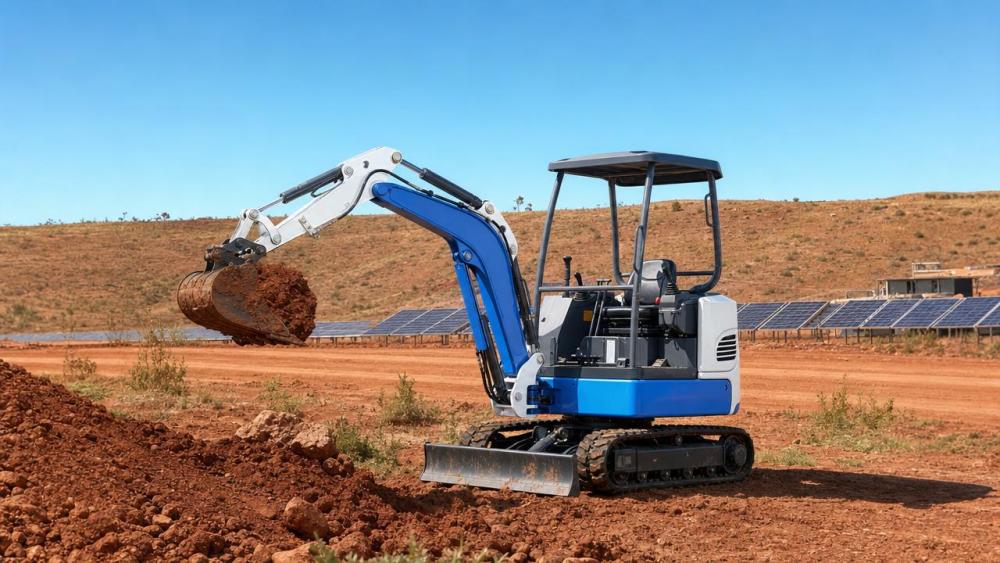
According to the China Construction Machinery Association, Chinese electric excavator exports reached USD 214 million from January to April 2026 — a year-on-year increase of 63.2%. Growth was primarily fueled by three major overseas projects: Australia’s mining equipment modernization initiative, Germany’s municipal underground utility network renewal program, and Brazil’s national green infrastructure investment plan. Compact and mini electric excavators (1–3 ton class) accounted for 58% of total export value, underscoring a pronounced market preference for zero-emission, maneuverable machinery in space-constrained or environmentally sensitive worksites.
Impact Across Supply Chain Roles
Export-oriented manufacturing enterprises
These firms face intensified pressure to scale production of compact electric models while maintaining compliance with regional safety, electromagnetic compatibility (EMC), and battery certification requirements (e.g., UN 38.3, IEC 62133). Delivery timelines and order fulfillment capacity are now closely tied to battery cell sourcing stability and local homologation lead times.
Raw material and component suppliers
Suppliers of lithium-ion battery cells, high-efficiency motors, and regenerative braking systems are seeing rising demand — but also stricter traceability and sustainability documentation requirements, especially under EU Battery Regulation (Regulation (EU) 2023/1542) and upcoming Brazilian green procurement guidelines.
Contract manufacturers and OEMs
Manufacturers must adapt production lines for modular electric platforms and ensure technical documentation aligns with tender specifications in target markets — particularly regarding operating conditions (e.g., dust resistance IP65+, thermal management in tropical climates), noise limits (
Logistics and compliance service providers
Third-party conformity assessment bodies, customs brokers, and certification support agencies report increased inquiries related to CE marking (for EU), RCM marking (for Australia), and INMETRO certification (for Brazil), especially for sub-3-ton electric units where classification thresholds for regulatory scrutiny are narrower.
Key Operational Priorities for Exporters
Accelerated alignment with regional EV equipment certification frameworks
Given the dominant share of compact models in export growth, exporters must prioritize verification against application-specific standards — including EN 474-1:2020+A1:2023 (earth-moving machinery safety), EN 61000-6-3 (EMC emission limits), and country-level battery labeling and end-of-life take-back obligations.
Supply chain readiness for high-voltage component sourcing
Procurement teams should audit supplier qualifications for battery management systems (BMS), insulated gate bipolar transistors (IGBTs), and liquid-cooled motor housings — with emphasis on documented lifecycle validation reports and ISO 16750-4 (electrical load dump) test compliance.
Technical bid responsiveness for infrastructure tenders
As demand stems largely from publicly funded projects (e.g., German municipal upgrades, Brazilian federal green bonds), bidders must pre-validate technical specifications against tender annexes — especially clauses covering battery cycle life (>3,000 cycles at 80% DoD), charging interface compatibility (CCS2 or GB/T 20234.3), and cybersecurity provisions for telematics modules.
Industry Observation: Structural Shift Beyond Volume Growth
Analysis shows this export surge reflects more than cyclical demand — it signals a structural recalibration in global procurement logic. Observably, public-sector infrastructure tenders increasingly embed zero-emission equipment as a mandatory requirement, not just a scoring bonus. It is more appropriate to understand this as a de facto policy-driven market segmentation: compact electric excavators are becoming the default choice for urban, indoor, and ecologically protected sites — where acoustic, air quality, and spatial constraints override traditional cost-per-hour calculations. What deserves closer attention is how rapidly certification pathways are converging across jurisdictions — suggesting future harmonization may reduce duplication, but also raise baseline technical thresholds uniformly.
Toward Sustainable Export Capacity
This growth trajectory underscores a broader industry transition: from exporting diesel-powered machinery as commodities to delivering integrated, regulation-aware electromechanical solutions. Success will depend less on raw production volume and more on responsive compliance engineering, cross-border technical documentation agility, and proactive engagement with evolving green public procurement rules. The trend does not guarantee sustained expansion — but it does confirm that regulatory alignment has become a core operational capability, not a peripheral administrative task.
Source Transparency and Monitoring Guidance
This article synthesizes only the information provided in the user input — including the headline, event date (May 24, 2026), and summary statement from the China Construction Machinery Association. Specific official source links were not provided in the input and should be verified continuously. Stakeholders are advised to monitor upcoming updates to EU Delegated Act on Green Public Procurement criteria, Australia’s Clean Energy Finance Corporation (CEFC) equipment eligibility guidelines, and Brazil’s National Infrastructure Investment Program (PNI) technical annex revisions — all of which may further define testing protocols, warranty expectations, and local after-sales service obligations for electric construction equipment.