
Related News
- 00
0000-00
How to size heavy-duty loaders for North American mining operations - 00
0000-00
How altitude affects mining excavator performance in Latin America - 00
0000-00
Caterpillar Launches New Cat 6060 and Upgraded Autonomous Mining System - 00
0000-00
When does eco-friendly construction equipment pay for itself? - 00
0000-00
Will a wheel loader quick coupler fit your existing attachments?
Tags
Caterpillar reported a 38% year-on-year increase in machinery revenue for Q1 2026 — its strongest quarterly growth in a decade — signaling broad-based acceleration in global infrastructure investment. Released on April 26, 2026, the results highlight robust end-market demand across three key regions: Middle Eastern energy infrastructure, African copper mining developments, and Southeast Asia’s new capital city construction. This trend carries direct implications for manufacturers, exporters, and service providers of compact excavators, wheeled skid steers, and hydrostatic dozers — particularly those with localized financing solutions and certified pre-owned equipment support.
Event Overview
On April 26, 2026, Caterpillar Inc. published its first-quarter 2026 financial report. The company confirmed that machinery segment revenue rose 38% year-on-year — the highest such growth rate in ten years. The report explicitly attributed this increase to heightened activity in three geographic areas: energy-related infrastructure projects in the Middle East; copper mine development in Africa; and new capital city construction in Southeast Asia.
Industries Affected
Export-Oriented Machinery Manufacturers
These companies supply compact excavators, wheeled skid steers, and hydrostatic dozers — product categories cited in Caterpillar’s report as experiencing strong terminal demand in the three highlighted regions. The surge reflects not just volume growth but also rising buyer expectations around after-sales support and financing accessibility.
Distribution & Channel Partners Operating in Target Markets
Regional distributors and dealers serving the Middle East, Africa, and Southeast Asia are seeing intensified procurement activity and extended lead-time requests. Demand is shifting toward bundled offerings — equipment plus local credit terms or trade-in programs — rather than standalone unit sales.
Aftermarket & Certified Pre-Owned Equipment Providers
The report notes that ‘second-hand equipment assurance’ is a stated competitive advantage for certain suppliers in these markets. This implies growing buyer sensitivity to total cost of ownership and lifecycle risk — elevating the strategic relevance of refurbishment standards, warranty portability, and residual value transparency.
Logistics & Cross-Border Financing Service Providers
Increased shipment volumes to infrastructure-heavy regions are placing pressure on inland transport coordination, customs documentation accuracy, and working capital instruments. Localized financing capabilities — especially those integrated with equipment delivery timelines — are becoming a functional differentiator, not just a commercial add-on.
What Relevant Companies or Practitioners Should Monitor and Do
Track official regional project updates and tender timelines
Infrastructure momentum remains highly project-specific. Stakeholders should monitor government-issued tender notices, environmental impact approvals, and sovereign funding disbursement schedules — particularly for the new capital city in Southeast Asia and major copper corridor initiatives in Africa.
Validate demand signals against actual equipment deployment data
While Caterpillar’s revenue growth is confirmed, it reflects order intake and revenue recognition — not necessarily field-level machine utilization. Companies should cross-reference with port import statistics, fuel consumption trends at mining sites, or satellite-derived construction site activity where available.
Assess readiness for localized financial and service integration
Given the emphasis on local financing and second-hand equipment assurance, firms should review internal capabilities in credit underwriting partnerships, certified refurbishment protocols, and multilingual service contract administration — especially in Arabic-, French-, and Bahasa-speaking markets.
Review supply chain buffers for high-demand configurations
Compact and mini excavator models with enhanced hydraulic breakout force, low-ground-pressure tracks, and operator comfort features are disproportionately represented in recent project specifications. Proactive allocation of component inventory and assembly capacity for these variants is advisable.
Editorial Perspective / Industry Observation
Observably, this result functions less as an isolated earnings milestone and more as a macroeconomic confirmation signal — one that aligns with parallel indicators such as rising global cement production indices and elevated commodity-linked freight rates. Analysis shows the growth is geographically concentrated and functionally specific: it reflects capital expenditure timing in resource-backed infrastructure, not broad-based industrial recovery. From an industry perspective, the current strength appears sustainable only so long as sovereign funding commitments remain intact and permitting timelines hold — both of which warrant ongoing monitoring. It is better understood as a directional indicator of near-term regional opportunity, not yet a structural shift in global equipment demand patterns.
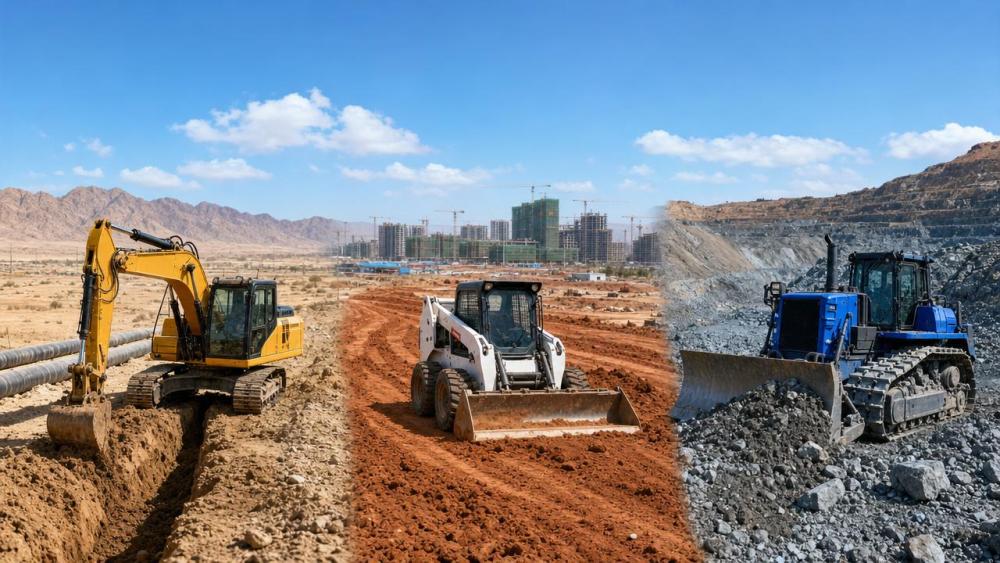
Conclusion: Caterpillar’s Q1 2026 machinery revenue growth confirms tangible acceleration in select infrastructure corridors — but does not imply uniform expansion across all equipment segments or geographies. For stakeholders, the primary value lies in validating market entry assumptions, refining regional go-to-market models, and calibrating operational readiness against verified project pipelines — rather than extrapolating broad sectoral optimism. At present, this development is best interpreted as a high-signal, regionally bounded inflection point requiring targeted response, not generalized scaling.
Source: Caterpillar Inc. Q1 2026 Earnings Report (released April 26, 2026).
Note: Ongoing observation is recommended for project-level implementation progress in the three cited regions — particularly regarding sovereign financing execution and equipment import clearance efficiency.