Related News
- 00
0000-00
How to size heavy-duty loaders for North American mining operations - 00
0000-00
How altitude affects mining excavator performance in Latin America - 00
0000-00
Caterpillar Launches New Cat 6060 and Upgraded Autonomous Mining System - 00
0000-00
When does eco-friendly construction equipment pay for itself? - 00
0000-00
Will a wheel loader quick coupler fit your existing attachments?
On May 24, 2026 at 15:08 JST, a magnitude 4.0 earthquake struck offshore Ibaraki Prefecture, Japan. Though minor in scale and without reported casualties or structural damage, the event triggered a Port State Control (PSC) Level 2 response at Tokyo Port—directly impacting export clearance timelines for construction and earthmoving machinery destined for Southeast Asia and Oceania.
Event Overview
At 15:08 JST on May 24, 2026, a magnitude 4.0 earthquake occurred off the coast of Ibaraki Prefecture, with a focal depth of 50 km and a maximum seismic intensity of Shindo 3. Tokyo Port has activated its PSC Level 2 protocol, mandating enhanced documentary verification and random container inspections for imported heavy machinery units and large hydraulic components. Export clearance delays of 2–3 working days are expected between May 27 and May 30, 2026.
Industries Affected
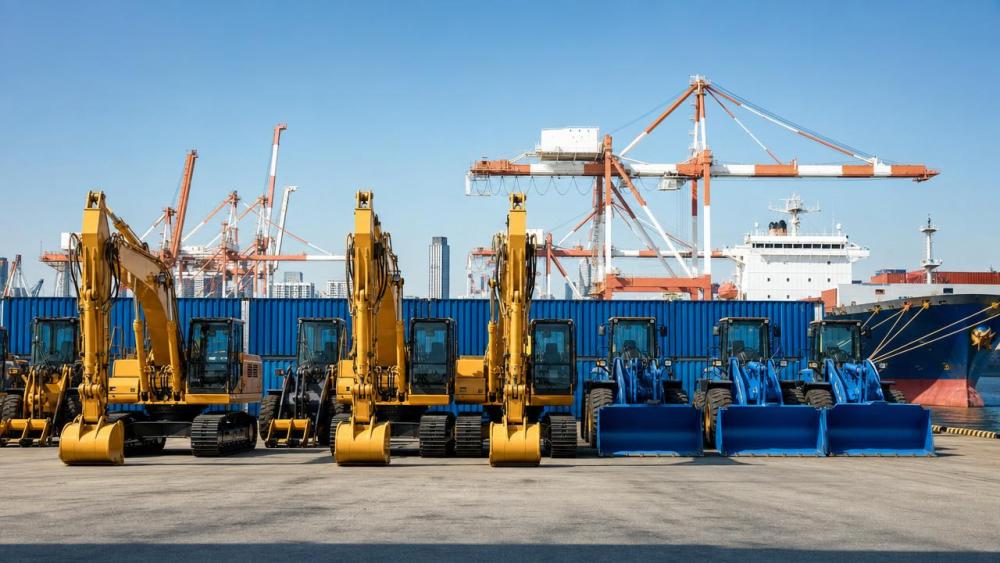
Direct trading enterprises: Exporters and importers handling complete machinery units (e.g., excavators, wheel loaders) through Tokyo Port face extended customs release cycles. Delayed documentation processing and physical inspection queues directly affect shipment scheduling, contract fulfillment deadlines, and demurrage exposure—particularly for time-bound project deliveries in ASEAN infrastructure contracts.
Raw material procurement enterprises: Firms sourcing high-precision hydraulic valves, control modules, or cast structural parts from Japanese Tier-2 suppliers may experience upstream delivery slippage—not due to production disruption, but because component shipments bound for assembly plants abroad are now routed through Tokyo Port’s tightened clearance workflow. This introduces unpredictability into just-in-time procurement planning.
Manufacturing enterprises: Japanese OEMs and joint-venture assemblers exporting finished machines (especially those with integrated hydraulic systems) face cascading timing pressure. While factory output remains unaffected, post-assembly logistics bottlenecks at Tokyo Port compress buffer time for quality rework, final commissioning, or certification document corrections prior to dispatch.
Supply chain service enterprises: Freight forwarders, customs brokers, and port logistics providers must reallocate staff to support intensified documentation audits and coordinate contingency plans—including rerouting consignments to alternative gateways. Their operational flexibility is tested not by capacity shortage, but by sudden procedural complexity and inter-agency coordination overhead.
Key Considerations and Recommended Actions
Adjust vessel booking windows immediately
Procurement teams in Southeast Asia and Oceania should extend lead-time buffers by at least five calendar days for orders scheduled to clear Tokyo Port between May 27–30. Confirm with carriers whether pre-arrival documentation submission can be accelerated to offset dockside verification lag.
Activate secondary port options proactively
Shippers are advised to initiate pre-clearance procedures at Kobe and Osaka ports—both operating under standard PSC protocols—as alternate entry points. Note that inland transport lead times from these ports to major distribution hubs (e.g., Nagoya or Yokohama rail yards) require recalibration; consult local logistics partners before switching.
Verify hydraulic component traceability documentation
Random inspections target large hydraulic attachments (e.g., swing motors, main control valves). Ensure all CE/ISO compliance certificates, serial-number-matched test reports, and origin declarations are digitally pre-submitted and cross-referenced with packing lists—reducing risk of hold-ups during physical checks.
Editorial Perspective / Industry Observation
Analysis shows that this incident underscores how low-magnitude seismic events—historically treated as operationally negligible—can exert outsized influence on global equipment supply chains when they intersect with high-compliance, high-value cargo categories. Observably, Tokyo Port’s PSC Level 2 activation reflects an institutional shift toward anticipatory risk governance rather than reactive response. From an industry perspective, this is less about infrastructure vulnerability and more about regulatory posture: the tightening of verification standards for safety-critical components signals growing alignment with EU Machinery Regulation (EU 2023/1230) enforcement trends—even in non-EU jurisdictions. Current more relevant interpretation is that such protocols are becoming de facto benchmarks for cross-border trade in industrial capital goods, regardless of destination market.
Conclusion
This episode does not indicate systemic port instability, but rather highlights the increasing sensitivity of global machinery logistics to procedural rigor—not physical disruption. For international buyers and distributors, resilience now depends less on geographic diversification alone and more on procedural agility: real-time customs intelligence, modular documentation architecture, and pre-vetted multi-port routing options. A measured, data-informed response—not overreaction—is the appropriate industry stance.
Source Attribution
Japan Meteorological Agency (JMA) earthquake bulletin (ID: JMA202605241508); Tokyo Metropolitan Government Port Bureau PSC Alert Notice #TPB-PSC-2026-047 (issued May 24, 2026, 16:22 JST); Japan Customs Service Advisory Circular on Enhanced Inspection Protocols for Hydraulic Equipment (Ref: JC/INS/2026/05-24-01). Monitoring continues for updates on PSC status and potential extension beyond May 30.