
Related News
- 00
0000-00
How terrain and dealer support shape machinery selection in Latin America - 00
0000-00
How market insight content analysis reveals shifts in equipment demand - 00
0000-00
When do OEM heavy machinery parts justify their higher cost? - 00
0000-00
What to compare among construction equipment manufacturers in North America - 00
0000-00
How a supplier solution database reduces sourcing risk
How Long Does a Hydrostatic Transmission Last in Heavy Equipment?
How long does a hydrostatic transmission last in heavy equipment? The honest answer is that there is no dependable single-hour figure. A hydrostatic drive in a compact track loader, skid steer, crawler dozer, wheel loader, or specialized grading machine may provide a long working life when its hydraulic circuit stays clean, cool, correctly pressurized, and properly operated. The same design can suffer an early and expensive failure when contamination, overheating, cavitation, excessive shock loading, or neglected filtration becomes routine.
For equipment owners, fleet managers, and maintenance planners, the more useful question is not simply “How many hours should it last?” It is: What is this machine asking of the transmission every day, and are the conditions under control? Hydrostatic transmissions are highly capable systems. They offer smooth speed control, rapid reversals, compact packaging, and precise tractive effort. Those benefits are especially valuable in dozers, skid steers, compact track loaders, and machines that repeatedly load, push, grade, turn, or work attachments at low ground speeds. They also make the transmission sensitive to hydraulic discipline.
A realistic lifespan assessment must account for application severity, duty cycle, ambient temperature, oil specification, service history, operator technique, and the condition of the wider hydraulic system. Calendar age alone says very little. A carefully maintained machine used intermittently on light material may age more gently than a newer machine that spends every shift pushing dense rock, climbing stockpiles, or running high-flow attachments in dust and heat.
Why Hydrostatic Drives Wear Differently
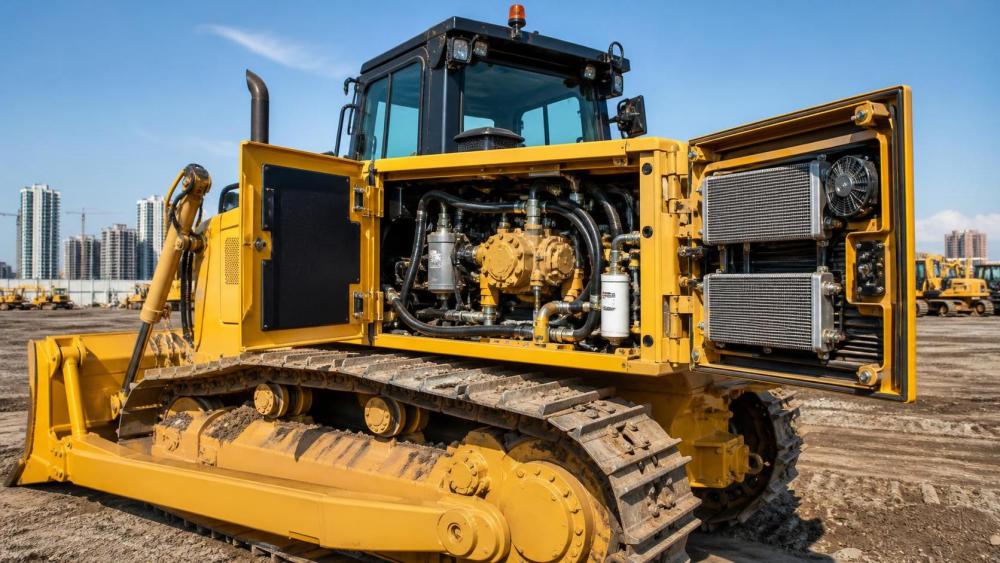
A hydrostatic transmission transfers engine power through pressurized hydraulic fluid rather than through a conventional gear train alone. Depending on the machine, the arrangement commonly includes a variable-displacement pump, hydraulic motor or motors, charge pump, valves, filters, cooling components, hoses, and electronic or mechanical controls. Changes in pump and motor displacement regulate travel speed, direction, and torque.
The core rotating groups operate with extremely close internal clearances. That is why fluid cleanliness is not a minor maintenance detail. Abrasive particles can score surfaces, accelerate leakage across internal components, and reduce the system’s ability to hold pressure. Water contamination can compromise lubricity and promote corrosion. Air entering the circuit may create cavitation, noisy operation, erratic response, and damage that becomes visible only after performance has already declined.
Unlike a simple mechanical component that may gradually become noisier while remaining usable, a hydrostatic drive can enter a damaging cycle. Internal wear increases leakage; leakage generates more heat; excessive heat degrades the oil; degraded oil reduces protection and raises wear further. A small change in travel behavior can therefore deserve attention long before the machine becomes immobile.
This is particularly relevant in compact equipment. Skid steers and compact track loaders are often expected to perform loader work, material handling, trench backfilling, demolition cleanup, snow work, grading, and attachment-driven tasks. Their versatility is commercially valuable, but constant direction changes, high drawbar loads, and poorly matched attachments can put exceptional stress on the hydrostatic circuit.
The Conditions That Determine Service Life
Operating load is the first major variable. A dozer continuously pushing at the edge of available traction, or a skid steer repeatedly forcing a bucket into dense, compacted material, places greater demand on pumps and motors than a machine performing light finish work. High-load work is not inherently improper; the equipment is designed to work. The problem arises when severe loading is prolonged, the cooling system is restricted, or the operator uses aggressive throttle and travel commands without allowing the system to stabilize.
Heat is the second major variable, and it is often misunderstood. High hydraulic temperature is not always caused by a failed transmission. A blocked cooler, damaged cooling fan, dirty radiator package, incorrect oil viscosity, low oil level, restricted charge circuit, dragging brakes, worn undercarriage components, or an attachment application beyond the machine’s intended capability may all contribute. Replacing a pump without identifying the thermal cause risks repeating the failure.
Oil quality matters just as much as oil level. The transmission should receive the fluid grade and specification called for by the machine manufacturer. “Hydraulic oil” is not a universal substitute. Viscosity behavior, additive chemistry, friction characteristics, and compatibility with seals and components vary. Mixing fluids casually, topping up from unverified containers, or extending change intervals because oil still looks clear can create avoidable uncertainty.
Environmental exposure shapes the maintenance burden. Fine quarry dust, demolition debris, wet clay, salt exposure, high-altitude cold starts, and hot urban paving work impose very different risks. A machine working in remote earthmoving operations may also face longer response times when a minor hose seep, warning code, or overheating event appears. In such settings, preventive inspection is not administrative routine; it is protection against downtime far from repair capacity.
Hours Are Useful, but They Are Not a Diagnosis
Machine hours remain an essential planning reference. They help schedule filter changes, fluid sampling, inspections, and manufacturer-recommended service intervals. But two machines with similar hours can have fundamentally different transmission risk profiles. One may have operated mainly in controlled yard work with disciplined servicing. The other may have run under heavy shock loads, experienced repeated overheating, or spent months with compromised filtration.
When evaluating used equipment, a low hour meter reading should therefore never be treated as proof of hydrostatic health. Review service records, filter history, oil-change documentation, warning-code history where available, evidence of cooler cleaning, and any previous pump, motor, or hose repairs. Ask whether a failed component was rebuilt or replaced, whether the circuit was flushed, and whether the root cause was identified. A contaminated system can damage replacement components quickly if cleaning and verification were incomplete.
The most defensible expectation is this: a well-maintained hydrostatic transmission should be evaluated by condition and duty history, not judged against a universal expiration point. The operator’s manual and the relevant OEM service documentation remain the primary references for that machine’s fluid, filtration, pressure-testing, and inspection requirements.
Early Warning Signs That Deserve Investigation
Hydrostatic failures rarely become less expensive when ignored. The following symptoms do not automatically mean that a pump or motor must be replaced, but they justify structured diagnosis:
- Slower travel, reduced pushing power, or a machine that feels weak under a familiar load.
- Unusual delay when shifting from forward to reverse, or inconsistent response between travel directions.
- Persistent hydraulic temperature warnings, especially when the workload has not changed.
- Whining, growling, or cavitation-like noise that differs from the machine’s normal operating sound.
- Visible foaming in the reservoir, repeated low-fluid conditions, or signs of leakage around hoses, fittings, and drive components.
- Metallic material in filters or abnormal findings in oil analysis.
It is tempting to interpret weak travel as a pump problem immediately. Yet similar symptoms can come from control issues, charge-pressure problems, clogged filters, damaged hoses, incorrect calibration, failing sensors, brake drag, or mechanical resistance elsewhere in the drivetrain. A competent assessment normally combines fault-code review, visual inspection, fluid and filter examination, temperature checks, and pressure testing against OEM procedures. Diagnosis should precede parts ordering.
Practical Ways to Extend Hydrostatic Transmission Life
The most effective protection strategy is usually not dramatic. It is consistent. Start with contamination control: use clean, sealed fluid containers; keep fill points clean; replace filters according to the specified interval and application conditions; and investigate damaged breathers, loose caps, or recurring leaks. If oil analysis is practical for the fleet, use trends rather than a single isolated report. Changes in particle counts, moisture, wear metals, or viscosity can provide a reason to inspect before a loss of performance becomes a work stoppage.
Cooling-system care deserves equal attention. Clean the radiator, hydraulic cooler, screens, and surrounding air paths in a way that does not bend fins or force debris deeper into the package. Verify fan operation and inspect belts, guards, shrouds, and cooling-related sensors where applicable. In high-debris environments, the interval between cleaning checks may need to reflect the actual site rather than a generic routine.
Operator behavior can materially influence life. Smooth reversals, appropriate travel speed for the grade and load, avoidance of prolonged stall-like conditions, and thoughtful use of high-flow attachments reduce unnecessary heat and pressure spikes. This does not mean treating the machine delicately. It means recognizing that repeated full-command reversals with a heavily loaded bucket, or forcing tracks against an immovable obstruction, transfers stress directly into a costly system.
Attachment matching matters too. Auxiliary hydraulic requirements, machine operating capacity, cooling capability, and the intended duty cycle should be considered together. A commercially attractive attachment can still be the wrong operational match if it causes sustained thermal loading beyond what the machine can dissipate under site conditions.
Different Machines, Different Failure Patterns
In full-hydraulic bulldozers, transmission health is closely tied to prolonged tractive effort, terrain resistance, cooling performance, and the interaction between the drive system and undercarriage. A deteriorated undercarriage or excessive track resistance can increase the power needed simply to move the machine. That may be experienced by the operator as a transmission concern even when the hydraulic components are not the original cause.
Skid steer loaders and compact track loaders often see more rapid cycling and more varied operators. Their risk profile may include abrupt reversals, attachment mismatch, debris accumulation around coolers, and hose damage in crowded work zones. Wheel loaders can face heat and loading stress in repetitive stockpile, quarry, and material-transfer work, while graders add another layer of precision: travel performance must remain predictable when the machine is supporting accurate blade control and increasingly sophisticated 3D guidance workflows.
Crawler excavators are not usually described through hydrostatic “transmission” language in exactly the same way as a compact loader or dozer, yet their travel drives depend on hydraulic reliability and clean oil for the same underlying reason: high-pressure systems do not tolerate contamination or neglected heat management for long.
Treat Transmission Reliability as an Asset-Utilization Issue
At Global Earth-Mover Dynamics, transmission questions are best understood within the broader operating system of the machine. The same infrastructure cycle that demands more output from earthmoving fleets is also increasing dependence on precision controls, remote-operation architectures, tighter emissions packaging, and equipment availability. A hydrostatic drive is not an isolated maintenance item; its performance affects loading cycles, grading consistency, fuel use, operator confidence, and the ability to keep a machine scheduled on a critical project.
That perspective matters as fleets move toward electrification and greater automation. Software can improve control response and monitor operating conditions, but it does not eliminate the physical requirements of clean fluid, healthy cooling, correct calibration, and disciplined inspection. In some respects, more connected equipment makes early intervention easier because temperature trends, fault histories, and operating patterns can be reviewed before a failure becomes catastrophic.
If a machine is showing transmission symptoms, begin with its actual operating record: workload, recent overheating events, fluid type, filter changes, attachment use, fault codes, and repair history. Then compare test results with the OEM procedure for that model. That approach gives owners a far better answer than a generic lifespan estimate—and a better chance of preserving the machine’s productive life before a small hydraulic warning becomes a major interruption.