
Related News
- 00
0000-00
How to size heavy-duty loaders for North American mining operations - 00
0000-00
How altitude affects mining excavator performance in Latin America - 00
0000-00
Caterpillar Launches New Cat 6060 and Upgraded Autonomous Mining System - 00
0000-00
When does eco-friendly construction equipment pay for itself? - 00
0000-00
Will a wheel loader quick coupler fit your existing attachments?
Electro hydraulic control for dozers has become a defining variable in grading accuracy, especially where finish quality, production speed, and repeatability must coexist. For operations comparing modern grading systems, the difference often appears in how precisely blade commands become hydraulic movement, and how consistently that movement holds grade under changing load, traction, and ground conditions.
That matters well beyond operator feel. In infrastructure work, mining support, site preparation, and large earthmoving programs, grading precision affects rework, fuel burn, machine hours, survey corrections, and the ability to integrate with digital jobsite control. It is also why platforms such as EMD track electro-hydraulic logic alongside 3D guidance, hydrostatic efficiency, and the broader shift toward autonomous heavy equipment.
Why blade control now carries more weight
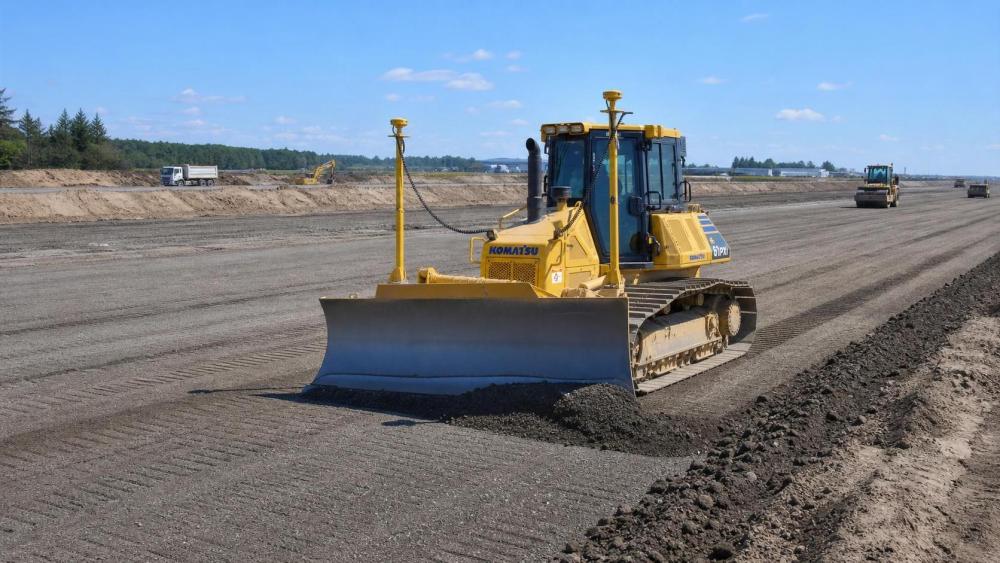
Bulldozers have always delivered brute force well. The current challenge is using that force with tighter surface control.
Road base construction, landfill cell shaping, solar site preparation, haul road maintenance, and pad finishing all demand more than pushing power. They require predictable blade response across long passes and variable material densities.
Mechanical linkages and older pilot systems can still perform heavy work effectively. Yet when tolerance bands narrow, delays between lever input and cylinder response become more visible in the final surface.
Electro hydraulic control for dozers addresses this by replacing much of that indirect response with electronically interpreted commands. The system can meter hydraulic flow more accurately, hold a commanded position better, and support finer adjustments at speed.
What electro hydraulic control changes inside the machine
At a basic level, the operator input becomes an electrical signal rather than a purely mechanical or hydraulic one. That signal is processed by control software, then sent to proportional valves that regulate blade lift, tilt, angle, or pitch.
This architecture creates three practical advantages.
- Command precision improves because valve actuation can be finely modulated.
- Response time improves because control logic reduces lag between input and hydraulic action.
- Repeatability improves because software can manage movement curves more consistently than manual-only systems.
In practical grading, that means less blade bounce, smoother feathering at the end of a pass, and better control when trimming thin lifts. The machine becomes easier to keep on target without constant correction.
This is also the foundation for grade control integration. GPS, GNSS, laser, IMU, and mastless systems need a controllable hydraulic platform. Without accurate electro-hydraulic actuation, sensor intelligence cannot fully translate into surface accuracy.
How grading accuracy actually improves
The gain in accuracy does not come from one feature alone. It comes from several small improvements that accumulate across every pass.
Finer low-speed blade modulation
Finish grading often happens in very small blade increments. Electro hydraulic control for dozers allows smaller, smoother corrections, which helps avoid overcutting and reduces the saw-tooth effect visible on marginal systems.
Better compensation under variable load
Blade load changes as material type, moisture, and slope change. A well-tuned electro-hydraulic system maintains more consistent cylinder behavior, so the blade is less likely to hunt or drift during load transitions.
Reduced operator correction frequency
When response is predictable, fewer compensating inputs are needed. That lowers fatigue and helps different operators produce closer results on the same work package.
Stronger integration with 2D and 3D guidance
Modern dozers increasingly work within digital terrain models. Electro hydraulic control for dozers allows the blade to follow guidance commands with less overshoot, which is essential when targets are measured in centimeters rather than broad finish zones.
Where the value is easiest to see
Not every dozing application demands the same control resolution. The value becomes clearer in jobs where surface quality directly affects downstream cost or schedule.
In these settings, grading accuracy is not a cosmetic issue. It directly influences surveying loops, material balance, compaction readiness, and how quickly the next machine can enter the workflow.
What to evaluate beyond the sales claim
Electro hydraulic control for dozers is not equally effective on every platform. The label alone says little about actual grading performance.
A stronger assessment usually includes the following points.
- Valve resolution and control smoothness across very small blade movements.
- System latency between command input and cylinder response.
- Blade stability during transitions between cut, carry, and spread.
- Software tuning options for different grading modes or attachments.
- Compatibility with 2D, 3D, and remote support architectures.
- Serviceability of sensors, harnesses, controllers, and proportional valves.
It is also worth separating peak capability from repeatable capability. Some machines demonstrate impressive short-run precision, yet lose consistency when heat, vibration, and long-cycle production loads build up.
That is where EMD’s broader perspective becomes relevant. In heavy equipment, control quality should be judged as part of a system that includes hydraulics, software logic, undercarriage stability, telematics, emissions strategy, and the path toward autonomy.
Operational tradeoffs that deserve attention
The benefits are real, but the technology introduces its own evaluation points.
Electronic control increases dependence on sensors, calibration quality, and software reliability. Poor setup can weaken the advantages of electro hydraulic control for dozers, even when the hardware itself is capable.
Training also shifts. The machine may be easier to grade finely, but proper use now includes understanding control modes, guidance integration, and diagnostic behavior.
Another practical issue is site support. A high-precision system is only valuable if the local service structure can maintain sensors, update firmware, and restore calibration without long downtime.
For mixed fleets, interoperability matters too. If excavators, motor graders, and dozers share digital design files but not data standards or support workflows, the grading gain may be reduced at project level.
How to use this in equipment selection
A useful next step is to match control sophistication to the actual grading task. Not every fleet needs the same level of automation, but most high-accuracy programs benefit from stronger electro-hydraulic performance.
Start by defining the tolerance range, pass length, material variability, and digital guidance requirements. Then compare how each machine handles low-speed blade inputs, grade hold, and correction frequency under load.
Field demonstrations should focus on measurable outcomes, not only impressions. Blade response, finish uniformity, rework rate, and time to target grade usually reveal more than feature lists.
For organizations tracking the future of heavy earthmoving, electro hydraulic control for dozers is more than a comfort feature. It is part of the control architecture that connects traditional pushing force with precision grading, digital workflows, and the industry’s move toward lower waste and smarter autonomy.
That makes the right evaluation framework simple: judge the machine by how accurately it turns command into blade action, how consistently it holds that behavior on the jobsite, and how well it fits the broader grading system around it.