
Related News
- 00
0000-00
How to size heavy-duty loaders for North American mining operations - 00
0000-00
How altitude affects mining excavator performance in Latin America - 00
0000-00
Caterpillar Launches New Cat 6060 and Upgraded Autonomous Mining System - 00
0000-00
When does eco-friendly construction equipment pay for itself? - 00
0000-00
Will a wheel loader quick coupler fit your existing attachments?
Why site leveling setup changes from one job to another
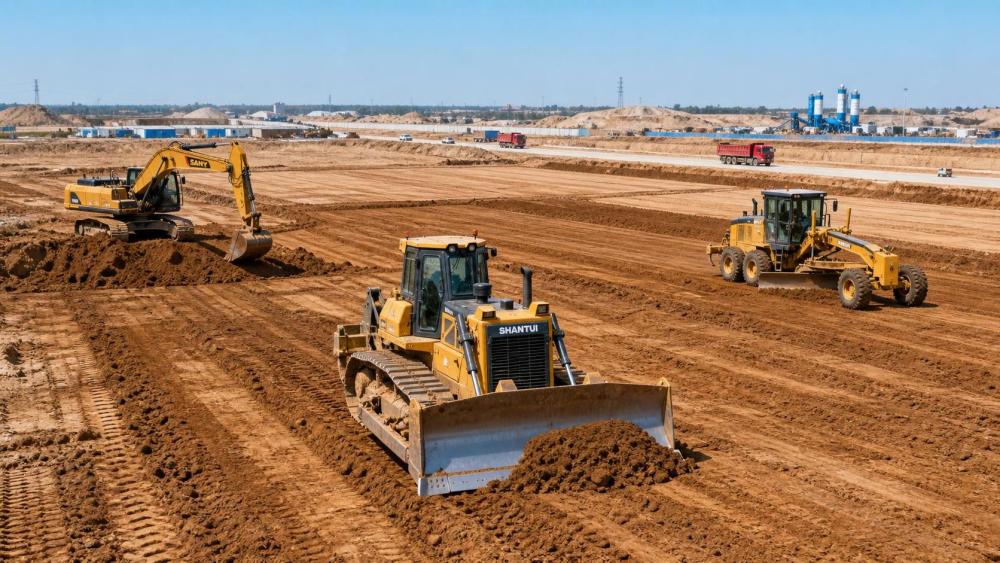
Site leveling looks straightforward on paper, yet field conditions rarely behave the same way twice.
The best results come from matching machine roles, grade control, and haul flow to the actual ground profile.
That is why construction equipment applications site leveling cannot be reduced to one preferred machine or one preferred setup.
A warehouse pad, a subdivision roadbed, and an airport shoulder may all require leveling, but their tolerances differ sharply.
So do moisture conditions, material behavior, traffic access, and the cost of rework after compaction begins.
In practical terms, good setup choices protect schedule certainty more than headline machine power alone.
They also reduce idle cycles, unnecessary passes, and grade correction after utilities, drainage lines, or base layers are installed.
EMD closely follows this shift toward precision-driven earthmoving, where hydraulic force, digital guidance, and equipment pairing matter equally.
Across global infrastructure work, the strongest setups usually combine raw tractive effort with accurate surface control.
That balance is central to construction equipment applications site leveling when budgets tighten and surface tolerances become less forgiving.
Start with the ground, not the fleet list
The first judgment is not machine brand or blade width.
It is the relationship between cut volume, fill balance, and finish tolerance.
When the site includes heavy stripping, dozer-led setups often outperform grader-first planning.
When the subgrade is already close, a motor grader with GPS or laser control becomes the productivity center.
Excavators enter earlier when drainage shaping, trench interaction, or selective cut zones complicate the surface.
Wheel loaders matter more where stockpile movement, truck feeding, and short-distance relocation affect rhythm.
Skid steers become valuable when access is restricted and the finish zone sits near structures, curbs, or utility corridors.
This is where construction equipment applications site leveling becomes a coordination question, not just a machine selection question.
A quick way to separate common leveling conditions
The table shows why construction equipment applications site leveling should begin with job geometry and material behavior.
A setup that excels on open industrial plots may lose efficiency on confined municipal work.
Open earthmoving jobs need force first, then precision
Large greenfield platforms usually reward a rough-to-finish sequence instead of trying to finish too early.
Bulldozers create the first stable shape because track grip and machine mass handle loose or resistant material better.
Crawler excavators then manage deep cuts, ditch transitions, and localized high spots that a straight push cannot solve cleanly.
Once bulk balance improves, wheel loaders help maintain flow between stockpiles, trucks, and fill areas.
Only after that does the motor grader deliver the surface discipline needed for consistent elevation.
This sequencing is common in construction equipment applications site leveling because finish machines lose time when forced into rough correction work.
A frequent mistake is assigning the grader too early because it appears faster on a clean drawing.
In the field, that often produces repeated passes, uneven moisture exposure, and avoidable undercut before compaction crews arrive.
Road, rail, and runway work demand different grading discipline
Linear infrastructure changes the setup logic because small elevation errors accumulate over distance.
Here, motor graders become central rather than secondary.
The key is not just blade control, but how grade technology, haul timing, and material consistency interact.
For highways, stable crown and shoulder shaping usually matter as much as absolute depth.
For rail support zones, drainage response and edge stability become more sensitive.
For airport work, tolerance discipline rises again because surface transitions affect later paving performance.
EMD tracks how GPS, laser systems, and 3D spatial control are redefining these construction equipment applications site leveling decisions.
Digital guidance does not replace operator judgment, but it shortens correction loops and improves repeatability across long runs.
That matters when weather windows are short and handoff between earthworks and paving is tightly scheduled.
Where judgment usually shifts on linear projects
- Long passes favor grade control stability over maximum engine output.
- Material segregation can undermine surface accuracy even when machine guidance is excellent.
- Truck spacing affects finish quality because interrupted feed leads to patchwork grading.
- Drainage details should be confirmed before final trimming, not after compaction begins.
Tight urban work calls for compact adaptability
Urban site leveling often appears smaller, but the setup can be harder to get right.
Access restrictions, buried services, existing slabs, and traffic management compress the working envelope.
In this setting, compact machines do more than fill a size gap.
They reduce repositioning time and allow attachments to change the work method without changing the whole fleet plan.
Skid steer loaders are especially useful in construction equipment applications site leveling where final surface shaping happens between curbs, columns, or retaining edges.
Compact track loaders may outperform wheeled units when the ground stays soft or disturbed.
Still, compact flexibility should not be confused with universal suitability.
If the site requires substantial cut-and-fill balancing, a compact machine alone can stretch cycle time too far.
A common adjustment is to let an excavator handle selective excavation while compact loaders manage finish correction nearby.
The hidden cost is often in setup gaps, not machine rates
Many overruns in construction equipment applications site leveling come from mismatched sequencing rather than weak equipment specifications.
One machine waits for survey confirmation.
Another reworks a zone already trimmed once.
Haul units queue because the cut area and fill area were not staged together.
Those losses rarely appear in a simple equipment rate comparison.
They show up later as fuel waste, delayed compaction, and unstable daily output.
A more reliable approach is to review setup choices against five field checks:
- Can the rough-cut machine leave a surface the finish machine can actually use?
- Will grade control match the site tolerance, or is it over-specified for the task?
- Are stockpile and truck movements aligned with the grading sequence?
- Does ground moisture change tire or track performance during the day?
- Can the setup adapt when utilities or drainage details shift in the field?
What gets misjudged most often before leveling begins
The most common misread is treating similar-looking sites as identical leveling jobs.
Two pads with the same square footage may need different machine combinations because one includes unstable fill and the other does not.
Another mistake is chasing low acquisition or rental cost without pricing rework risk.
That usually hurts projects where tolerance is tight and finish windows are short.
Some teams also overestimate what digital grading can solve by itself.
If haul flow is inconsistent or the initial cut is unstable, guidance systems cannot erase those upstream problems.
EMD’s broader market view is useful here because decarbonization, autonomy, and control architecture are changing machine expectations.
But field success still depends on whether the chosen setup suits the site’s real operating conditions.
A practical way to narrow the best setup choices
The most effective next step is to define the site by work behavior, not by a generic leveling label.
Map where bulk cut happens, where finish tolerance tightens, and where access or drainage creates constraints.
Then compare construction equipment applications site leveling options against those specific zones.
That comparison should include machine role, grade technology, support flow, maintenance exposure, and likely rework points.
When the setup is chosen this way, equipment pairing becomes more rational.
Dozers handle force where force is needed.
Graders protect tolerance where precision matters.
Excavators solve localized complexity.
Loaders and compact units keep the site moving without overcrowding it.
That is usually the clearest path to stable production, cleaner finish quality, and fewer corrections after the leveling phase is supposed to be complete.