
Related News
- 00
0000-00
How much does a 3D grader guidance system cost fully installed? - 00
0000-00
How to verify capacity before sourcing equipment from manufacturers - 00
0000-00
When to choose LGP dozers for infrastructure site preparation - 00
0000-00
How to size heavy-duty loaders for North American mining operations - 00
0000-00
How altitude affects mining excavator performance in Latin America
When heavy machinery parts fail unexpectedly, downtime risk rises fast—disrupting schedules, increasing repair costs, and putting pressure on aftersales maintenance teams. From hydraulic systems to undercarriage components, understanding the most failure-prone parts is essential for improving reliability, planning preventive service, and keeping excavators, loaders, graders, and bulldozers working at peak performance.
Which heavy machinery parts create the highest downtime risk?
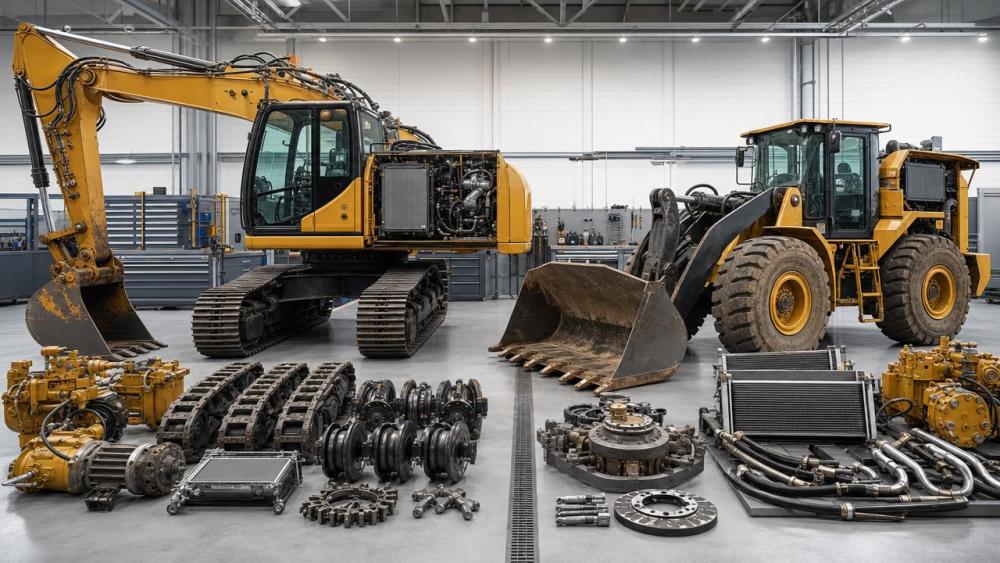
For aftersales maintenance personnel, not all heavy machinery parts carry the same operational risk. Some components fail gradually and can be managed during planned service windows. Others trigger immediate machine stoppage, secondary damage, or safety concerns that force urgent field response.
Across crawler excavators, wheel loaders, motor graders, bulldozers, and skid steer loaders, the most downtime-sensitive parts usually sit inside three systems: hydraulic power, powertrain transfer, and ground engagement. Failures in these areas tend to halt production rather than simply reduce efficiency.
The failure groups that matter most
- Hydraulic pumps, cylinders, hoses, seals, and control valves can quickly disable digging, lifting, steering, blade control, or attachment function.
- Undercarriage heavy machinery parts such as track chains, rollers, idlers, sprockets, and track shoes often drive both wear cost and immobilization risk on crawler machines.
- Engine and cooling system parts including injectors, turbochargers, belts, radiators, and fan drives can trigger derating, overheating, or forced shutdown.
- Driveline and transmission components on loaders and dozers can turn minor vibration into major repair events if contamination or slippage is ignored.
- Electrical and electro-hydraulic control parts, especially sensors, wiring harnesses, solenoids, and controllers, increasingly affect modern fleets with GPS, grade control, and remote diagnostics.
EMD tracks these failure patterns in the context of high-load earthmoving, precision grading, and severe-duty hydraulic applications. That matters because the same part category behaves differently on a quarry loader, a grading machine with 3D control, or an excavator running continuous trenching cycles.
Why do these failures hit excavators, loaders, graders, and dozers differently?
A practical maintenance strategy starts with machine duty, not with parts catalogs alone. Heavy machinery parts fail according to load pattern, contamination exposure, operator behavior, idle ratio, climate, and service discipline. The same seal kit may survive on one site and fail early on another because heat, dust, shock load, and cycle frequency are different.
For example, crawler excavators often stress hydraulic cylinders, swing systems, and final drives. Wheel loaders repeatedly load axles, bucket linkages, cooling packages, and transmission systems. Motor graders place unusual importance on blade circle wear, articulation joints, and electronic positioning systems. Bulldozers amplify undercarriage wear and hydrostatic or transmission stress in abrasive push conditions.
Typical machine-specific stress points
This comparison helps aftersales teams prioritize inspection routes and stocking plans. Instead of treating all heavy machinery parts equally, maintenance leaders can rank them by machine role, production dependency, and failure consequence.
What failure signs should aftersales maintenance teams never ignore?
Unexpected downtime is rarely truly unexpected. In most cases, a machine shows warning behavior first. The issue is that field teams are under pressure, production cannot stop, and early symptoms are often misread as normal wear. The cost of that delay can be severe when one failed component contaminates adjacent systems.
High-priority warning indicators
- Hydraulic response slows during warm operation, especially under load. This can point to internal leakage, pump wear, restricted filtration, or valve inefficiency.
- Metal particles appear during oil sampling or drain inspection. That often signals accelerated wear in gears, bearings, pumps, or final drives.
- Undercarriage noise becomes irregular, with binding, popping, or side pull. These symptoms should trigger alignment and wear measurement immediately.
- Operating temperatures trend upward, even if they have not crossed shutdown threshold. Cooling inefficiency often shortens the life of several heavy machinery parts at once.
- Machine control alarms appear intermittently and then disappear. Sensor, harness, or controller faults often start as unstable signals before complete failure.
EMD’s industry view is especially useful here because modern equipment no longer fails only through visible wear. Electro-hydraulic control, remote diagnostics, and precision guidance systems mean maintenance teams must read both mechanical and digital symptoms together.
How should you prioritize heavy machinery parts for stocking and replacement?
One of the hardest aftersales tasks is balancing uptime against inventory cost. Overstocking ties up capital. Understocking extends machine idle time while the site waits for parts, approvals, and freight. The right approach is to sort heavy machinery parts by failure frequency, downtime impact, lead time, and interchangeability.
The table below offers a practical selection framework for maintenance planners handling mixed fleets in construction, quarry, mining support, and infrastructure grading environments.
The best inventory decision is not always to buy more. Sometimes it is better to create a faster qualification process, pre-approved supplier list, and model-based interchange map. That reduces reaction time without carrying excessive stock across every site.
A simple prioritization method
- Rank by machine criticality: a primary excavator on a pipeline project deserves different support than a backup skid steer.
- Rank by lead time: imported or specialized heavy machinery parts should be planned earlier than locally available consumables.
- Rank by consequence: parts that can trigger collateral damage should never wait for visible failure.
Should you choose OEM, aftermarket, or rebuilt heavy machinery parts?
This is rarely a simple price question. Aftersales teams must weigh machine age, duty severity, warranty exposure, fleet standardization, and delivery urgency. A lower purchase price can become a higher total cost if fit tolerance, sealing quality, metallurgy, or calibration stability is inconsistent.
For high-risk heavy machinery parts inside hydraulic control, powertrain, and precision guidance systems, reliability and compatibility usually matter more than initial savings. For predictable wear parts, qualified alternatives may be acceptable when technical review and traceability are clear.
Comparison for maintenance decision-making
The key is to match part strategy to failure consequence. For example, a grader sensor affecting millimeter-level blade accuracy should not be evaluated the same way as a bucket edge segment. EMD’s cross-machine intelligence is valuable because it connects performance, application severity, and sourcing logic in one maintenance framework.
How can preventive maintenance reduce failure rates without inflating service cost?
Effective preventive maintenance is not just about shorter intervals. It is about better targeting. If inspections are too generic, teams waste labor and still miss the heavy machinery parts most likely to stop production. If intervals are too aggressive, cost rises without meaningful reliability gain.
A practical field checklist
- Use oil analysis for engines, hydraulics, transmissions, and final drives where contamination can predict internal wear early.
- Track temperatures and pressure trends, not only alarm events. Gradual drift often appears before hard failure.
- Measure undercarriage wear at consistent intervals using the same method, especially on dozers and excavators in abrasive ground.
- Review operator reports seriously. Changes in feel, noise, or control response often reveal issues before diagnostic codes do.
- Link parts replacement history to duty profile so repeat failures can be traced to root cause rather than treated as isolated events.
Where possible, combine scheduled inspection with digital service records. On modern fleets, the interaction between hydraulic load, electronic control, and thermal stress is too complex to manage with memory alone. This is especially true as electrification, autonomy, and precision control systems continue to expand across heavy equipment platforms.
What standards, compliance points, and documentation should maintenance teams check?
Not every part purchase is only a technical purchase. In multinational fleets and contractor environments, documentation can delay installation just as much as freight. Heavy machinery parts used in emission-related systems, safety circuits, or precision control assemblies may require closer review of part numbers, revision history, and installation procedures.
Useful compliance checks before approval
- Confirm part revision and machine serial applicability to avoid mismatch on electronically controlled equipment.
- Check whether the component affects non-road emission systems, hydraulic safety holding, braking, or steering functions.
- Request inspection reports or test documentation for rebuilt assemblies where performance consistency is critical.
- Verify installation torque, fluid cleanliness level, and calibration steps so the new part does not fail from poor commissioning.
This is where an intelligence-led partner adds value. EMD does not simply look at replacement demand. It connects parts selection with machine architecture, emission-rule pressure, electro-hydraulic response logic, and field application conditions that influence service success.
FAQ: common questions about heavy machinery parts and downtime
How do I identify which heavy machinery parts deserve emergency stock?
Start with failure consequence and lead time. If a part can immobilize a revenue-critical machine and takes days or weeks to source, it belongs on the emergency list. Then check whether the part is common across multiple units. Shared critical components justify stocking faster than one-off, low-frequency items.
Are aftermarket heavy machinery parts always a higher risk?
No. Risk depends on part type and supplier control. For simple wear components with proven material and dimensional consistency, qualified aftermarket supply can work well. For electro-hydraulic, fuel, transmission, or precision control components, tolerance and calibration risk are higher, so evaluation should be stricter.
Which parts usually cause the most expensive secondary damage?
Hydraulic pump failures, lubrication-related bearing failures, cooling system neglect, and undercarriage misalignment are common examples. When these are ignored, contamination, heat, or abnormal loading spreads to adjacent heavy machinery parts and turns a manageable service job into a major rebuild.
What is the most common maintenance mistake in mixed fleets?
Using one service logic for every machine type. Excavators, graders, loaders, and bulldozers experience different stress patterns. A mixed fleet needs machine-specific inspection points, different stocking profiles, and separate risk thresholds tied to application and production priority.
Why choose us for heavy machinery parts intelligence and maintenance planning?
EMD supports aftersales maintenance teams with a deeper view than a simple parts listing. We connect failure-prone heavy machinery parts with real machine duty, hydraulic intensity, precision grading demands, undercarriage wear economics, and the transition toward smarter, lower-emission equipment.
If you are evaluating part risk, supplier options, or fleet maintenance priorities, you can consult us for practical support in the areas that matter most to uptime:
- Parameter confirmation for hydraulic, driveline, undercarriage, and control-related heavy machinery parts.
- Part selection guidance based on machine type, duty cycle, failure history, and budget constraints.
- Lead-time and delivery planning for critical components that threaten project continuity.
- Alternative sourcing review for OEM, aftermarket, and rebuilt options with application-specific cautions.
- Documentation review related to serial applicability, service procedures, and compliance-sensitive systems.
- Quotation discussions and tailored maintenance intelligence for excavators, loaders, graders, bulldozers, and compact support equipment.
When downtime risk is rising, faster decisions are not enough. You also need better decisions. That is where EMD helps maintenance teams move from reactive replacement to informed reliability planning.