
Related News
- 00
0000-00
How to size heavy-duty loaders for North American mining operations - 00
0000-00
How altitude affects mining excavator performance in Latin America - 00
0000-00
Caterpillar Launches New Cat 6060 and Upgraded Autonomous Mining System - 00
0000-00
When does eco-friendly construction equipment pay for itself? - 00
0000-00
Will a wheel loader quick coupler fit your existing attachments?
Mining equipment cost trends in 2026 are moving beyond simple price inflation
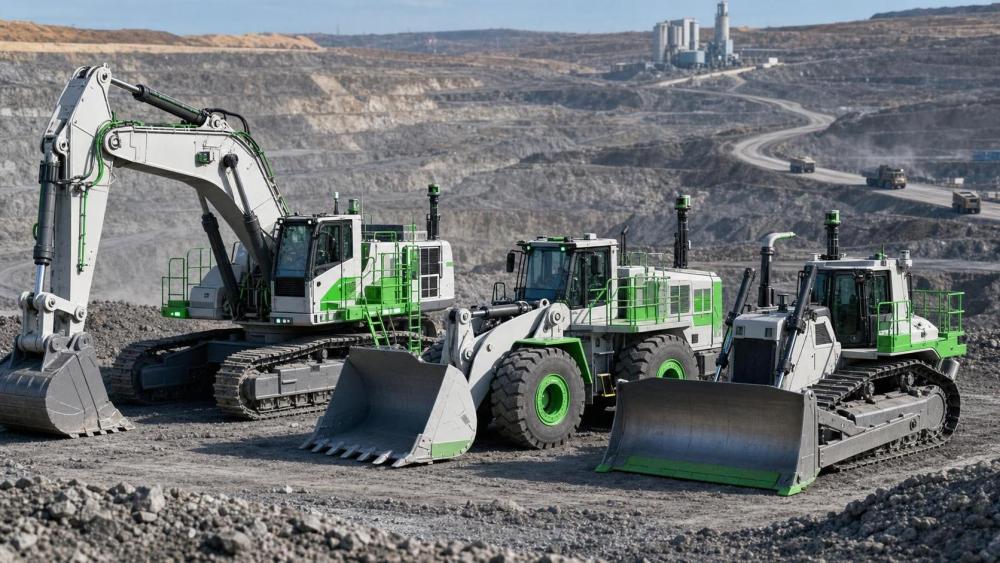
As 2026 draws closer, the cost logic behind mining equipment is changing faster than many capital plans assumed.
The visible issue is not only higher sticker prices. The deeper shift is how cost now accumulates across powertrain choices, compliance, software, parts, and financing.
That matters across the wider earthmoving landscape, where crawler excavators, wheel loaders, bulldozers, graders, and compact support machines increasingly share the same technology roadmap.
EMD has tracked this convergence closely. In both mine stripping and infrastructure construction, the same pressure points keep appearing: emissions rules, electrification, autonomy, and asset utilization.
So the key question for 2026 is no longer whether mining equipment will cost more. It is which cost categories will rise quickly, which will normalize, and which will create durable operational value.
The market signal is clear: cost pressure is becoming more layered
Recent buying patterns show that mining equipment budgets are being stretched from several directions at once.
Steel, tires, hydraulics, semiconductors, and power electronics no longer move in a predictable cycle. Some categories have eased, but others remain structurally volatile.
More importantly, the composition of equipment itself is changing. A machine now carries more sensors, control units, telematics modules, and software-defined functions than it did a few years ago.
For heavy mining equipment, this means cost inflation is becoming layered rather than linear. Base machine prices, support contracts, data systems, and training requirements are increasingly linked.
What once looked like a one-time capital purchase now behaves more like a long-life technical platform.
Where the fastest changes are appearing
This is why many 2026 decisions will depend less on nominal price and more on total cost visibility.
Why mining equipment costs are being reshaped so quickly
The first driver is regulation. Emissions compliance for off-highway equipment is no longer a distant concern limited to a few mature markets.
As standards tighten, diesel platforms need more advanced engines, cleaner combustion strategies, and more complex aftertreatment systems.
The second driver is electrification. In mining equipment, electrification does not always mean full battery conversion. Hybridization, energy recovery, and electric auxiliaries also raise engineering complexity.
The third driver is autonomy. Remote-controlled systems in hazardous zones, collision avoidance, and machine guidance are shifting from pilot projects toward operating reality.
EMD’s long view across excavators, loaders, and grading equipment suggests that digital capability is now influencing equipment cost as much as raw mechanical performance.
A fourth driver is supply-chain redesign. More OEMs are diversifying suppliers, localizing selected components, and holding higher inventory for critical parts.
That improves resilience, but it can also prevent a full return to pre-disruption pricing.
The less obvious force: software is turning into a cost line
In the past, software was often hidden inside the machine. Now it is visible in telematics subscriptions, fleet analytics, guidance systems, and remote diagnostics.
For mining equipment, this can improve uptime and fuel discipline. It also means the purchasing model increasingly includes recurring digital spend.
That shift is especially relevant for mixed fleets, where interoperability can determine whether technology lowers cost or simply adds another integration burden.
The impact is not limited to one machine class
Mining equipment cost trends are spreading across machine categories in different ways.
Crawler excavators face rising cost around hydraulic efficiency, electro-hydraulic controls, and operator-assist systems.
Wheel loaders are seeing pressure from drivetrain upgrades, payload intelligence, and tire-related operating cost volatility.
Bulldozers increasingly absorb cost through traction optimization, hydrostatic refinement, and remote operation packages for difficult terrain.
Motor graders reflect another side of the trend. Precision guidance, GPS correction, and laser-based surface control make grading more accurate, but also more electronics-dependent.
Even skid steer loaders, often viewed as smaller support assets, now carry a more advanced attachment and control ecosystem than their earlier generations.
This broader pattern matters because cost discipline can no longer focus only on flagship mining equipment. Supporting fleets also influence total project economics.
What is likely to rise, what may stabilize, and where value can still emerge
From recent market behavior, several directional judgments are becoming more credible.
- Compliance-heavy diesel platforms are likely to stay expensive, even if commodity input costs soften.
- Battery and power electronics costs may improve gradually, but integration costs will remain meaningful.
- Autonomy-related hardware may decline slowly in unit cost, while software and connectivity spending grows.
- Core structural components may stabilize faster than smart subsystems and specialty parts.
- Financing pressure may remain a deciding factor, especially for large fleet renewal programs.
The better news is that some expensive features are no longer purely defensive spending.
If a machine delivers measurable gains in fuel burn, cycle time, tire life, or planned maintenance, a higher purchase price may still improve full-life economics.
That is why the most relevant mining equipment comparison for 2026 is not cheapest unit versus premium unit. It is low-visibility cost versus high-visibility value.
The real risk is making 2026 decisions with a 2022 cost model
One common mistake is to assume cost inflation remains mostly temporary and external.
In reality, part of the increase is now embedded in the technical baseline of mining equipment.
Another mistake is to evaluate electrified or autonomous machines only through capex. That approach often misses downtime reduction, labor flexibility, and regulatory resilience.
More worth watching is the growing gap between machines that are merely compliant and machines that are strategically future-ready.
In actual fleet planning, the difference shows up in retrofit risk, resale uncertainty, training requirements, and the speed of software updates.
Questions that deserve attention now
- Which mining equipment categories face the highest regulatory exposure by region?
- Where does digital functionality reduce operating cost, and where does it mainly add complexity?
- How much of the fleet should remain diesel-led through the next replacement cycle?
- Which suppliers can support both hardware uptime and software continuity?
- How sensitive is total ownership cost to interest rates, residual values, and utilization swings?
A practical response starts with sharper cost segmentation
The strongest responses in 2026 will likely come from organizations that separate mining equipment costs into clearer decision layers.
One layer is unavoidable cost. This includes compliance, baseline safety, and critical component reliability.
Another layer is performance-linked cost. This covers features that improve productivity, precision, or utilization in measurable ways.
A third layer is optional complexity. Not every connected feature or semi-autonomous function will create value in every site condition.
That distinction matters in both large mining equipment and adjacent earthmoving fleets used for haul road development, stripping, and support operations.
EMD’s coverage of hydraulic performance, precision controls, and low-latency remote systems points to the same conclusion: returns improve when technical selection matches operating reality, not market fashion.
Useful next steps for 2026 planning
- Rebuild cost models around total ownership, not unit acquisition alone.
- Map mining equipment exposure to emissions, power, and connectivity requirements by site.
- Compare retrofit pathways against new-platform investments before replacement windows tighten.
- Track supplier strength in software support, parts resilience, and control-system integration.
- Set a staged review cycle so capital assumptions can adjust as 2026 signals become clearer.
Mining equipment costs are not moving in one direction for one reason. They are being reshaped by a broader industrial transition.
The smartest move now is to keep watching the signals that connect regulation, machine intelligence, energy strategy, and real asset productivity.
That is where the next cost surprise will appear, and where the next advantage is most likely to be built.