
Related News
- 00
0000-00
How to size heavy-duty loaders for North American mining operations - 00
0000-00
How altitude affects mining excavator performance in Latin America - 00
0000-00
Caterpillar Launches New Cat 6060 and Upgraded Autonomous Mining System - 00
0000-00
When does eco-friendly construction equipment pay for itself? - 00
0000-00
Will a wheel loader quick coupler fit your existing attachments?
Construction equipment emissions standards are changing, but what actually changed?
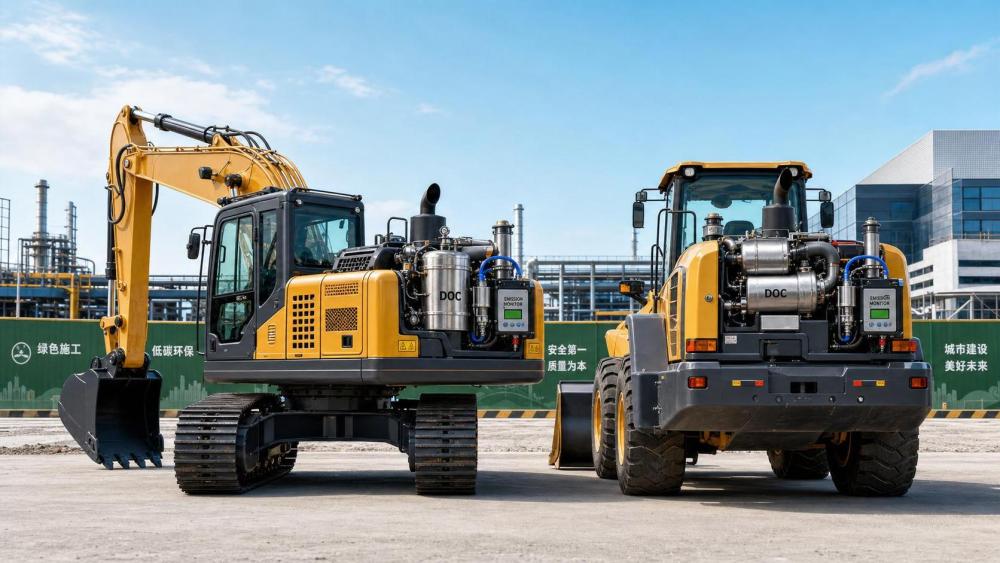
Construction equipment emissions standards now move beyond basic engine limits and into a broader compliance framework.
That framework includes tighter nitrogen oxides, particulate matter, evaporative controls, onboard diagnostics, and in some markets, carbon reporting.
For earthmoving fleets, the change is not one rule or one date.
It is a layered shift across the US, EU, China, India, and selected urban low-emission zones.
The practical effect is simple.
A crawler excavator, wheel loader, motor grader, bulldozer, or skid steer loader may meet one market’s rule and still face restrictions elsewhere.
This matters because construction equipment emissions standards now influence machine architecture, software calibration, service intervals, resale geography, and project eligibility.
Across large infrastructure programs, compliance has become part of bid readiness.
EMD tracks this shift closely because non-road equipment regulation now intersects with hydraulic efficiency, power management, and the industry’s path toward autonomy and decarbonization.
A modern machine is no longer judged only by breakout force or grading precision.
It is also judged by how cleanly that performance is delivered.
Which parts of the rulebook are drawing the most attention now?
The headline standards remain familiar: US EPA Tier 4 Final, EU Stage V, China IV, and Bharat Stage CEV rules.
What changed is the level of enforcement, monitoring, and alignment with broader climate policy.
Three developments are shaping the discussion.
- Portable emissions measurement and real-world verification are becoming more important.
- Aftertreatment durability and tampering controls are under greater scrutiny.
- Public projects increasingly connect local air rules with carbon reduction targets.
That means construction equipment emissions standards are no longer just a factory certification topic.
They now affect in-use compliance and asset planning.
For example, Stage V expanded control over particle number limits.
That pushed wider adoption of diesel particulate filters in power bands once treated more flexibly.
In urban projects, restrictions may go further than national rules.
A machine can be legal to sell but still unwelcome on a sensitive jobsite near schools, ports, or dense residential corridors.
More common now is a two-level test.
First, does the machine meet formal construction equipment emissions standards?
Second, does it satisfy project-specific low-emission requirements?
A quick comparison helps clarify the pressure points
Who feels the impact first: OEMs, fleets, or project owners?
All three do, but not in the same way.
OEMs absorb redesign pressure first.
They must balance cooling package size, engine mapping, aftertreatment packaging, and machine visibility.
That is especially difficult in compact equipment, where space is already limited.
Fleets feel the impact next through operating complexity.
A skid steer on stop-start urban duty cycles behaves differently from a bulldozer pushing continuously in a mine or dam project.
Regeneration events, DEF consumption, idle controls, and telematics alerts become day-to-day management issues.
Project owners often feel the impact through compliance clauses, noise limits, carbon disclosures, and public accountability.
In practice, construction equipment emissions standards hit hardest where equipment utilization is high and project scrutiny is even higher.
That includes metros, airports, ports, tunnels, renewable energy sites, and cross-border infrastructure corridors.
EMD’s machinery coverage shows that the most affected categories are often the ones doing the most visible work.
Crawler excavators, wheel loaders, and graders now sit at the center of compliance planning because they combine high utilization with strong public exposure.
Does meeting the standard automatically protect asset value?
Not always, and this is where many decisions go wrong.
Meeting current construction equipment emissions standards is necessary, but it does not guarantee future marketability.
Residual value depends on where the machine will work, how long it will be kept, and how easily compliance can be documented.
A few warning signs deserve attention.
- Machines with weak emissions records may face resale discounts, even when technically compliant.
- Poor service history around DPF or SCR systems can reduce buyer confidence fast.
- Grey-market movement between regions may create certification mismatches.
- Software or hardware tampering can damage warranty, insurability, and tender eligibility.
A more reliable approach is to treat emissions compliance as part of lifecycle value.
That means checking documentation quality, telematics support, fuel and DEF logistics, and expected rule changes in target resale regions.
For premium equipment, the data trail matters almost as much as the engine badge.
The strongest assets are usually those that combine compliant hardware with transparent operating records.
How should compliance be evaluated before procurement or fleet renewal?
The useful question is not only, “Does it comply today?”
A better question is, “Will this machine remain deployable and economical through its planned service life?”
That shifts attention from headline certification to operating fit.
Before any commitment, it helps to test decisions against a short checklist.
In real projects, this evaluation should be tied to machine class.
A grader working with 3D controls on airport pavement has different emissions exposure than a loader in quarry transfer duty.
The certification label may be similar.
The compliance risk is not.
What should be watched next as construction equipment emissions standards keep evolving?
The next phase will likely connect local air pollutants, carbon intensity, and digital verification more tightly.
That does not mean diesel disappears immediately.
It means compliant diesel must coexist with hybrid, battery-electric, and possibly fuel-cell equipment in a more segmented market.
Three signals are worth monitoring.
- New city or project rules that set stricter access standards than national law.
- Tender documents asking for verified fuel burn or greenhouse gas data.
- Faster OEM development in electrified compact and mid-sized machines.
This is also where strategic intelligence becomes useful.
EMD’s perspective across excavators, bulldozers, graders, and loading equipment helps connect regulation with machine physics and deployment reality.
That connection matters because emissions decisions are no longer isolated compliance exercises.
They shape total cost, project access, technology timing, and long-term competitiveness.
The most useful next step is a structured review.
Map current fleet certifications, likely operating regions, maintenance readiness, and tender requirements for the next three to five years.
Then compare those findings against replacement cycles and emerging low-emission equipment options.
That is usually the clearest way to turn construction equipment emissions standards from a compliance burden into a planning advantage.