
Related News
- 00
0000-00
How much does a 3D grader guidance system cost fully installed? - 00
0000-00
How to verify capacity before sourcing equipment from manufacturers - 00
0000-00
When to choose LGP dozers for infrastructure site preparation - 00
0000-00
How to size heavy-duty loaders for North American mining operations - 00
0000-00
How altitude affects mining excavator performance in Latin America
Road construction machinery is starting to change the calendar, not just the jobsite
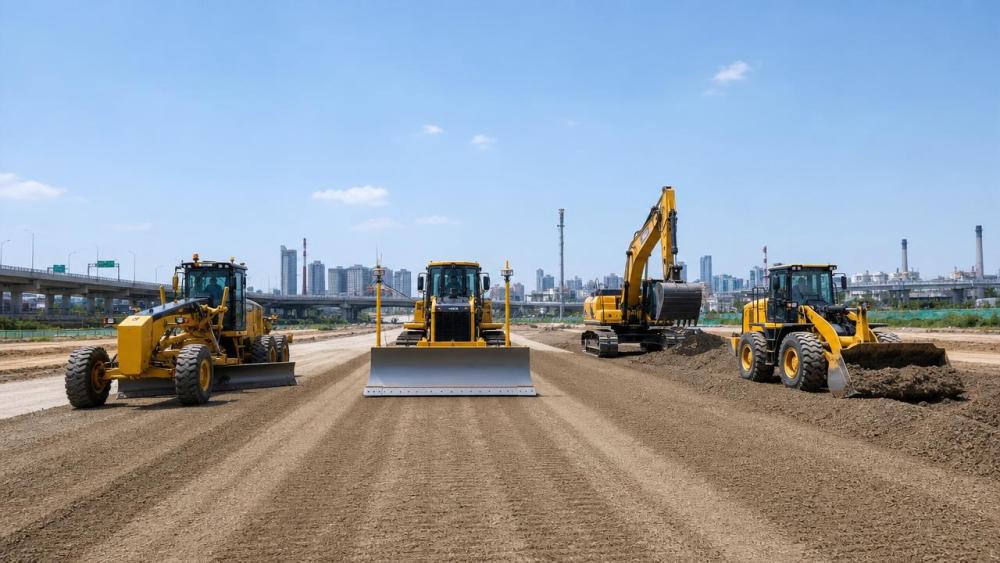
In 2026, road construction machinery is becoming a schedule tool as much as a production asset.
That shift matters because project duration now depends on data accuracy, machine coordination, and uptime stability, not only engine output or bucket size.
Across highways, urban connectors, airport aprons, and industrial access roads, the strongest signal is clear.
Road construction machinery with automation, connected controls, and precision grading is compressing rework, reducing idle intervals, and tightening handoff between crews.
This is not an isolated equipment upgrade.
It reflects a broader infrastructure cycle shaped by labor pressure, emissions regulation, financing discipline, and higher expectations for delivery certainty.
Seen through the lens of EMD’s earthmoving intelligence, the center of gravity is moving from raw force toward orchestrated performance.
Crawler excavators, wheel loaders, motor graders, bulldozers, and skid steer loaders are being judged by how well they fit digital workflows.
The implication is practical.
Road construction machinery decisions now influence mobilization speed, tolerances, fuel planning, maintenance windows, and even risk exposure in claims discussions.
Why this shift is becoming visible in 2026
Several forces are converging at once, and they are reinforcing one another.
The first is timeline pressure.
Public and private owners increasingly want shorter closure windows and faster commissioning, especially where traffic disruption carries political or commercial costs.
The second is precision pressure.
As pavement structures become more engineered, upstream grading errors quickly become downstream delays.
The third is emissions and energy pressure.
Non-road equipment rules are tightening, while fuel volatility is pushing contractors to examine every hour of machine utilization.
The fourth is labor reality.
Experienced operators remain difficult to replace, which raises the value of intuitive controls, semi-autonomous functions, and machine guidance.
More interestingly, these drivers favor integrated fleets rather than stand-alone machines.
This is why road construction machinery is now discussed alongside scheduling software, site connectivity, and production analytics.
The machines gaining influence are not always the biggest ones
From recent deployment patterns, the most valuable road construction machinery often sits at the intersection of precision and flexibility.
Motor graders are a prime example.
With GPS, IMU correction, and laser-assisted systems, graders are turning subgrade and base preparation into a more repeatable process.
That repeatability protects downstream paving productivity.
Bulldozers are also changing roles.
Hydrostatic drive improvements and blade control integration help push material with fewer correction passes, especially on variable terrain.
Crawler excavators remain essential, but their value is expanding beyond excavation.
Electro-hydraulic responsiveness supports trenching accuracy, shoulder work, drainage preparation, and safer interaction with utility constraints.
Wheel loaders and skid steer loaders are becoming rhythm machines.
They keep materials, attachments, and compact work zones moving without creating bottlenecks around paving and grading crews.
EMD has long framed these categories as pillars of infrastructure productivity.
In 2026, that framing feels especially accurate because the schedule benefit comes from fleet choreography, not from one flagship machine.
What is changing inside the fleet mix
- More compact equipment is being added for urban road packages and staged rehabilitation zones.
- Grade-critical machines are receiving software upgrades faster than structural redesigns.
- Attachment versatility is becoming a schedule hedge in utility-heavy or narrow-access sites.
- Connected telemetry is moving from a maintenance tool to a production planning input.
Automation and connectivity are reducing hidden delays
A major timeline problem in roadwork has always been invisible lost time.
Waiting for survey checks, correcting grade drift, reassigning machines, and troubleshooting after a fault can consume entire shifts.
This is where smart road construction machinery is reshaping outcomes.
Machine control systems reduce dependency on repeated staking.
Fleet dashboards show underused assets before they become expensive idle inventory.
Remote diagnostics shorten the gap between warning and intervention.
Low-latency communication, a subject closely tracked by EMD in remote-control architecture, is also becoming relevant outside mines.
On complex road packages, stable connectivity supports faster supervision across dispersed crews and subcontracted tasks.
The result is not full autonomy everywhere.
The result is fewer interruptions between intention, execution, and verification.
The gains showing up most often
- Shorter setup time at the start of each work zone
- Lower overcut and overfill in earthmoving phases
- More consistent base and slope quality across shifts
- Better machine handoff between earthmoving and fine grading
- Earlier warning of maintenance risks that threaten sequence plans
Electrification is moving from pilot status to selective schedule strategy
Not every road construction machinery category will electrify at the same speed.
Still, the conversation has matured.
The practical question is no longer whether electrification is coming, but where it improves delivery performance today.
Compact loaders, support equipment, and some urban-duty machines are early fits because charging windows and duty cycles are easier to manage.
For larger road construction machinery, hybridization, idle reduction, and smarter hydraulic efficiency may matter sooner than full battery conversion.
This matters for timelines because energy logistics shape production continuity.
Noise restrictions, emission caps, and night-work permissions can turn lower-emission machines into schedule enablers.
In dense urban corridors, the machine that can keep operating under tighter environmental limits may be the one that protects the completion date.
The impact is spreading across planning, execution, and risk control
The influence of road construction machinery trends is not limited to field productivity.
It now reaches estimating assumptions, bid strategy, staffing models, and contractual risk posture.
Estimators must account for machine-assisted precision when modeling cycle times and material volumes.
Schedulers need realistic allowances for software integration, calibration, and charging or fueling transitions.
Site teams benefit when digital models, survey data, and equipment settings are aligned before mobilization.
Risk teams also have a new task.
They need clearer governance around data ownership, machine logs, remote support access, and cyber resilience.
The more connected road construction machinery becomes, the more operational resilience depends on information discipline.
Areas worth reviewing now
- Whether current site data can feed 3D machine control without frequent manual correction
- Whether service support matches the sophistication of the equipment mix
- Whether urban projects need a different balance between compact and heavy machines
- Whether emissions compliance could constrain future working hours or access permits
The next smart move is to evaluate readiness, not chase every new feature
There is no single ideal road construction machinery roadmap for every portfolio.
Projects differ by terrain, closure limits, climate, material availability, and utility complexity.
What does translate broadly is the need for phased readiness.
Start by identifying where delays actually originate.
If grade correction is the issue, precision grading technology may outperform additional horsepower.
If machine downtime is recurring, telematics and support response may deliver the strongest return.
If urban restrictions are tightening, quieter and cleaner road construction machinery may protect workable hours.
That is why intelligence platforms such as EMD matter in this cycle.
The market is no longer sorted by machine category alone.
It is increasingly sorted by who can connect hydraulic capability, digital control, and decarbonization logic into dependable execution.
In the months ahead, keep watching fleet integration, grading accuracy, emissions adaptation, and service responsiveness.
Those four signals will say more about future project timelines than headline horsepower ever could.
A sensible next step is to review current projects against these signals, compare equipment performance by delay source, and build a staged upgrade plan.