
Related News
- 00
0000-00
How to size heavy-duty loaders for North American mining operations - 00
0000-00
How altitude affects mining excavator performance in Latin America - 00
0000-00
Caterpillar Launches New Cat 6060 and Upgraded Autonomous Mining System - 00
0000-00
When does eco-friendly construction equipment pay for itself? - 00
0000-00
Will a wheel loader quick coupler fit your existing attachments?
What to Evaluate Before Signing an OEM Equipment Cooperation Agreement
Before signing an OEM equipment cooperation agreement, most teams start with unit price, tooling cost, and lead time. Those matter, but they rarely decide whether the relationship will actually work. In heavy equipment and industrial machinery, a poor OEM partnership usually fails somewhere else first: the hydraulic system does not match the application, documentation is incomplete for target markets, engineering change control is loose, or after-sales responsibilities are left vague until the first field complaint arrives.
That is especially true in categories such as crawler excavators, wheel loaders, motor graders, bulldozers, and skid steer loaders, where equipment performance is tied directly to uptime, jobsite safety, fuel efficiency, operator confidence, and brand reputation. A machine may look competitive on paper, yet become expensive if failure rates rise, parts support is inconsistent, or local compliance work has to be rebuilt by the buyer.
For business evaluators, the right question is not simply, “Can this supplier build the machine?” It is closer to, “Can this partner support the machine, the market, and the business model we are trying to build over the next several years?”
Start with fit, not factory scale
A large factory and an impressive equipment portfolio can create false confidence. OEM equipment cooperation works best when the supplier’s engineering logic matches your actual market position. If you are targeting rental fleets, for example, serviceability, parts commonality, operator simplicity, and durability under mixed usage may matter more than headline performance. If you are targeting premium infrastructure contractors, control precision, telematics integration, emissions readiness, and grade-control compatibility may carry more weight.
In earthmoving equipment, the application gap can be costly. A crawler excavator configured for one region’s soil conditions, fuel quality, and operator habits may not translate well to another. The same goes for wheel loaders working in aggregates versus port handling, or motor graders expected to interact with advanced GPS or laser-based site systems. Before any legal review begins, the commercial side should confirm that the supplier understands the machine’s working environment, duty cycle, operator expectations, and maintenance realities.
This is one reason intelligence-led evaluation matters. EMD’s coverage of construction machinery tends to focus not just on machines themselves, but on the interaction between hydraulic breakout force, control logic, grading precision, emissions transition, and autonomy trends. That broader view is useful because OEM agreements often fail when one side treats the product as a static unit and the other is planning for a moving technology roadmap.
Technical compatibility is more than a specification sheet
A common mistake in supplier selection is to compare only rated power, operating weight, bucket size, travel speed, or breakout force. Those specifications are necessary, but they do not reveal enough about integration risk.
In an OEM equipment cooperation agreement, technical due diligence should go deeper into areas such as hydraulic architecture, electronic control systems, attachment interfaces, software access, fault diagnostics, and component sourcing. If the machine uses electro-hydraulic proportional control, for instance, who owns calibration parameters? If your brand intends to localize telematics or remote diagnostics later, will the OEM provide data access, API support, or at least structured communication protocols? If the machine is expected to support autonomy features in the future, is the electrical architecture ready for that path or already near its limits?
These questions are no longer niche. As EMD’s Strategic Intelligence Center often highlights, the industry is moving toward electrification, remote operation, and tighter digital integration. Even if your current agreement covers conventional diesel platforms, it is worth checking whether the partner’s engineering team can support future iterations without redesigning the entire platform from scratch.
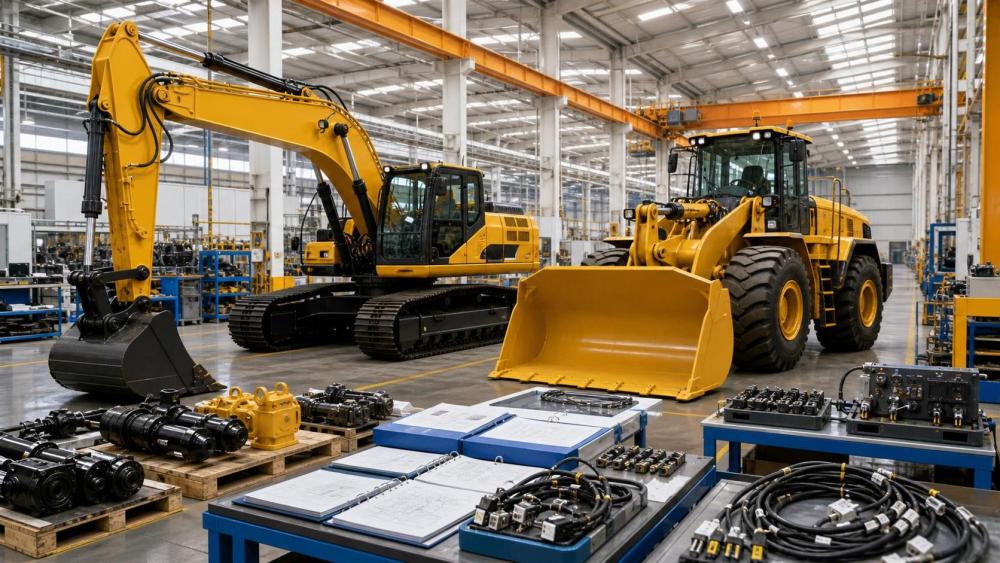
The most practical way to evaluate this is to request structured engineering documentation early: bill-of-material logic, major component brands, interface definitions, control architecture summaries, and change-management procedures. You do not need every proprietary detail, but you do need enough visibility to judge whether the platform is stable, maintainable, and extensible.
Quality systems matter more than promises about inspection
Nearly every manufacturer will say quality is under control. The real question is how that control works when production volumes rise, suppliers change, or field issues emerge. Business evaluators should look for evidence of process discipline rather than broad claims.
That means reviewing incoming material control, weld consistency management, torque traceability for critical assemblies, hydraulic cleanliness practices, test procedures, final inspection records, and nonconformance handling. In heavy machinery, many expensive failures begin with small process weaknesses: contamination in hydraulic circuits, loose fastener control, inconsistent hose routing, poor harness protection, or uneven assembly standards across shifts.
It is also wise to ask how warranty feedback is translated into engineering correction. A supplier that can list common field failure modes and explain what changed in design or process is often a safer long-term partner than one that insists problems are rare. In other words, maturity is not the absence of issues; it is the ability to identify, contain, and solve them.
Compliance should be checked against target markets, not assumed
For cross-border OEM cooperation, regulatory risk is often underestimated until late in the project. Non-road mobile machinery may face different emissions, safety, noise, lighting, labeling, operator protection, documentation, and import requirements depending on destination market. A machine accepted in one region may still need meaningful changes before it is saleable in another.
This becomes more important as emission regulations tighten and as buyers look at electrified or hybrid platforms. A supplier may be technically strong in one product class but less prepared in compliance file management, homologation support, or multilingual technical documentation. Evaluators should confirm what the OEM will provide, what must be localized by the buyer, and who bears the cost if compliance assumptions prove incomplete.
There is no single checklist that fits every market, so this part usually needs review against actual target countries, machine classes, and end-use applications. Still, one principle holds: never treat regulatory readiness as a side note in the legal annex. It belongs in the core business decision.
Delivery stability is a supply chain question, not just a lead-time question
A quoted delivery time tells you very little by itself. What matters is whether the supplier can hold that timing through demand swings, component shortages, logistics disruptions, and engineering changes. In machinery, a plant may assemble the final unit but still depend heavily on external suppliers for engines, hydraulics, undercarriage systems, electronics, tires, or steel structures.
Ask where the bottlenecks are. Which components have long replenishment cycles? Are there single-source dependencies? Does the OEM keep safety stock for critical parts, or is everything built around forecast accuracy? Can production be prioritized for your orders during peak periods, and if so, under what commercial terms?
For equipment classes like bulldozers or excavators, one delayed subsystem can hold up shipment of a complete machine. Evaluators should therefore review delivery resilience at the subsystem level, not only at the finished-machine level. If the cooperation involves CKD, SKD, or localized assembly, the logistics exposure is even greater because packaging quality, part identification, assembly documentation, and kit completeness become part of the risk profile.
Clarify ownership, exclusivity, and engineering change control early
Many disputes in OEM relationships are not caused by price; they come from assumptions that were never fully written down. Brand usage, exclusivity by territory or channel, mold and tooling ownership, spare parts rights, software access, and product improvement responsibilities should all be addressed before signature.
Engineering change control deserves special attention. If the supplier changes a hydraulic pump source, a controller revision, a steel grade, or even a hose routing design, who must be informed? What changes require prior approval? How are old and new parts managed in the field? For business evaluators, this may seem technical, but it directly affects inventory exposure, warranty cost, and legal defensibility if something fails after a silent product change.
A sound OEM equipment cooperation agreement should make room for controlled evolution. The heavy equipment market is not standing still. EMD’s long view of infrastructure machinery shows how quickly machine expectations are shifting toward lower emissions, smarter control, higher uptime visibility, and better operator assistance. A frozen agreement in a changing market usually becomes a commercial problem before it becomes a legal one.
After-sales capacity is part of the product
If a supplier can produce the machine but cannot support parts supply, service training, troubleshooting, and technical updates, the product is incomplete. This is especially true in markets where downtime penalties are high or fleets operate in remote mining, infrastructure, or municipal environments.
Review spare parts structure, recommended stocking lists, lead times for wear and failure parts, service manual quality, training plans, and escalation paths for complex failures. The right level of support depends on the product category. Skid steer loaders used in urban utility work may need fast turnaround and broad attachment support. Motor graders tied to precision road work may require stronger electronic diagnostics and calibration guidance. Excavators in hard-duty applications may need closer attention to undercarriage wear, hydraulic sealing, and cooling-system performance.
A useful test is simple: if the first 20 units enter the field, what happens when the first serious failure appears? If neither side can answer that clearly, the agreement is not ready.
Use a decision lens that combines today’s contract with tomorrow’s market
In industrial equipment, the best OEM partner is not always the one with the lowest initial cost or the broadest catalog. It is usually the one whose product architecture, quality discipline, compliance readiness, supply chain stability, and service model align with your target market and brand promise.
That is why informed evaluation matters so much in construction machinery. Whether the platform is a crawler excavator built around hydraulic precision, a wheel loader optimized for bulk movement, a grader dependent on sensing accuracy, or a bulldozer designed for extreme tractive effort, the agreement should reflect how the machine will actually live in the field. EMD’s industry perspective is useful here because it connects machine performance with larger forces shaping the sector: decarbonization, autonomy, digital control, infrastructure investment cycles, and the growing premium on reliability.
Before signing, it is worth pausing on a final set of checks: Are the technical assumptions documented? Are compliance responsibilities allocated? Are supply chain weak points visible? Are field service obligations practical? And does the partnership still make sense if the market shifts toward stricter emissions rules, smarter machine control, or different demand patterns in the next few years?
If those answers are still fuzzy, the contract is probably early. If they are clear, specific, and backed by evidence, you are no longer just buying equipment capacity. You are building a cooperation model that has a better chance of surviving real-world use.