
Related News
- 00
0000-00
How to size heavy-duty loaders for North American mining operations - 00
0000-00
How altitude affects mining excavator performance in Latin America - 00
0000-00
Caterpillar Launches New Cat 6060 and Upgraded Autonomous Mining System - 00
0000-00
When does eco-friendly construction equipment pay for itself? - 00
0000-00
Will a wheel loader quick coupler fit your existing attachments?
For procurement teams sourcing excavators, loaders, graders, and other heavy equipment across borders, every supplier decision carries operational and financial risk. Using a reliable global supplier reference framework helps buyers verify capability, consistency, and compliance before contracts are signed. This article explores how procurement professionals can turn supplier references into a practical risk-control tool for safer, smarter equipment sourcing.
In heavy equipment sourcing, the word “reference” is often handled too casually. Many buyers still treat it as a box to tick near the end of supplier qualification: ask for a few customer names, place a few calls, record positive feedback, and move forward. That approach may work for low-risk purchases. It is far less effective when the asset is a crawler excavator heading into a mining project, a motor grader tied to a road-building timeline, or a wheel loader expected to run in a high-utilization quarry environment.
For these categories, a poor supplier choice does not just create price variance. It can trigger shipment delays, weak parts support, field failures, compliance exposure, idle crews, and disputes over warranty responsibility across jurisdictions. In that context, supplier references are not a formality. They are a source of operational evidence.
Why references matter more in global equipment sourcing than in domestic buying
Cross-border procurement adds layers of uncertainty that do not always appear on a quotation sheet. A supplier may offer an attractive unit price, acceptable lead time, and polished technical documentation, while still being a weak fit for the buyer’s actual risk profile. References help test whether the supplier performs under real-world conditions rather than in presentation materials.
That matters especially in heavy machinery because performance is rarely determined by the machine alone. A supplier’s value also depends on manufacturing consistency, pre-shipment inspection discipline, export packaging, spare parts responsiveness, commissioning support, documentation accuracy, and the ability to handle claims without months of friction.
References become even more important when buyers face one or more of the following situations:
- the supplier is new to the buyer’s region;
- the machine configuration is customized;
- the project schedule leaves little room for delivery slippage;
- local emissions, safety, or import compliance requirements are strict;
- after-sales support must be coordinated across dealers, agents, and OEM facilities.
In those cases, a reference is not simply proof that the supplier has sold equipment before. It is evidence of how the supplier behaves when complexity appears.
What a useful supplier reference actually looks like
Procurement teams often receive references that are technically real but commercially weak. A list of customers with no project context does not say much. Nor does a generic endorsement from a partner with limited machine hours on the equipment.
A useful reference has three qualities: relevance, verifiability, and comparability.
Relevance means the referenced project resembles your own sourcing case. If you are buying 36-ton crawler excavators for high-dust, high-hour aggregate work, a reference from a landscaping contractor using compact equipment is of limited value. If you need Stage V or EPA-compliant units, references for unregulated markets may not answer your key concerns. The closer the operating environment, duty cycle, and service model are to your own, the more informative the reference becomes.
Verifiability means the reference can be checked through direct conversation, external trade records, local market feedback, service networks, or project documentation. A name without a role, location, or deployment details is hard to trust.
Comparability means the information can be evaluated across suppliers using the same questions. Otherwise references become anecdotal and difficult to use in a procurement decision matrix.
Strong procurement teams do not ask, “Can you provide references?” They ask, “Can you provide references for machines of similar tonnage, regulatory configuration, operating conditions, and delivery region within the last 24 months?” That small shift usually changes the quality of what comes back.
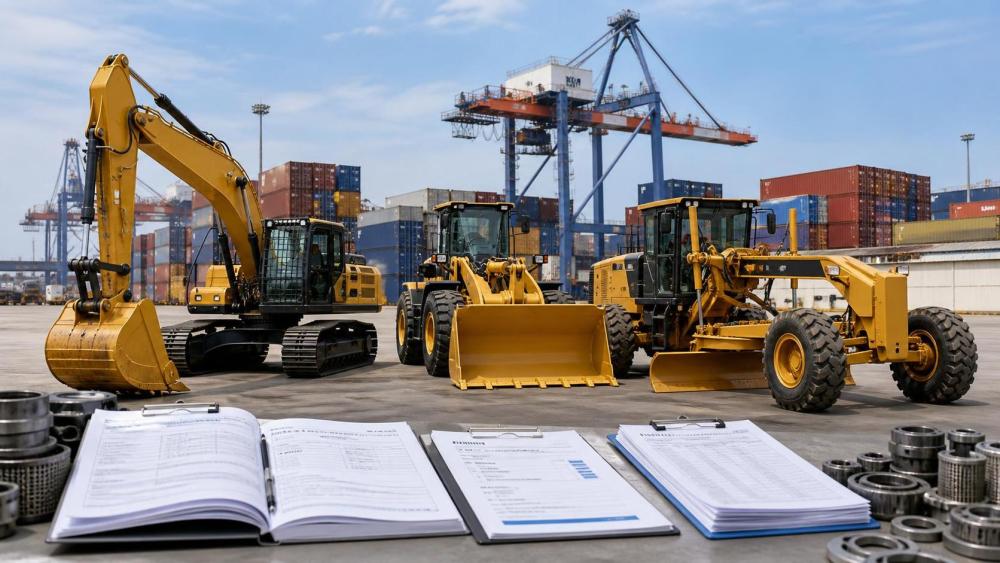
Which reference signals reduce risk most effectively
Not all reference checks produce equal value. For heavy equipment buyers, the most useful signals usually sit in five areas.
Delivery performance. Did the supplier ship on the committed schedule? Were documents accurate for customs clearance? Did machines arrive with the agreed specification, attachments, and labeling? Delays at this stage can erase any initial price advantage.
Product consistency. Was the delivered fleet uniform in build quality and configuration? In equipment procurement, inconsistency across units can create spare parts complexity, technician confusion, and unpredictable uptime.
Field reliability. How did the machines perform after 500, 1,000, or 2,000 hours? Early-life reliability matters because many hidden quality issues do not show up during factory inspection. References from customers with meaningful operating hours are more valuable than fresh deliveries.
After-sales responsiveness. When hydraulic, electrical, telematics, or undercarriage issues emerged, how quickly did the supplier respond? Did they provide root-cause analysis, replacement parts, and technical support, or did they default to delay and argument?
Claim behavior. This is one of the most underused but most revealing areas. Almost every industrial supplier can point to successful deliveries. The stronger question is how they handled a failure, shortage, or mismatch. A supplier’s conduct under stress often tells buyers more than a perfect project reference.
For procurement purposes, references that speak only about “good cooperation” are weak. References that describe lead time adherence, commissioning quality, defect rates, wear performance, parts fill rates, and dispute resolution are decision-grade.
How to structure reference checks so they support purchasing decisions
References become much more useful when they are treated as part of a sourcing method rather than an informal conversation. For procurement teams, that means building a repeatable reference framework and linking it to sourcing gates.
One practical approach is to use references at three stages.
During supplier prequalification, references help screen out unproven vendors before engineering and commercial resources are spent in depth. At this stage, the goal is not to validate every detail but to confirm that the supplier has credible export experience, relevant installations, and a support model that matches the target market.
During shortlisting, references should be used comparatively. Buyers can run a standard interview sheet covering delivery, quality, support, documentation, and warranty behavior. This makes it easier to compare suppliers that look similar on paper.
Before award or contract signature, the reference check should become more targeted. If one supplier appears commercially attractive but carries concerns around emissions documentation, local service capability, or parts availability, the final reference round should focus directly on those points.
In larger purchases, references should feed into a weighted supplier evaluation model rather than sit in email folders. If a vendor scores well on price but poorly on evidence of service execution, that should be visible in the sourcing decision.
Questions procurement teams should actually ask reference customers
The quality of a reference check depends heavily on the questions asked. Vague questions produce polite answers. Targeted questions produce operational insight.
Useful questions include:
- What equipment did you purchase, and in what quantity?
- How similar was your application to ours in terms of load profile, terrain, climate, and operating hours?
- Did the supplier deliver on time and to full specification?
- Were there any deviations between the quote, technical files, and actual shipment?
- How did the machines perform during the first year of operation?
- What were the most common technical issues, if any?
- How quickly were spare parts supplied for urgent cases?
- Did the supplier provide adequate commissioning, training, or troubleshooting support?
- How were warranty claims handled in practice?
- Would you buy again from the same supplier for the same use case?
The last question is especially helpful, but it should not stand alone. A customer may say yes because pricing was aggressive, local alternatives were limited, or switching costs were high. Procurement teams need the reasoning behind the answer.
Common mistakes when using references in equipment sourcing
The most common mistake is accepting only supplier-selected references. Naturally, suppliers share accounts that present them favorably. That does not make the references false, but it does mean the sample is biased. Buyers should ask for different types of references: recent deliveries, long-term users, cross-border shipments, and cases involving similar machine classes.
Another mistake is focusing only on OEM brand reputation while ignoring the execution capability of the actual exporting entity, distributor, or manufacturing site. In global machinery trade, the contract party, production location, and service party are not always the same. A strong brand name does not automatically remove channel risk.
A third error is using references too late. If reference checks happen only after commercial alignment is nearly complete, teams may be reluctant to change direction even if warning signs emerge. References work best when they shape the shortlist, not just the final file.
There is also a tendency to overvalue positive language and undervalue missing detail. In B2B equipment markets, weak references often sound acceptable until you notice what they do not mention: no machine hours, no service experience, no information on claim resolution, no specifics about repeat orders.
What references cannot tell you on their own
Even strong references have limits. They should reduce uncertainty, not replace due diligence. A capable supplier may still be a poor fit if your compliance requirements, local support expectations, or payment risk controls differ from those of the referenced customer.
References also cannot fully confirm current manufacturing conditions. A supplier that performed well two years ago may now face capacity strain, component shortages, ownership change, or quality drift. This is particularly relevant in periods of volatile steel costs, hydraulic component bottlenecks, freight instability, or shifting emissions rules.
That is why procurement teams should combine references with other verification tools such as factory audits, financial checks, export records, third-party inspection, sample parts orders, and contract-level service commitments.
For regulated markets, references also do not replace formal compliance verification. If equipment must meet specific safety, emissions, or import requirements, buyers should confirm the applicable standards independently. Requirements vary by market and product category, and specific certifications should be checked case by case. Where documentation is unclear, the correct label is not “acceptable risk” but “【待核实】”.
Building a practical global reference framework for heavy equipment procurement
The most effective procurement organizations treat references as structured evidence across the supplier lifecycle. In practice, that means creating an internal framework with a few disciplined elements.
Start by grouping suppliers by risk level. A standard wheel loader purchase for a familiar market may require lighter reference depth than a customized excavator package for a remote mining project.
Then match the reference requirements to the sourcing exposure. Higher-risk purchases should require:
- multiple customer references across different regions or applications;
- at least one reference involving after-sales or warranty interaction;
- evidence of relevant export and documentation capability;
- confirmation of parts support and escalation paths.
Procurement teams should also retain reference outcomes in a supplier knowledge base. This matters because machinery buying is not always a one-time event. A supplier that performed well for compact machines may not be equally strong in larger-tonnage equipment, in electrified variants, or in markets with tighter compliance controls. Over time, stored reference intelligence becomes more valuable than isolated conversations.
As construction equipment becomes more connected, the content of references is also changing. Buyers increasingly need to ask about software support, telematics reliability, calibration tools, remote diagnostics, and data access rights in addition to traditional mechanical performance. For fleets moving toward lower-emission or more automated platforms, those questions will become central rather than optional.
Where references fit in the total cost picture
For procurement teams under cost pressure, references may seem secondary to unit price negotiations. In reality, they are closely tied to cost control. A cheaper supplier with weak delivery discipline, inconsistent quality, or poor parts support can quickly become the higher-cost option once downtime, emergency freight, contractor penalties, or early replacement are taken into account.
In heavy equipment categories, total cost is shaped by more than acquisition price. Availability, fuel efficiency, wear life, serviceability, technician training, and residual value all matter. References help buyers test whether the supplier can support those outcomes in real operating conditions.
That is why experienced buyers do not ask whether references are necessary. They ask whether the references are decision-quality. If they are not, the sourcing risk remains largely unchanged.
Global equipment procurement will only get more complex as supply chains regionalize, emissions rules evolve, and customers demand better uptime with tighter capital discipline. In that environment, the procurement teams that use supplier references well are not the ones collecting the most names. They are the ones turning reference checks into evidence about execution, resilience, and lifecycle cost.
A credible supplier reference is not praise. It is proof that the supplier can deliver the machine, support the asset, and handle problems when the project is already moving. For buyers of excavators, loaders, graders, bulldozers, and skid steers, that distinction is where sourcing risk is either reduced early or paid for later.