
Related News
- 00
0000-00
How to size heavy-duty loaders for North American mining operations - 00
0000-00
How altitude affects mining excavator performance in Latin America - 00
0000-00
Caterpillar Launches New Cat 6060 and Upgraded Autonomous Mining System - 00
0000-00
When does eco-friendly construction equipment pay for itself? - 00
0000-00
Will a wheel loader quick coupler fit your existing attachments?
Why does an equipment specification sheet deserve a slower read?
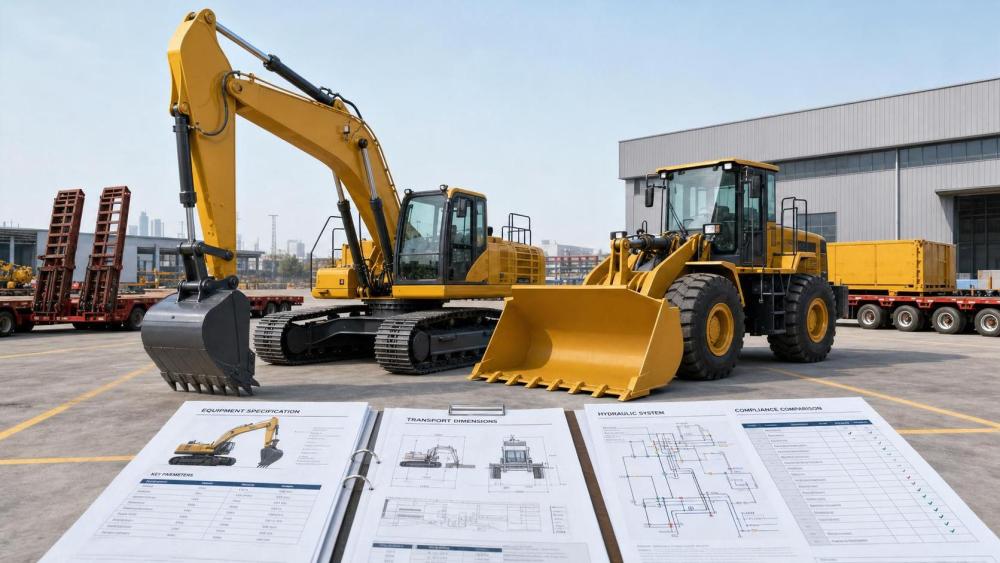
An equipment specification sheet often looks tidy, numeric, and easy to compare. The problem is that major risks rarely sit in one obvious line.
For excavators, loaders, graders, dozers, and skid steers, the same spec can signal different real-world outcomes depending on application, duty cycle, and site conditions.
That is why reading an equipment specification sheet is less about collecting numbers and more about testing whether those numbers fit the intended job.
A strong sheet helps identify capability, compliance, and operating limits. A weak reading leads to underperformance, attachment mismatch, transport issues, and faster wear.
In heavy machinery markets, EMD tracks this problem closely because machine selection now sits between productivity pressure, emissions regulation, automation upgrades, and asset utilization targets.
So the key question is not whether the equipment specification sheet exists. It is whether the sheet is being interpreted in context.
Which lines on the equipment specification sheet usually hide the biggest risks?
The most expensive mistakes usually come from lines that seem precise but are actually conditional. Rated values often depend on test standards, configuration, and optional packages.
Start by checking these areas before comparing price:
- Operating weight: confirm whether the figure includes standard bucket, full fuel, operator, counterweight, and protective structures.
- Engine power: check gross versus net power, and note the emissions stage attached to the rating.
- Hydraulic flow and pressure: these determine attachment performance more reliably than headline horsepower.
- Breakout force or tractive effort: verify the test method and whether boost modes were used.
- Reach, dump height, blade width, or grading precision: geometry matters only if matched to the working envelope.
- Transport dimensions: width, height, and shipping weight can change permit needs and mobilization cost.
In practice, footnotes matter as much as the main values. One optional undercarriage, tire size, or linkage can shift the usefulness of the entire equipment specification sheet.
This is especially true for crawler excavators and dozers, where ground pressure, counterweight setup, and track shoe choice affect stability and site suitability.
A quick risk screen before deeper comparison
Before ranking models, it helps to use a short decision table. It turns a dense equipment specification sheet into a practical review tool.
How do you tell whether the sheet matches the real job, not just the brochure story?
A useful equipment specification sheet should answer a jobsite question. If a number cannot be tied to workload, cycle demand, or material type, it is easy to misread.
For example, a wheel loader with attractive bucket capacity may still disappoint if breakout force, hinge pin height, and axle durability do not support the material density involved.
The same pattern appears with motor graders. Millimeter-level control claims matter only when the machine includes the sensing, software, and hydraulic response needed for fine grading.
More often, the best reading method is to map each specification to a field condition:
- Rock, clay, sand, demolition, or aggregate handling
- High altitude, heat, mud, steep grades, or confined urban access
- Attachment dependence, such as breakers, augers, compactors, or grading systems
- Daily operating hours and expected maintenance intervals
If the equipment specification sheet does not clearly support those conditions, more clarification is needed before shortlisting the machine.
This is where EMD-style analysis becomes relevant. In modern fleets, selection is no longer about isolated iron. It includes hydraulic logic, control architecture, and future upgrade compatibility.
What differences between brands or regions can distort a fair comparison?
Two machines may look equivalent on paper and still behave differently in service. The equipment specification sheet can hide this through inconsistent rating methods.
One common issue is standards variation. Engine ratings, lifting charts, and stability limits may follow different regional rules or testing assumptions.
Another issue is configuration bias. A spec may reflect a premium package, while the quoted machine uses a lower trim or different undercarriage.
Electrification and autonomy features add another layer. Remote-control readiness, telematics, and low-latency communication hardware are not always included in the base specification.
For buyers comparing global offerings, the better approach is to normalize the equipment specification sheet around:
- Same application setup
- Same attachment assumptions
- Same emissions compliance level
- Same transport and site constraints
- Same service support expectation
Without that normalization, the comparison becomes neat in format but unreliable in substance.
Where do lifecycle cost and compliance risks usually appear on the sheet?
Many cost overruns begin with a narrow reading of acquisition data. The equipment specification sheet often hints at future cost, even when it does not show a full ownership model.
Look closely at engine stage, fuel consumption references, service intervals, lubrication points, filter access, and telematics integration.
A machine that meets the price target but falls short on emissions compliance can become unusable in regulated markets or public infrastructure projects.
Likewise, a machine with advanced electro-hydraulic control may offer better precision, yet it also requires stronger diagnostic support and software familiarity.
That does not make complexity a problem by itself. It means the equipment specification sheet should be read together with parts availability, technician capability, and update policy.
For dozers and excavators working in long cycles, even small differences in hydrostatic efficiency, idle management, or remote monitoring can materially change cost per productive hour.
A practical checklist before approval
- Confirm every headline number against the exact machine configuration being quoted.
- Request the test standard behind lift, power, force, and productivity claims.
- Check whether attachments need auxiliary hydraulic upgrades or software activation.
- Review emissions and safety compliance for the target country and project type.
- Estimate transport, setup, and service impacts before comparing unit price alone.
So what is the smartest way to use an equipment specification sheet in a final decision?
Use the equipment specification sheet as a screening tool, not as the final proof of suitability. Its real value comes from disciplined comparison.
A sound review usually moves through three layers. First, check baseline fit for capacity, dimensions, and compliance. Then verify application fit under actual site conditions. Finally, test lifecycle assumptions.
When those layers are documented, it becomes easier to reject attractive but risky options. It also creates a cleaner record for internal review and supplier clarification.
For machinery categories followed by EMD, this matters even more because equipment is evolving fast. Decarbonization, autonomy, and precision control are changing what a specification sheet needs to prove.
The next step is simple and concrete: build a comparison sheet around the job, not around the brochure. Mark every unclear figure, every optional feature, and every compliance question.
That approach turns the equipment specification sheet from a sales document into a decision document, which is exactly where risk begins to drop.