
Related News
- 00
0000-00
How to size heavy-duty loaders for North American mining operations - 00
0000-00
How altitude affects mining excavator performance in Latin America - 00
0000-00
Caterpillar Launches New Cat 6060 and Upgraded Autonomous Mining System - 00
0000-00
When does eco-friendly construction equipment pay for itself? - 00
0000-00
Will a wheel loader quick coupler fit your existing attachments?
How OEM Equipment Production Planning Reduces Costly Schedule Delays
A delayed excavator, grader, loader, or dozer is rarely an isolated purchasing problem. On an infrastructure program, it can hold up site access, bulk earthworks, haul-road preparation, utility trenching, final trimming, and the crews scheduled to follow. Rental substitutions may keep a job moving temporarily, but they can also introduce unfamiliar controls, missing machine-control interfaces, unsuitable attachments, or maintenance obligations that were never part of the original plan.
That is why OEM equipment production planning deserves attention long before a machine reaches final assembly. It is the discipline of connecting a project’s required-on-site date with the manufacturer’s build capacity, supplier lead times, engineering configuration, inspection process, transport route, and commissioning requirements. Done well, it turns an estimated delivery window into a managed sequence of decisions. Done poorly, it leaves the delivery date dependent on assumptions that may no longer be true once a specification changes or a critical component becomes constrained.
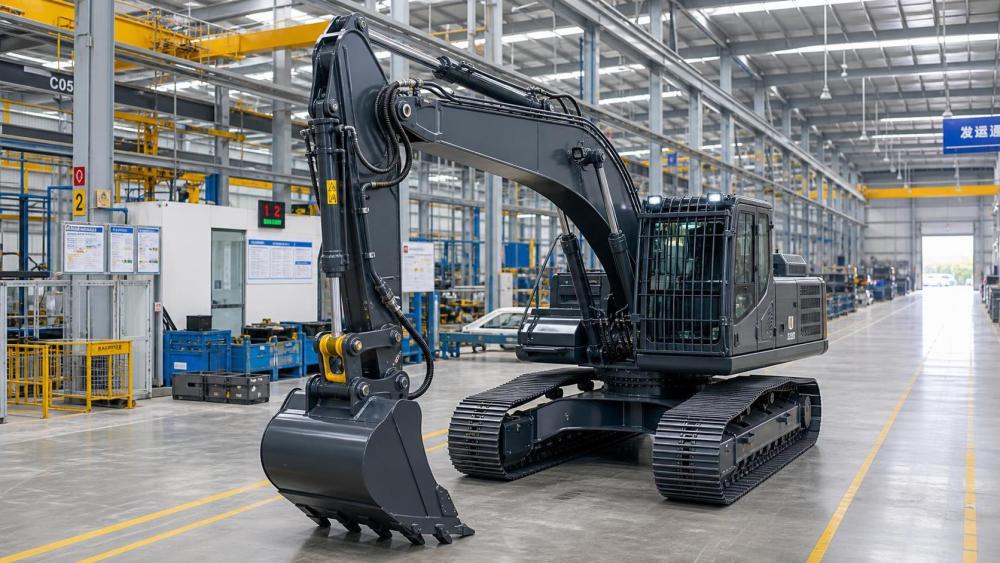
For heavy earthmoving fleets, the issue is more complicated than reserving a production slot. A crawler excavator may need a particular boom-and-arm arrangement, auxiliary hydraulic circuits, guarding, quick coupler compatibility, telematics hardware, or emissions configuration. A motor grader intended for precision road formation may require machine-control preparation, sensors, and software integration. Each item can affect the bill of materials, engineering approval path, test procedure, and shipment readiness.
The Real Schedule Starts Before Factory Assembly
A common planning error is to treat “production lead time” as the entire delivery timeline. In reality, the clock often starts earlier: when a project team defines the operating requirement, when the OEM confirms the configuration, and when long-lead components are allocated. It continues after assembly through quality checks, export documentation where applicable, port or inland transport scheduling, receiving inspections, and site commissioning.
The practical question is not simply, “When can the machine be built?” It is, “What must be true for this machine to be productive on the date the workfront opens?” A machine that arrives physically on site but lacks its approved attachments, grade-control calibration, operator familiarization, or correct fuel and emissions specification may still fail to protect the programme.
This distinction matters particularly on projects with linked activities. A bulldozer may be needed to establish stable access before trucks and loaders can work efficiently. Graders may need to arrive before a pavement crew begins fine preparation. Compact skid steer loaders can be critical in constrained urban zones where larger equipment cannot operate. The first machine delayed is not always the most expensive unit; it is often the unit sitting on the project’s operational critical path.
A sound OEM equipment production planning process therefore begins with a deployment map rather than a procurement list. The map should identify each machine’s required-on-site date, acceptable fallback date, intended role, mandatory configuration, attachments, commissioning dependencies, and the activity it unlocks. This gives both the buyer and manufacturer a more useful basis for prioritizing decisions.
Configuration Discipline Prevents Late Surprises
Late specification changes are among the most avoidable causes of delivery movement. They are not always frivolous. A revised geotechnical condition may justify a different bucket, undercarriage option, or track shoe. A site safety review may require additional cameras, access protection, fire suppression, or guarding. A client may decide that 3D machine-control readiness is essential after the original order has been released.
The problem is timing. Once an OEM has released a machine into its planning and material-allocation system, even a small alteration can trigger checks across engineering, purchasing, assembly sequencing, and quality documentation. An accessory that appears minor in a commercial quotation may be a controlled factory-installed option, an externally sourced item, or an interface requiring validation. Treating all changes as interchangeable creates false confidence.
A practical approach is to separate requirements into three categories before the order is finalized:
- Build-critical items: choices that affect the base machine, drivetrain, hydraulic architecture, emissions package, electrical system, structural arrangement, or factory test process.
- Deployment-critical items: attachments, machine-control components, tires or tracks, operator protection, telematics activation, and other elements required for the planned work.
- Post-delivery options: items that can genuinely be fitted, configured, or activated without compromising safe operation, warranty conditions, or commissioning timing.
The OEM should confirm which category applies rather than leaving the distinction to assumption. A configuration freeze date is then useful, but only if it is supported by a formal change-control path. When a change is unavoidable, the planning team needs a clear answer on what it affects: material availability, production slot, shipping date, acceptance test, cost, or all of them.
Visibility Is More Valuable Than a Single Promised Date
A promised delivery date has limited value if no one can see the conditions behind it. Better planning uses a set of milestones that reveal whether the plan remains healthy. These milestones do not need to expose confidential factory details. They do need to distinguish between an indicative commercial estimate and a date supported by released engineering, available components, scheduled assembly, completed inspection, and booked transport.
Milestone visibility also changes the quality of escalation. Instead of asking an account contact for a general update, a project team can ask whether a specific issue has been resolved and what the next decision deadline is. If a key hydraulic component is delayed, the question becomes whether an approved alternative exists, whether another build sequence is possible, and whether the affected unit is actually on the project critical path.
Supply-Chain Risk Should Be Managed by Consequence
Not every supply interruption warrants the same response. Heavy equipment production depends on a wide network of engines, hydraulics, electronics, fabricated structures, driveline assemblies, cabs, sensors, and specialized attachments. Some components can be rescheduled with little effect. Others are unique to a configured machine and cannot be replaced without technical review. The useful measure is not merely whether a part is late, but what that delay does to the deployment plan.
For example, an excavator intended for standard bulk excavation may have more practical substitution options than a grader configured for a tightly controlled airport or road-finishing operation. A fleet may be able to redeploy an existing wheel loader for temporary stockpile work, while there may be no ready substitute for a dozer with the specified blade, track arrangement, and site-required protection package. Planning should reflect these differences.
A useful risk review asks four direct questions: Which machines unlock the next workfront? Which options are single-source or long lead? Which site requirements make a substitute unacceptable? And what decision must be made before the fallback date disappears? This is more actionable than maintaining a generic supply-chain risk register filled with items that have no owner or recovery action.
Plan the Handover, Not Just the Shipment
A machine’s arrival can create a second bottleneck if the site is unprepared. Oversize transport access, unloading capacity, secure parking, fuel arrangements, maintenance support, operator authorization, and digital-system setup may all need to be ready. On connected equipment, data permissions and telematics workflows should be established early enough to support fleet oversight from the first operating shift.
Machine-control systems deserve particular care. For graders and excavators working to digital terrain models, the equipment, sensors, software version, site coordinate framework, and control files must align. The hardware can arrive on time while the production activity still waits for calibration or approved design data. Similar issues arise when remotely controlled or semi-autonomous equipment is used in hazardous environments: communications architecture, operating procedures, and site acceptance cannot be left until the machine is at the gate.
The Global Earth-Mover Dynamics (EMD) follows these connections across crawler excavators, wheel loaders, motor graders, bulldozers, and skid steer loaders because delivery reliability increasingly depends on more than factory throughput. Hydraulic capability, digital positioning, emissions requirements, and autonomy-related systems are becoming part of the planning conversation. EMD’s infrastructure-focused intelligence perspective is useful here: the relevant unit of analysis is not simply the machine, but the machine’s readiness to perform a defined task within a larger construction sequence.
What Strong OEM Planning Looks Like in Practice
The most resilient plans are collaborative without becoming bureaucratic. The project schedule provides the operational dates and consequences. The OEM provides configuration, material, assembly, and inspection visibility. Dealers, distributors, or logistics partners may manage local delivery, commissioning, parts support, and regulatory documentation. Each party should know which dates are fixed, which dates are forecast, and who has authority to resolve a conflict.
It is also sensible to avoid relying on a single fleet-wide arrival date. Phased delivery can reduce exposure where the work sequence permits it: early units support mobilization and initial earthworks, while later units arrive closer to their actual need date. This approach is not automatically better; it depends on storage, financing, maintenance capacity, and programme logic. But it can be preferable to waiting for every customized machine to be ready before releasing any equipment.
Contingency should be specific rather than symbolic. A credible fallback may include resequencing non-critical work, securing compatible temporary equipment, using an existing fleet asset in another role, or approving an alternative attachment. It should not mean assuming that any similarly sized machine can perform the same work. Ground pressure, hydraulic flow, breakout force, attachment compatibility, precision capability, and local compliance requirements can make apparent substitutes unsuitable.
Make Delivery Readiness a Project-Control Item
OEM equipment production planning reduces schedule delays when it is treated as part of project controls, not an administrative task delegated entirely to procurement. The key discipline is to connect machine configuration and production milestones to the workfronts they enable, then review exceptions early enough to preserve options.
Before committing to a delivery plan, confirm the required operating configuration, the production-release assumptions, the critical components or external systems involved, the logistics handover points, and the site acceptance activities that stand between shipment and productive work. For complex earthmoving programmes, those details are where weeks are often gained or lost. Visioning earthmoving dynamics means looking beyond the delivery promise and understanding the chain of readiness behind it.