
Related News
- 00
0000-00
How an earthmoving equipment portal helps vet factory capabilities - 00
0000-00
How to assess equipment specifications against applicable standards - 00
0000-00
How Middle East climate conditions should shape heavy equipment selection - 00
0000-00
Can an industrial equipment sourcing supplier directory improve vendor selection? - 00
0000-00
How earthmoving equipment is applied in canal construction
Heavy Machinery Parts: Why the OEM vs Aftermarket Debate Matters More Than Price
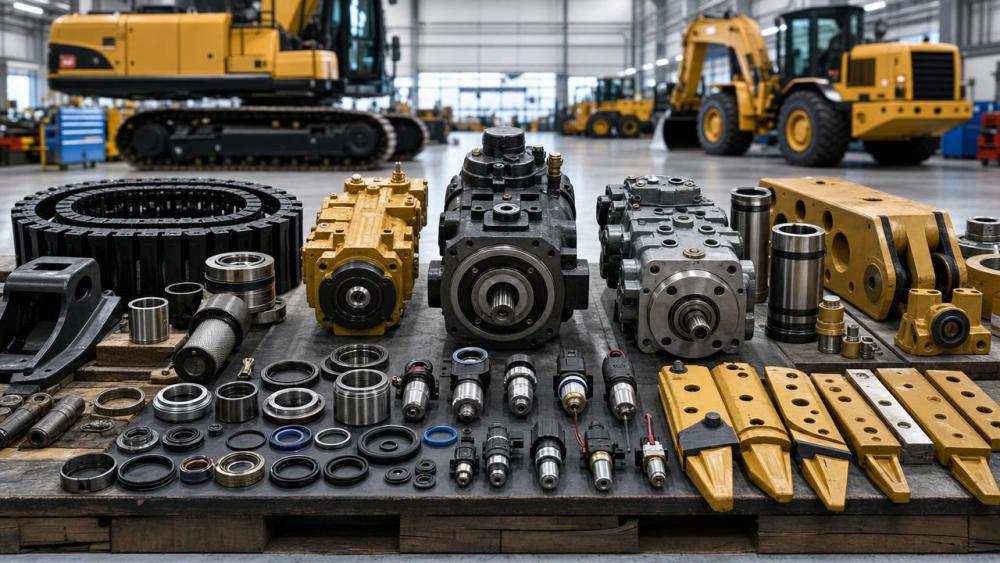
Choosing heavy machinery parts looks simple until downtime enters the equation.
A lower purchase price can disappear fast when a crawler excavator, wheel loader, or bulldozer misses critical working hours.
That is why the OEM versus aftermarket question remains central across construction, mining, grading, and urban equipment fleets.
In practical terms, the real trade-off includes service life, fit accuracy, warranty implications, shipping delays, and maintenance planning.
For machines operating under high hydraulic loads or strict grade tolerances, part quality affects more than repair cost.
It can influence fuel burn, operator confidence, attachment response, and total asset utilization.
EMD follows these decisions closely because modern earthmoving equipment is moving toward tighter controls, cleaner powertrains, and more connected systems.
As machines become smarter, the wrong heavy machinery parts can create hidden costs that are harder to trace.
What really separates OEM and aftermarket heavy machinery parts?
OEM parts come from the original equipment manufacturer or an approved production channel tied to the machine platform.
Aftermarket parts are produced outside that original brand network, although quality levels can vary widely.
The biggest misunderstanding is assuming aftermarket always means low quality.
Some aftermarket suppliers build to strong standards and perform well in selected applications.
The second misunderstanding is believing OEM always delivers the lowest total cost.
In slower-moving wear categories, that is not always true.
A more useful way to compare heavy machinery parts is by function and consequence.
- High-risk parts include hydraulic pumps, electronic sensors, final drive components, and control valves.
- Mid-risk parts often include undercarriage items, pins, bushings, cutting edges, and seal kits.
- Lower-risk categories may include filters, mirrors, basic lighting, mats, or cosmetic panels.
The closer a part sits to safety, calibration, emissions compliance, or machine intelligence, the more careful the comparison should be.
When does OEM usually justify the higher upfront cost?
OEM heavy machinery parts usually make more financial sense when failure carries a large operational penalty.
That often applies to excavators handling severe breakout cycles, graders working to fine tolerances, and loaders running continuous high-load shifts.
In these cases, precise fit and software compatibility matter as much as metal strength.
A sensor that reads slightly off can affect engine derating, hydraulic behavior, or grade-control accuracy.
A cheaper seal or hose assembly may survive in light duty, yet fail early in heat, dust, or pressure spikes.
OEM also tends to be the safer route under active warranty, extended service agreements, or regulated emissions conditions.
That matters more now because decarbonization rules and electronic controls are tightening across non-road equipment markets.
EMD’s coverage of autonomous and remote-controlled equipment also points to another issue.
Once machines rely on low-latency communication and precision electro-hydraulic response, part consistency becomes a strategic factor, not just a maintenance choice.
A quick judgment table helps clarify the trade-off
Where can aftermarket heavy machinery parts deliver real savings?
Aftermarket heavy machinery parts often create value in mature fleets, predictable service intervals, and non-sensitive wear applications.
This is common with skid steer loaders, support machines, or older bulldozers where the economic goal is extending usable life sensibly.
The smarter approach is selective substitution, not blanket replacement.
For example, an aftermarket cutting edge may be reasonable if the steel specification, hardness profile, and field history are transparent.
The same logic can apply to rollers, idlers, hoses, or common service kits.
Lead time is another practical reason buyers shift away from OEM-only sourcing.
If a machine is parked while waiting weeks for a branded part, the cheapest catalog line loses relevance.
In actual jobsite economics, availability can outweigh list price by a wide margin.
Still, savings only count when the supplier can document material consistency, manufacturing tolerance, and claims support.
How should cost be measured beyond the invoice price?
This is where many heavy machinery parts decisions improve or fail.
Invoice price is only one cost layer.
A better calculation includes replacement frequency, installation labor, freight urgency, collateral damage, and lost production.
That matters especially on earthmoving assets tied to project milestones or mine output schedules.
A part that lasts 20 percent longer may produce stronger value than one priced 15 percent lower.
Likewise, a component with better dimensional accuracy can reduce fitting time and prevent repeat service calls.
One useful method is to score options against total operating impact.
- Expected service life under actual duty.
- Risk of secondary system damage.
- Availability within required shutdown windows.
- Compatibility with software, sensors, and emissions systems.
- Claim response and documentation quality.
This framework fits the direction of the heavy equipment industry.
Machines are no longer just steel and hydraulics.
They are increasingly integrated systems where a low-cost part can disrupt a high-value machine function.
What mistakes cause the worst OEM versus aftermarket decisions?
The first mistake is comparing part price without comparing failure consequence.
A final drive seal and a cabin mirror do not belong in the same buying logic.
The second mistake is using one sourcing rule for every machine family.
Motor graders with precision controls deserve a different threshold than older support equipment.
Another common error is ignoring supplier depth.
A credible aftermarket source should provide traceability, warranty terms, field references, and technical data without hesitation.
It is also risky to overlook installation quality.
Even good heavy machinery parts can underperform when contamination control, torque procedure, or calibration is weak.
Finally, there is a timing mistake.
Waiting until failure occurs usually forces emergency buying, which narrows options and raises total cost.
A practical checklist before deciding
- Confirm whether the part affects safety, controls, emissions, or machine software.
- Check if the equipment is under warranty or tied to performance guarantees.
- Review actual failure history, not generic catalog claims.
- Compare lead times against planned maintenance windows.
- Ask for material, tolerance, and testing evidence on non-OEM options.
So what is the most reliable buying strategy for heavy machinery parts?
The strongest strategy is rarely OEM only or aftermarket only.
It is a segmented policy built around machine criticality, duty intensity, and downtime exposure.
For flagship excavators, precision graders, and highly loaded wheel loaders, OEM coverage often deserves a larger share.
For aging support assets and predictable wear categories, vetted aftermarket heavy machinery parts may improve lifecycle economics.
This balanced view aligns with the way EMD analyzes fleet performance.
The future of earthmoving depends on reliability, data integrity, energy efficiency, and disciplined asset use.
Part sourcing now sits inside that larger operational picture.
A sensible next step is to map parts into critical, moderate, and routine categories, then compare options by total cost, not sticker price.
That creates a repeatable standard for future repairs, planned overhauls, and fleet expansion decisions.
In the end, the best heavy machinery parts choice is the one that protects uptime without hiding tomorrow’s cost inside today’s discount.