
Related News
- 00
0000-00
How to size heavy-duty loaders for North American mining operations - 00
0000-00
How altitude affects mining excavator performance in Latin America - 00
0000-00
Caterpillar Launches New Cat 6060 and Upgraded Autonomous Mining System - 00
0000-00
When does eco-friendly construction equipment pay for itself? - 00
0000-00
Will a wheel loader quick coupler fit your existing attachments?
Tags
A hydraulic drive bulldozer makes sense on steep terrain when the job depends more on controlled, repeatable movement than on sustained high-speed pushing. The strongest fit is a slope where the operator must frequently modulate ground speed, change direction under load, maintain blade control during descent, or work around changing traction conditions. In those situations, smooth hydrostatic response can reduce abrupt track spin, lessen shock loading, and help the machine stay predictable.
That does not mean hydraulic drive is automatically the right choice for every hillside cut. A long, open push with uniform material and plenty of turning room may favor a conventional drivetrain, especially where production is measured mainly by moved volume over a long cycle. The decision should begin with the terrain, material behavior, required finish tolerance, and the consequences of losing control—not with the transmission label alone.
The slope situation that changes the equipment decision
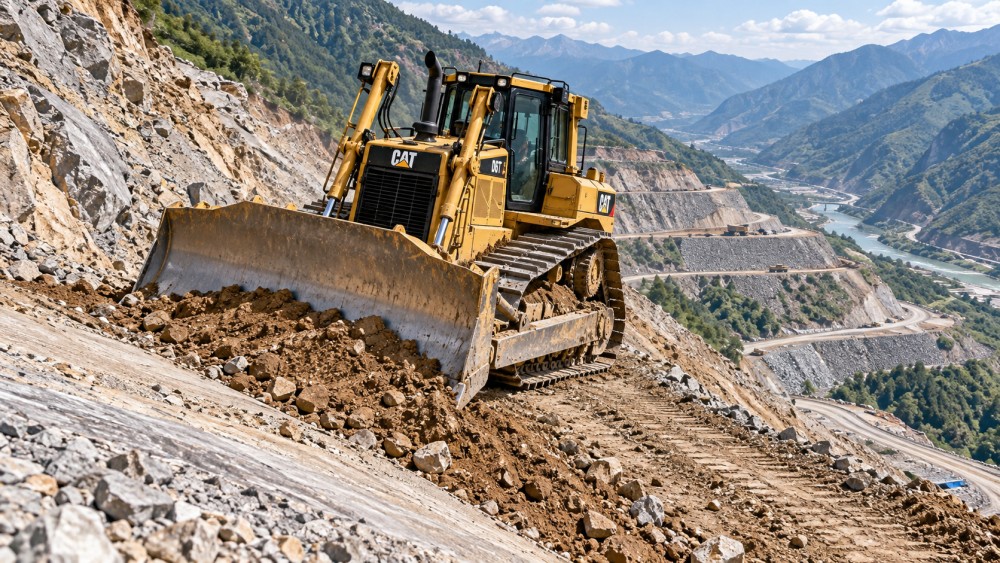
Steep work becomes difficult when several conditions overlap: the machine is crossing a side slope rather than climbing directly; the surface alternates between firm ground and loose spoil; the blade load changes quickly; or the work area leaves little room to straighten the machine before reversing. A dozer can have ample rated power and still become inefficient when the operator must repeatedly back off the throttle, brake, shift, or correct a developing slide.
A hydraulic drive bulldozer is particularly useful where the machine must creep with a loaded blade while holding a precise travel speed. Hydraulic drive systems generally allow continuous speed variation within a range rather than requiring distinct gear changes. The operator can match track speed to ground resistance with smaller corrections. On a slope, those small corrections matter because a sudden change in torque or travel speed can disturb the track-ground interface and start a slide that is difficult to recover cleanly.
The value is not simply “more traction.” Track traction remains limited by undercarriage condition, soil shear strength, track shoe selection, machine balance, and slope angle. The advantage is more accurate use of available traction. Instead of applying power in larger steps and then correcting spin or momentum, the operator can apply it progressively.
Where hydraulic drive usually earns its place
The technology tends to justify its cost and complexity in work that requires fine control through repeated changes in resistance. The following operating conditions are strong indicators.
Controlled downhill work with a blade load
Descending with material in front of the blade requires more than braking. The dozer must control its own weight, the force of the moving material, and the changing grade beneath the tracks. A machine that accelerates too quickly can push material beyond the intended line, overload the blade, or lose directional stability. Hydrostatic drive can provide controlled deceleration and a more gradual response as resistance changes, helping the operator maintain a deliberate descent rather than alternating between coasting and aggressive correction.
This is especially relevant when building benches, trimming access roads, shaping drainage swales, or maintaining controlled spoil placement. The objective is often not maximum material displacement per pass; it is keeping the blade, tracks, and machine body stable while preserving the planned grade.
Side-slope trimming and contour work
Cross-slope travel creates a different problem. Gravity pulls the machine downhill while the blade may be cutting into the uphill side, carrying material, or trying to maintain a shoulder. Directional corrections need to be gradual. An abrupt steering input can unload one track, disturb the blade load, or cause the machine to yaw downhill.
Hydraulic drive is useful here because forward/reverse transitions and steering response can be made with less interruption to the machine’s balance. This does not eliminate rollover risk or make unsafe side-slope angles acceptable. It does, however, support more controlled repositioning when the approved operating plan requires frequent short passes across varying contours.
Rocky or variable subgrade
A slope may look consistent from a distance but contain buried rock, fractured ledges, wet seams, loose fill, or compacted haul-road sections. Every change affects drawbar pull. On a conventional drivetrain, the operator may need to select a gear that is either too aggressive for weak patches or too slow for firmer sections. A hydraulic system can better accommodate those transitions by allowing speed to be reduced without an abrupt shift event.
This becomes valuable around cut-to-fill transitions, reclamation areas, quarry benches, and mountainous right-of-way work. The operator can hold the blade closer to a stable working load rather than allowing resistance to build until track slip or machine lurch becomes the warning sign.
Precision grading on short, steep sections
Short runs often demand more control than long ones. There may be a crest, a drainage outlet, a retaining feature, a haul-road edge, or another machine near the work zone. With limited runout, a dozer that must stop, reverse, and reset frequently benefits from responsive travel control. The smoother the reversals, the easier it is to maintain a consistent blade approach and avoid disturbing a finished surface.
Where grade-control systems are used, stable low-speed movement also helps the operator act on guidance without overcorrecting. The transmission does not create grading accuracy on its own; blade linkage condition, calibration, operator technique, and site control still determine the final result. But a machine that responds predictably at low speed gives those systems a more manageable platform.
Do not confuse control advantages with unlimited slope capability
A frequent selection error is treating hydraulic drive as a substitute for a slope assessment. It is not. A dozer may still be unsuitable if the ground cannot support its bearing pressure, if the slope is beyond the manufacturer’s operating guidance, if the material can suddenly liquefy or slough, or if there is no safe recovery route. A controlled drivetrain cannot prevent a slide caused by saturated clay, frozen-over mud, voids beneath fill, or a failed edge.
Before assigning any dozer to steep terrain, review the actual travel path rather than only the design grade. A usable path can be materially steeper in localized sections because of ruts, windrows, loose rock, or crossfall. The following questions expose risks that are often missed during equipment planning:
- Will the machine travel straight up and down the slope, work across it, or alternate between both?
- Is the surface compacted, layered, wet, blasted, frozen, or freshly placed?
- Does the task require carrying a substantial blade load downhill or pushing uphill into a cut?
- Are there berms, drop-offs, soft shoulders, buried utilities, or constrained turnaround areas?
- Can the operator stop and reverse safely if traction declines halfway through a pass?
- Will rain, seepage, traffic, or haul activity change the condition during the shift?
These answers also determine whether a low-ground-pressure configuration, wider track shoes, different blade arrangement, site drainage work, or a revised sequence is more important than the drive type itself.
Comparing the job against a conventional drivetrain
A practical comparison should focus on cycle behavior, not generalized claims about one transmission being superior. Conventional powershift-style dozers can be highly effective in sustained heavy pushing, bulk earthmoving, and applications where the operator can select a working gear and maintain it over a relatively predictable push. They are often well understood by maintenance teams and may suit fleets with established parts, service procedures, and operator familiarity.
The comparison is not a reason to disregard productivity. A hydraulic machine can lose time if the task actually calls for long, high-load pushes with minimal need for modulation. Conversely, a machine chosen only for peak push capability may lose productive time on a difficult slope through slower corrections, rework, excessive track slip, or more conservative operating margins.
Build the choice around the whole operating system
Transmission selection should be made alongside configuration and work method. A hydraulic drive bulldozer on unsuitable shoes, worn track components, or poorly maintained final drives will not deliver controlled performance. Undercarriage inspection is especially important before slope work because uneven track tension, excessive grouser wear, seized rollers, and damaged idlers can affect how consistently the machine follows the ground.
Blade configuration matters as well. A larger blade is not automatically beneficial on a steep grade. More carried material increases downhill force and can obscure the surface ahead. The appropriate blade capacity depends on material density, moisture, slope direction, and whether the job requires cutting, carrying, spreading, or trimming. In some slope applications, smaller controlled passes produce better progress than attempting to maximize load every cycle.
Work sequencing can reduce risk more effectively than a machine upgrade. Establishing a stable access route, removing loose surface material, constructing safe turn areas, controlling water, and keeping spoil away from vulnerable edges may convert a marginal operating condition into a manageable one. It may also reveal that the slope needs an excavator, winch-assisted method, different haul arrangement, or staged benching before a dozer should enter.
What to verify during a field evaluation
A demonstration or trial should reflect the difficult portion of the intended work, not just level-ground travel. Ask the operator to perform controlled starts on the representative grade, gradual descents with a realistic blade load, short reversals near the expected turnaround area, and fine trimming passes where resistance changes. Watch for track spin, abrupt directional corrections, excessive machine pitch, inconsistent deceleration, and the amount of blade rework needed to maintain the line.
Also evaluate the machine after it has worked long enough to reach normal operating temperature. Hydraulic behavior, responsiveness, and cooling demand must remain acceptable throughout the working cycle. Dust, ambient temperature, altitude, and the severity of the push can affect thermal load. The machine should be assessed with its expected attachments, track configuration, and grade-control equipment, rather than in a simplified setup that will not be used on site.
Maintenance personnel should be part of the decision when the terrain is remote or the project schedule leaves little tolerance for downtime. Hydraulic-drive equipment requires attention to fluid condition, filtration, hose routing, cooling-system cleanliness, and diagnostic capability. This is not an argument against the technology; it is a reminder that precise control depends on a healthy system. A site that cannot maintain hydraulic cleanliness or promptly identify abnormal temperature, pressure, or response behavior should account for that constraint before standardizing on the machine.
A clear decision rule for steep-terrain work
Choose hydraulic drive when the slope work is defined by precision, changing traction, frequent reversals, controlled descent, or finish-sensitive grading, and when the site can support proper maintenance and operator familiarization. Its main contribution is the ability to apply power and change travel behavior progressively when abrupt movement would compromise safety, grade quality, or cycle consistency.
Look beyond hydraulic drive when the work is primarily long-distance, repetitive bulk pushing on stable ground, or when the real problem is unstable material, poor access geometry, inadequate drainage, or an unsafe slope plan. In those cases, resolving the ground and method issues is more important than selecting a different transmission. The right dozer is the one that lets the crew maintain traction, control blade load, and exit the work area safely through the full range of conditions expected on the slope.