
Related News
- 00
0000-00
How to size heavy-duty loaders for North American mining operations - 00
0000-00
How altitude affects mining excavator performance in Latin America - 00
0000-00
Caterpillar Launches New Cat 6060 and Upgraded Autonomous Mining System - 00
0000-00
When does eco-friendly construction equipment pay for itself? - 00
0000-00
Will a wheel loader quick coupler fit your existing attachments?
Hydrostatic transmission sits behind many of the control qualities people notice first in modern construction machinery.
Smooth starts, steady travel, strong low-speed torque, and accurate inching often come from this powertrain choice.
That matters even more now, as equipment evaluation increasingly connects mechanical efficiency with automation, emissions, and lifecycle value.
For sectors tracked by EMD, from bulldozers to skid steer loaders, hydrostatic transmission is not a side topic.
It is a practical lens for understanding machine behavior, jobsite productivity, and technology direction.
What does hydrostatic transmission actually mean in construction machinery?
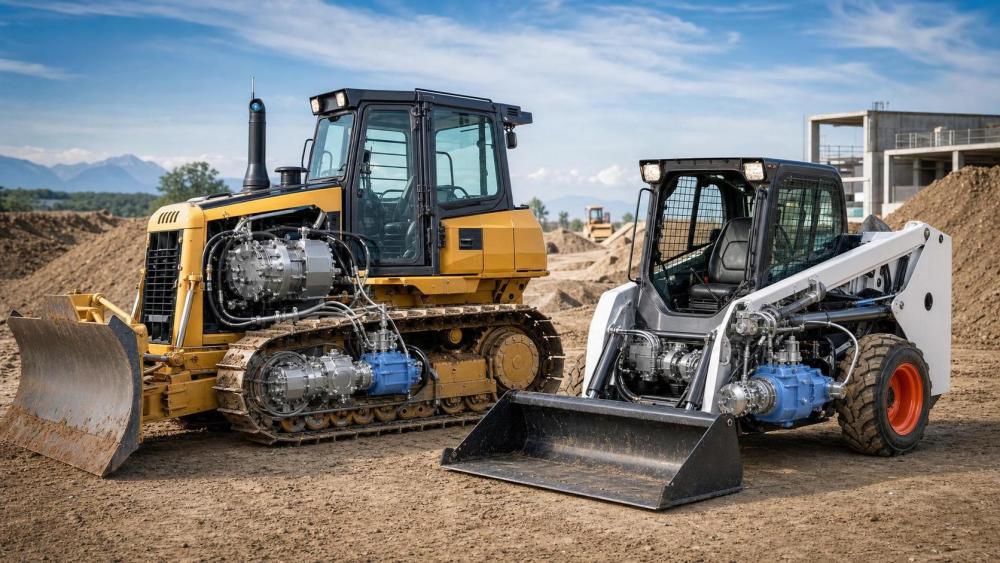
In simple terms, hydrostatic transmission transfers engine power through hydraulic flow rather than only through gears and torque converters.
A typical system uses a hydraulic pump and a hydraulic motor.
The pump creates pressurized oil flow, and the motor converts that flow back into rotary motion.
By changing pump displacement, motor displacement, or both, the machine adjusts speed and tractive effort very precisely.
This is why hydrostatic transmission is common where controlled movement matters more than simple high-speed travel.
Bulldozers, compact loaders, and some grading or material handling platforms benefit from that fine response.
The idea sounds technical, but the field result is easy to recognize.
Operators get smoother modulation, easier reversals, and stronger usable torque at low ground speed.
For EMD’s coverage areas, this links directly to push performance, maneuverability, and grading accuracy.
Why is hydrostatic transmission so valued on real jobsites?
The short answer is controllability.
Construction sites rarely reward raw power alone.
They reward power that can be applied exactly when traction, slope, load variation, and space constraints keep changing.
Hydrostatic transmission helps machines move from standstill without harsh shock loads.
That reduces wheel slip in loaders and improves track control in dozing and fine leveling work.
Another reason is fast directional change.
In repeated forward-reverse cycles, a hydrostatic transmission can feel more responsive than mechanical alternatives.
That is especially useful in urban worksites, quarry handling, stockpile management, and confined infrastructure repair zones.
More importantly, hydrostatic transmission fits the industry's wider shift toward intelligent control.
Electronic management can coordinate engine speed, hydraulic demand, and travel response with much finer logic.
This supports automation features, remote operation, and fuel-saving strategies.
That is one reason EMD often connects powertrain analysis with autonomy and decarbonization trends.
A quick way to compare field expectations
When people compare transmission types, the real question is usually about operating behavior rather than theory.
Which machines benefit most from hydrostatic transmission?
Not every machine gains the same advantage.
The best fit usually appears where speed modulation, traction control, and repeated directional changes define productivity.
Bulldozers are a clear example.
A hydrostatic transmission helps maintain controlled pushing force while supporting smooth steering and precise blade work.
That matters in finish dozing, slope shaping, landfill work, and rough terrain operation.
Skid steer loaders also align well with hydrostatic transmission.
Their zero-radius maneuvering and attachment versatility depend on fast, controlled hydraulic response.
In tight urban jobsites, that responsiveness can be more valuable than top travel speed.
Wheel loaders may use different transmission strategies depending on size and application.
Hydrostatic transmission is often attractive in compact or specialized loader segments where fine modulation improves loading precision.
Motor graders and crawler excavators involve a more complex picture.
Their overall machine architecture depends on more than travel drive alone.
Still, the broader logic remains relevant.
Where precision, smooth response, and integrated electro-hydraulic control dominate, hydrostatic thinking tends to gain importance.
How is hydrostatic transmission different from other transmission options?
This is where confusion often starts.
People sometimes assume hydrostatic transmission is automatically better in every respect.
A more useful view is that it solves a different operating problem.
Mechanical and powershift systems often suit applications that prioritize durable high-speed travel or simpler drivetrain layouts.
Hydrostatic transmission shines when precise control outweighs the need for straightforward gear-based power delivery.
There is also a control-system advantage.
Hydrostatic transmission integrates naturally with sensors, electronic controllers, and machine assistance functions.
That makes it highly relevant in the move toward semi-autonomous construction equipment.
EMD’s strategic coverage often highlights this exact connection.
Transmission choice is no longer only about torque curves.
It is also about data control, emissions strategy, and how a machine behaves within a digital jobsite ecosystem.
A practical comparison checklist
- Look at duty cycle, not only peak output.
- Check low-speed controllability under load.
- Review heat management in continuous operation.
- Compare service complexity and diagnostic needs.
- Assess how the transmission supports automation features.
What are the common mistakes when evaluating hydrostatic transmission?
One common mistake is judging hydrostatic transmission only by brochure language.
Terms like smoothness or efficiency sound attractive, but they need context.
A compact loader in stop-start work may show clear benefits.
A different machine running long, fast travel segments may produce another result.
Another mistake is ignoring thermal behavior.
Hydraulic power conversion creates heat, and poor system matching can reduce efficiency or affect durability.
Maintenance understanding matters too.
Hydrostatic transmission depends heavily on fluid cleanliness, correct pressure settings, and accurate diagnostics.
It should not be treated like a sealed black box.
There is also a strategic mistake that appears more often now.
Some evaluations separate the transmission from broader machine intelligence.
In practice, hydrostatic transmission performance is increasingly linked with control software, sensor calibration, and operator assistance logic.
That is why technical reporting platforms such as EMD treat the topic as part of a system-level analysis.
If you are comparing machines, what should you check next?
Start with the application, not the label.
Ask whether the machine spends most of its time pushing, grading, cycling, climbing, creeping, or traveling long distances.
Then connect that duty pattern to transmission behavior.
It also helps to compare five practical checkpoints.
- Response at low speed with a real working load.
- Fuel consumption across mixed duty cycles, not one test point.
- Cooling capacity in hot climates or long shifts.
- Ease of service, diagnostics, and parts support.
- Compatibility with grade control, telematics, or remote operation plans.
Hydrostatic transmission becomes easier to judge when these factors are reviewed together.
It is not only about whether the system is advanced.
It is about whether the system matches the machine’s actual mission.
For anyone following heavy equipment technology, that is the more reliable next step.
Hydrostatic transmission deserves attention because it connects productivity, control, and future-ready machine architecture in one place.
From bulldozers and loaders to compact urban equipment, its value appears when operating precision truly affects output.
A sensible evaluation should compare application fit, efficiency under real duty, service demands, and integration with intelligent controls.
If the next step is deeper research, build a simple comparison sheet around those points and track how each machine performs beyond headline specifications.