
Related News
- 00
0000-00
How to size heavy-duty loaders for North American mining operations - 00
0000-00
How altitude affects mining excavator performance in Latin America - 00
0000-00
Caterpillar Launches New Cat 6060 and Upgraded Autonomous Mining System - 00
0000-00
When does eco-friendly construction equipment pay for itself? - 00
0000-00
Will a wheel loader quick coupler fit your existing attachments?
A hydrostatic dozer transmission rarely begins overheating for a single, isolated reason. The oil temperature rises because heat is being generated faster than the machine can reject it, and that imbalance can come from excessive internal leakage, inadequate charge flow, restricted cooling, contaminated oil, or an operating condition that keeps the drive at high pressure with little effective ground speed.
For an aftermarket maintenance team, the priority is to separate a cooling problem from a transmission-efficiency problem before changing parts. A plugged cooler can produce high temperature with otherwise normal drive behavior. A worn pump, motor, relief valve, or charge circuit may create heat even after the cooling package has been cleaned. Treating every hot transmission as a radiator issue can delay the repair until the oil has already lost viscosity and the rotating group has suffered damage.
Start by confirming that the temperature reading is credible. Compare the dash indication with a calibrated measurement at the approved test point, then review the conditions under which the temperature climbs: sustained push, high ambient temperature, long travel, frequent directional changes, side-slope work, or a rise that appears even at light load. The pattern often provides the first useful direction for diagnosis.
Begin With the Heat Balance, Not the Fault Code
A hydrostatic drive converts engine power into hydraulic flow and then back into track torque. Every restriction, pressure drop, and internal leakage path converts part of that power into heat. Some heat is normal, particularly during heavy dozing, but a system should stabilize within the manufacturer’s specified operating range once coolant, air flow, and oil flow are adequate.
If temperature rises only under prolonged heavy pushing and drops promptly during a lighter travel cycle, inspect the cooling package and operating technique first. If it climbs quickly during ordinary work, continues rising at low load, or remains elevated after the machine is allowed to idle, assume there may be a loss of hydrostatic efficiency or a problem with oil circulation.
Do not rely on temperature alone. Record engine speed, travel range, commanded direction, ground speed, charge pressure, loop pressure where test access is available, hydraulic oil level, ambient conditions, and the time required for temperature to rise. A single reading tells the team that the machine is hot. A short operating record helps explain why.
Protect Cooling Capacity Before Investigating Internal Components
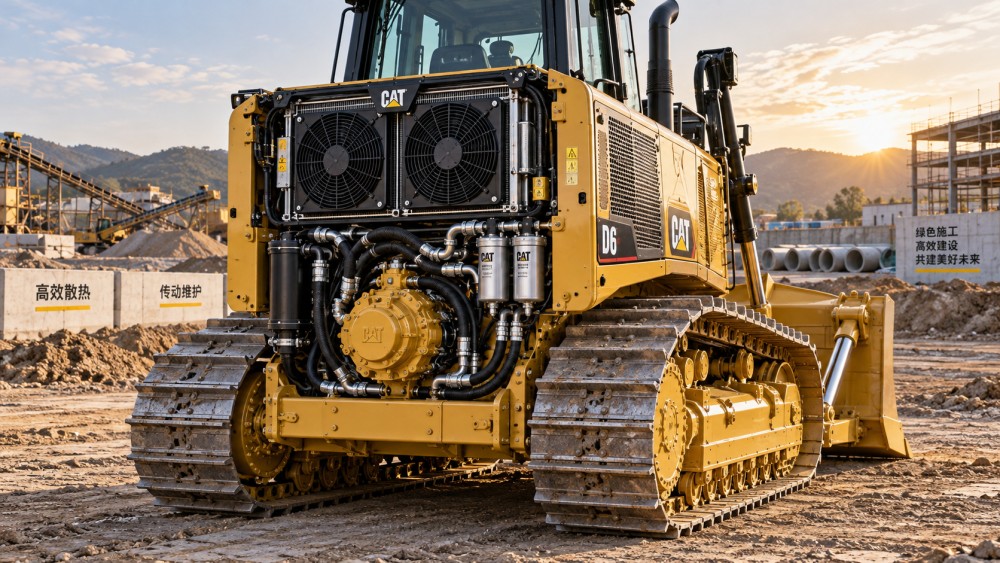
The cooling system is the fastest place to find preventable overheating, especially on dozers working in dusty fill, land clearing, coal handling, demolition, or fine-material grading. Hydraulic coolers can look clean from the outside while the core is packed between fins, behind guards, or against the radiator stack. Air follows the easiest path; damaged seals, missing baffles, and loose side panels can allow it to bypass the cooler instead of passing through it.
Inspect the cooling package as an air-management system rather than a collection of separate cores. Check for:
- Debris embedded in the oil cooler, radiator, charge-air cooler, and condenser stack.
- Fins bent tightly enough to restrict air flow.
- Fan damage, incorrect fan rotation, slipping belts, weak fan drive performance, or an inoperative reversible-fan function.
- Missing seals, panels, shrouds, and core spacers that permit recirculation or bypass.
- Cooler hoses that are internally deteriorated, externally crushed, routed against hot surfaces, or partially restricted.
- Thermostatic or bypass components that fail to direct hot oil through the cooler when required.
Cleaning deserves more care than it sometimes receives. High-pressure washing at the wrong angle can fold fins and drive debris deeper into a stacked cooler pack. Follow the equipment procedure for opening or separating the cores, then clean from the discharge side toward the intake side where possible. After cleaning, inspect air flow again rather than assuming a visually cleaner surface has restored cooling performance.
Oil level also affects heat rejection and pump reliability. Low oil can promote aeration, reduce the available thermal mass, and compromise charge-pump suction. Overfilling is not a harmless correction: churning oil can entrain air and raise temperature. Check the level using the prescribed oil temperature, machine position, and engine condition. A reading taken after shutdown or on a slope may be misleading.
Use Oil Condition as a Diagnostic Signal
Hydrostatic transmissions depend on the oil for lubrication, cooling, control response, and power transmission. Using an oil with the wrong viscosity, additive package, or cleanliness level can change operating behavior long before a hard failure is visible. In cold weather, oil that is too viscous can increase suction losses and pressure drop. At high temperature, oil with insufficient viscosity can increase internal leakage across pumps and motors, reducing tractive efficiency while generating still more heat.
Follow the machine manufacturer’s specified fluid and service interval. “Universal” hydraulic oil is not automatically suitable for a hydrostatic transmission, even when it appears compatible with basic hydraulic systems. The relevant requirement may include friction behavior, anti-wear chemistry, viscosity grade, oxidation resistance, and compatibility with the transmission’s wet brakes, control valves, or final-drive arrangement.
When overheating is reported, take an oil sample before changing the fluid if practical. Look beyond a visual check. Dark oil, burnt odor, foam, water contamination, and metallic debris are warning signs, but lab analysis can reveal wear metals, silicon ingress, viscosity loss, oxidation, and contamination trends that are not apparent in the field. A sample from the reservoir may not identify every localized failure, yet it can establish whether the machine is being exposed to a broader fluid-control problem.
Filter restriction should be assessed with the system’s indicators or pressure measurements, not by appearance alone. A collapsed element, incorrect filter, damaged seal, plugged suction screen, or bypassing filter can affect charge flow and contamination control. Replace filters only with the specified type and verify that the old seal has not remained on the housing. A double-gasketed spin-on filter can create an external leak and a rapid loss of oil.
Charge Pressure Is an Early Warning Point
The charge circuit keeps the closed hydrostatic loop supplied with makeup oil, replenishes internal leakage, supports control functions, and carries hot oil out of the loop for cooling. Low charge pressure is therefore more than a pressure-reading problem. It can allow cavitation, poor directional response, loss of pulling power, and accelerated wear in the pump and travel motors.
Test charge pressure at the specified engine speed and oil temperature, then compare it with the service manual’s requirements for neutral, travel, and loaded operation. A reading that is acceptable when cold may fall below specification once the oil thins. That pattern often points toward a worn charge pump, a sticking charge relief valve, leakage in the charge circuit, a restriction on the suction side, or excessive leakage inside a hydrostatic unit.
Listen for changes that accompany low charge pressure: growling from the pump area, delayed response after shifting direction, surging travel speed, or a drive that feels weak after it has warmed up. These symptoms should not be dismissed as normal behavior on an older machine. They can indicate that the transmission is losing its ability to maintain the oil film and flow needed for efficient operation.
A high charge-pressure reading can also deserve attention. If a relief valve is sticking, a line is restricted, or a control issue is forcing abnormal pressure, energy is being converted into heat. The goal is not simply to find a low number; it is to verify that the charge circuit is controlling pressure and flow as designed.
Find Internal Leakage Before It Becomes a Major Repair
When the cooler is clean, the correct oil is in service, and charge conditions do not explain the temperature rise, investigate the transmission’s internal efficiency. Hydrostatic pumps and motors wear gradually. As clearances increase, more oil leaks internally from high-pressure areas to low-pressure areas. The machine may still move, but it needs more engine power to produce the same track effort, and the lost power becomes heat.
Useful field clues include reduced pushing performance after warm-up, uneven track response, a noticeable loss of travel speed under load, frequent relief-valve noise, or temperature rise that is disproportionate to the work being done. Confirming the cause normally requires manufacturer-approved pressure, flow, case-drain, and control tests. Avoid making a replacement decision solely from a noisy pump or a single pressure reading; valve faults, calibration errors, restricted flushing flow, and external leakage can imitate a failing rotating group.
Case-drain testing is particularly valuable when supported by the service procedure. Excessive case flow can indicate wear in a pump or motor, but the test must be performed at the specified temperature, speed, and load condition. Incorrect connections or an unrestrained measurement hose can create a safety hazard and produce invalid results. Hydrostatic loops can retain dangerous pressure after shutdown, so technicians should use the documented depressurization sequence and rated test equipment.
Do Not Ignore Undercarriage and Operating Load
A transmission can be healthy and still overheat when the dozer is forced to overcome unnecessary resistance. Excessive track tension, seized rollers, damaged idlers, poor track alignment, packed material in the undercarriage, or a dragging brake increases the pressure needed to move the machine. The operator may compensate by using higher engine speed or holding the machine in a demanding travel condition, which drives oil temperature upward.
Blade technique also matters. Continuous high-load pushing in a speed range that keeps the system near maximum pressure can produce more heat than the cooler can reject, especially on hot days or in soft material. The answer is not automatically to reduce production targets. It may involve adjusting push distance, blade loading, machine selection, work sequence, or travel range so the dozer is not spending extended periods at maximum hydraulic demand with limited ground movement.
Repeated direction changes under heavy load deserve scrutiny as well. A hydrostatic dozer is designed for controlled reversals, but aggressive cycling increases heat load and exposes weak charge or control performance. If the machine is used in a short-cycle application, maintenance intervals and cooler-cleaning frequency may need to reflect that duty rather than a generic calendar schedule.
Build a Maintenance Response That Prevents Repeat Failures
Once the immediate cause has been corrected, make the inspection routine specific enough to detect recurrence. Temperature trends are more useful than isolated overheat events. Capture the normal stabilized transmission temperature for comparable work, then investigate deviations before warning thresholds are reached. A gradual upward shift can reveal cooler fouling, changing oil condition, or increasing internal leakage weeks before the machine is forced out of service.
For machines with electronic monitoring, review stored events alongside operating hours and work conditions. An overtemperature code recorded during a single extreme load event carries a different meaning from repeated warnings during ordinary travel. For machines without detailed telemetry, a consistent inspection sheet can provide the same discipline: oil level, cooler condition, visible leaks, filter indicators, undercarriage condition, temperature behavior, and any change in travel response.
The practical objective is to preserve hydraulic efficiency while maintaining the system’s ability to remove heat. Clean cooling air, correct oil, stable charge pressure, controlled contamination, and a free-running undercarriage reinforce one another. When a hydrostatic dozer begins running hot, early diagnosis is usually far less costly than continuing operation until the oil is degraded and the transmission damage becomes unmistakable.