
Related News
- 00
0000-00
How to size heavy-duty loaders for North American mining operations - 00
0000-00
How altitude affects mining excavator performance in Latin America - 00
0000-00
Caterpillar Launches New Cat 6060 and Upgraded Autonomous Mining System - 00
0000-00
When does eco-friendly construction equipment pay for itself? - 00
0000-00
Will a wheel loader quick coupler fit your existing attachments?
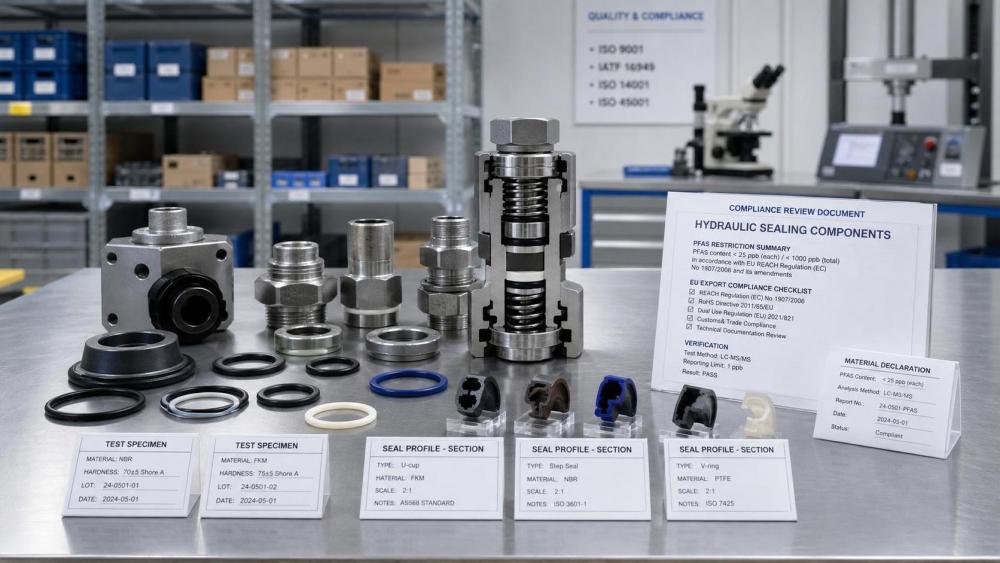
The EU regulatory treatment of PFAS in hydraulic components has moved into an enforceable stage. Effective December 1, 2026, the use of PFAS-containing dynamic seals in hydraulic attachments is prohibited under a new REACH Annex XVII restriction, making this a practical compliance issue for importers, manufacturers, procurement teams, and cross-border supply chain operators that place affected products on the EU market.
What the rule change confirms
On July 2, 2026, the European Commission adopted REACH amendment (EU) 2026/1387. According to the information provided, the amendment adds the use of per- and polyfluoroalkyl substances (PFAS) in dynamic seals used in hydraulic attachments to Annex XVII, entry 77.
The restriction becomes mandatory on December 1, 2026. Importers are required to provide a declaration of conformity and a third-party test report under ISO 21672:2025. If those documents are not available, the stated risks include customs detention and product withdrawal from the market.
Where the pressure is likely to appear first
Border-facing import activity becomes document-driven
From an industry perspective, direct trading companies and importers are likely to feel the impact first because the rule is tied not only to product content but also to documentary proof. The operational pressure is likely to concentrate on customs clearance, import files, and the readiness of conformity statements and third-party test reports.
Component sourcing and manufacturing move closer to compliance screening
Analysis shows that companies sourcing seals or assembling hydraulic attachments may need to review whether dynamic sealing parts used in relevant products fall within the restricted scope. The main business effect is likely to appear in supplier coordination, parts selection, and pre-shipment verification rather than in marketing or sales language.
Distribution and downstream buyers may face delivery and acceptance risk
Distributors, channel operators, and end users purchasing hydraulic attachments for EU-bound business may need to pay closer attention to whether shipments can be supported by complete compliance documents. What deserves closer attention is that the stated enforcement risk includes both customs detention and market withdrawal, which can affect delivery timing, inventory handling, and customer acceptance.
What companies should focus on now
Check which products and parts are actually exposed
Companies should first identify whether their hydraulic attachments use dynamic seals covered by the restriction and whether those products are intended for the EU market. This is a narrower and more practical question than treating all hydraulic products as equally affected.
Prepare documentation before shipment, not after clearance issues arise
The information provided makes documentation a central compliance point. Importers should pay close attention to the availability, consistency, and timing of declarations of conformity and third-party test reports referencing ISO 21672:2025, because missing files create a direct trade risk under the stated enforcement framework.
Recheck supplier communication and evidence chains
Observably, supplier qualification will matter not only in commercial terms but also in evidence quality. Companies may need to confirm whether upstream suppliers can provide usable compliance support, whether test documentation aligns with the shipped goods, and whether records can withstand customs or market surveillance review.
Separate the legal trigger from broader market assumptions
It is more appropriate to understand this update as a specific legal restriction with immediate operational consequences, rather than as a complete picture of PFAS regulation in all hydraulic products. That distinction matters when companies set procurement priorities, customer communications, and shipment planning.
Why this matters beyond a single compliance notice
Analysis shows that this development already represents a confirmed regulatory result, not a preliminary discussion, because the amendment was adopted and a mandatory effective date was given. At the same time, it is also more appropriate to understand it as a signal that market access in the EU increasingly depends on product-level substance control and document-backed proof, especially for components that might previously have received less public attention than finished equipment.
What deserves closer attention is not only the prohibition itself, but the combination of a restriction, a fixed enforcement date, and explicit documentary expectations for importers. For many businesses, that combination turns a legal update into a supply chain execution issue.
How this update is best understood at this stage
This is not simply a short-term news item. It is a concrete compliance change with a defined start date and stated enforcement consequences for affected hydraulic attachments using PFAS-containing dynamic seals. From an industry perspective, the most balanced reading is that the rule creates an immediate need for product screening and documentation readiness, while broader commercial effects will still depend on how individual companies, suppliers, and import flows are structured.
Basis of this article and points to keep verifying
This article is based on the user-provided news title, event date, and event summary. For this type of development, commonly relevant source categories include official regulatory notices, company disclosures, industry association updates, authoritative media coverage, and standard-setting organization documents.
No specific official source link was provided in the input, so the exact official publication path still needs to be continuously verified. Follow-up attention should remain on any further official wording, implementation-related clarifications, and document expectations connected to the REACH amendment, the Annex XVII entry, and ISO 21672:2025.