
Related News
- 00
0000-00
How to size heavy-duty loaders for North American mining operations - 00
0000-00
How altitude affects mining excavator performance in Latin America - 00
0000-00
Caterpillar Launches New Cat 6060 and Upgraded Autonomous Mining System - 00
0000-00
When does eco-friendly construction equipment pay for itself? - 00
0000-00
Will a wheel loader quick coupler fit your existing attachments?
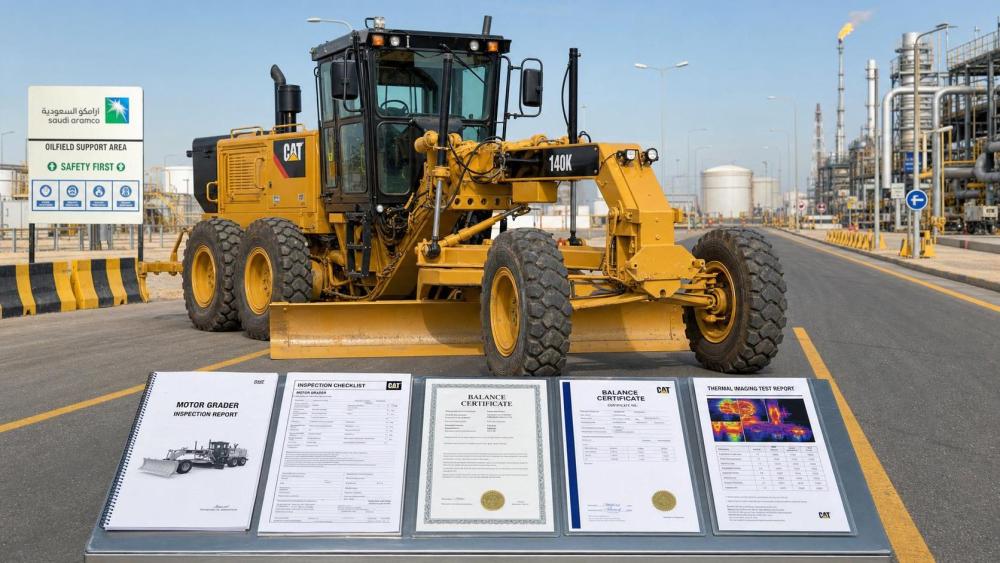
On July 4, 2026, Saudi Aramco updated its procurement requirements for AWD Motor Graders through the latest Motor Grader Technical Specification Addendum V.8.3. The change takes immediate effect and applies to all road and oilfield infrastructure tenders from Q3 2026 onward, making bid documentation a more critical compliance gate for equipment manufacturers, suppliers, testing-related service providers, and procurement teams. What deserves closer attention is that the update does not merely describe product performance expectations; it adds specific documentary requirements that can directly affect tender readiness and qualification.
What the addendum now requires in tender files
The confirmed change is limited but clear. Saudi Aramco issued the latest Motor Grader Technical Specification Addendum V.8.3 to global suppliers on July 4, 2026. Under this update, bids for AWD Motor Graders must include an ISO 1940-1 G2.5 balancing certificate and a thermal imaging operating log covering at least 100 hours of continuous operation. The new requirement is effective immediately and is applicable to all road and oilfield infrastructure tenders starting in Q3 2026.
Where the pressure will likely appear first
Bid preparation moves closer to technical compliance review
From an industry perspective, equipment suppliers and manufacturers are likely to feel the impact first at the tender preparation stage. The reason is straightforward: the new rule is tied to bid-file content, so qualification risk can arise before pricing, delivery, or after-sales discussions even begin. Companies participating in AWD Motor Grader tenders will need to pay closer attention to whether their technical files already contain the required balancing certificate and the specified thermal imaging log.
Testing and documentation become part of procurement readiness
Observably, the update can also affect organizations involved in certification support, inspection coordination, or technical document preparation. Where a supplier previously focused mainly on product configuration and standard bid paperwork, the immediate concern now shifts toward whether supporting records are available in an acceptable form for submission. The practical effect is not necessarily a change in the machine itself, but a change in what must be documented and presented during procurement.
Procurement teams face a narrower window for compliant submission
For procurement departments and trading intermediaries, the rule change may alter how supplier qualification is screened. Analysis shows that teams handling tenders for Q3 2026 projects and beyond will need to confirm document completeness earlier in the process, especially where AWD Motor Graders are sourced across multiple parties. The main area to watch is whether required certificates and operating logs can be aligned with bid deadlines and technical submission requirements.
Practical points companies should check now
Verify whether current bid dossiers meet the new threshold
Companies preparing to participate in the covered tenders should review whether existing bid files for AWD Motor Graders already include an ISO 1940-1 G2.5 balancing certificate and a thermal imaging operating log for at least 100 hours of continuous operation. Where those materials are missing, the issue is not abstract compliance planning but immediate bid eligibility risk.
Recheck internal ownership of technical records
What deserves closer attention is how these records are gathered and controlled inside the supply chain. Manufacturers, exporters, and bid agents may each hold part of the relevant documentation. Firms should therefore examine who is responsible for generating, validating, and compiling technical records before submission, especially when bid preparation is distributed across commercial and engineering teams.
Track tender wording and execution practice closely
Because the input information does not provide further enforcement detail, it is more appropriate to understand the current situation as a confirmed documentary requirement with execution details still requiring observation. Companies should monitor whether later tender documents, clarifications, or procurement communications further define format expectations, review criteria, or supporting evidence standards for the balancing certificate and thermal imaging log.
Review delivery planning through a documentation lens
Analysis shows that suppliers should also consider whether compliance documentation could affect delivery planning indirectly. Even without additional confirmed rules, any bid-stage requirement tied to technical evidence can influence internal approval timing, supplier selection, and submission sequencing. That makes document readiness part of commercial planning rather than a final administrative step.
Why this looks more like an execution signal than a general statement
From an industry perspective, this update is more appropriately understood as an applied procurement rule change rather than a broad policy signal without immediate consequence. The requirement is specific, document-based, effective immediately, and linked to tenders beginning in Q3 2026. At the same time, analysis should remain measured: the available information confirms the new threshold for bid submissions, but it does not yet explain the full review method, enforcement variations, or market response. That is why continued attention to implementation practice matters as much as the text of the addendum itself.
How to read the change at this stage
The most balanced reading is that Saudi Aramco has raised the documentary entry requirements for AWD Motor Grader tenders in a way that can affect procurement access, technical bid preparation, and supplier coordination immediately. It should not be overstated as a complete market reshaping event, but it should also not be treated as a routine wording update. For companies exposed to the relevant tenders, this is best understood as a live compliance and submission change that now needs to be reflected in tender preparation and document control.
Basis of this article and what still needs verification
This article is based on the user-provided news title, event date, and event summary. For developments of this kind, commonly relevant source types may include official procurement notices, regulatory releases, industry association updates, standard organization documents, trade administration information, and reporting from authoritative industry media. A specific official source link was not provided in the input, so the exact primary publication path still requires verification. Further observation should focus on any additional execution detail, certification interpretation, tender wording updates, market feedback, and how participating companies implement the new documentation requirement in practice.