
Related News
- 00
0000-00
What determines equipment durability on airport construction sites? - 00
0000-00
How terrain and dealer support shape machinery selection in Latin America - 00
0000-00
How market insight content analysis reveals shifts in equipment demand - 00
0000-00
When do OEM heavy machinery parts justify their higher cost? - 00
0000-00
What to compare among construction equipment manufacturers in North America
Tags
Bulldozers vs Excavators: Which Cuts Earthmoving Time Faster?
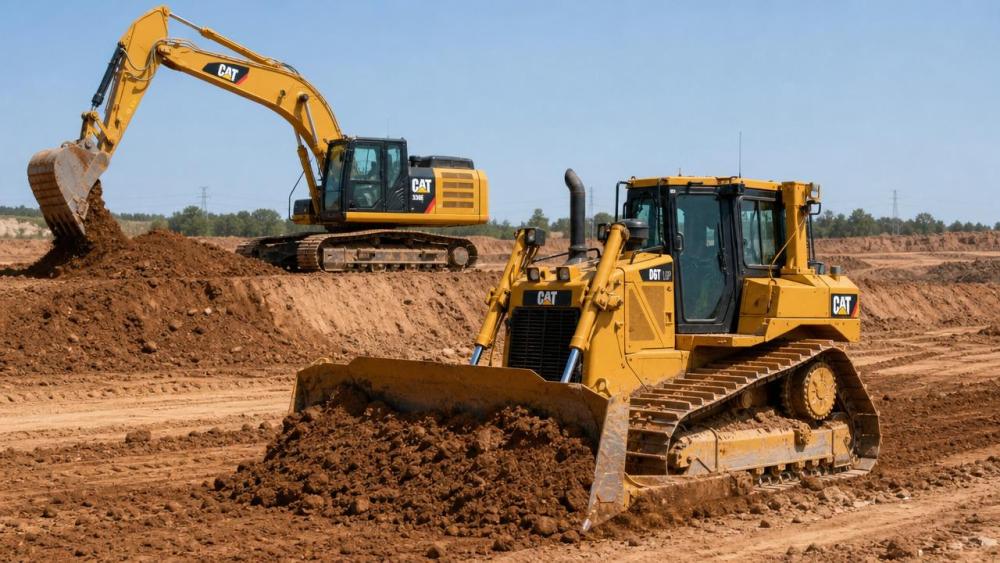
When schedules shrink, machine choice starts affecting every downstream task.
That is why the bulldozers versus excavators debate matters on real jobsites.
Both machines move earth fast, but they do it in very different ways.
Bulldozers win by pushing, spreading, and maintaining traction across rough ground.
Excavators win by digging, swinging, loading, and reaching below grade.
The fastest option depends on haul distance, material type, cut depth, and site layout.
In practice, the wrong machine often burns time through repositioning, rehandling, and fuel waste.
The right machine shortens cycles and keeps grade crews, haulers, and compaction teams moving.
So, which cuts earthmoving time faster?
The short answer is simple.
Bulldozers usually save more time in short-push, rough-spread, and clearing work.
Excavators usually save more time in trenching, deep cuts, truck loading, and selective digging.
The bigger opportunity is knowing when bulldozers should lead the cycle and when excavators should take over.
Where Bulldozers Cut Time the Fastest
Bulldozers are built for ground contact, drawbar pull, and continuous pushing.
That combination makes bulldozers extremely efficient when material only needs to move a short distance.
On cut-and-fill pads, landfill cells, haul road shaping, and site stripping, bulldozers often beat excavators on total cycle time.
They do not pause to swing and dump.
They keep material moving in one continuous pass.
From recent field trends, this is even more obvious on wet, loose, or uneven surfaces.
Tracked bulldozers stay productive where wheeled support equipment starts slipping or waiting.
Best bulldozer use cases
- Pushing blasted rock, soil, or overburden over short distances
- Spreading dumped material before grading or compaction
- Clearing vegetation, topsoil, debris, and soft obstructions
- Maintaining haul roads and working platforms
- Ripping hard ground before other machines enter the area
Bulldozers also reduce dependency on perfect truck positioning.
That matters when visibility is poor or traffic patterns keep changing.
A skilled operator can reshape the workface while keeping the machine in motion.
That flexibility often saves minutes every hour.
Where Excavators Move Faster
Excavators are faster when the job requires vertical control and selective material removal.
They cut below grade, load trucks directly, and separate usable material from waste.
This avoids double handling, which is a major hidden time loss on many projects.
If the task involves trench walls, foundations, basements, utilities, or deep drainage, excavators usually finish faster.
They can dig, swing, and place material with far more accuracy than bulldozers.
That accuracy reduces cleanup passes later.
Best excavator use cases
- Trenching for utilities, drainage, and pipe installation
- Deep excavation for footings, pits, and basement work
- Direct loading into articulated trucks or dump trucks
- Selective rock removal or demolition sorting
- Slope cutting where precision matters more than bulk pushing
Excavators also perform better when material must be lifted over obstacles.
Think retaining structures, narrow corridors, pipeline strings, or urban work zones.
In these conditions, bulldozers may spend more time maneuvering than producing.
The Real Time Factor: Distance, Depth, and Rehandling
The machine is only part of the answer.
Earthmoving time is mostly controlled by three variables.
- How far the material moves
- How deep the cut must be
- How many times the material gets handled
If material moves only a short distance, bulldozers often dominate.
If it must be lifted, loaded, or placed precisely, excavators usually take the lead.
More importantly, every extra touch costs time.
For example, an excavator that digs into a stockpile for a bulldozer to re-spread may slow the overall process.
The reverse is also true.
A bulldozer pushing material to an edge for later excavator loading can add an unnecessary step.
How to Choose Faster on Site
In real operations, speed comes from matching the tool to the cycle, not the logo on the side.
A simple selection framework can prevent hours of lost production.
Use bulldozers first when
- The job is mostly pushing, stripping, or spreading
- Ground conditions are soft, uneven, or slippery
- Travel distances are short
- You need a stable working pad quickly
- Material does not require precise placement
Use excavators first when
- The cut is below grade or near structures
- Material goes straight into trucks
- The site is narrow or obstructed
- Spoil must be placed with control
- The work requires attachment flexibility
From an efficiency standpoint, the strongest signal is cycle interruption.
If bulldozers keep stopping to maneuver around piles, the layout needs changing.
If excavators keep waiting on trucks, the loading plan is wrong.
Small adjustments often recover more time than adding another machine.
Common Mistakes That Slow Both Machines
Even the best bulldozers or excavators lose speed when planning falls apart.
Several problems show up again and again on mixed earthmoving jobs.
- Overlong push distances for bulldozers
- Poor truck staging around excavators
- No separation between cut zone and spread zone
- Ignoring weather-related traction changes
- Using one machine to solve every task
This also affects fuel burn, undercarriage wear, and operator fatigue.
Over a week, those losses become serious schedule drift.
A faster job is rarely about running harder.
It is about removing wasted motion.
A Practical Strategy for Faster Earthmoving
The best results usually come from sequencing, not choosing sides.
Bulldozers prepare, push, and spread.
Excavators cut, load, and shape where precision matters.
That handoff is where many crews gain back lost time.
A simple field checklist
- Measure average push distance before assigning bulldozers
- Confirm required excavation depth and dump point
- Set truck paths to reduce waiting and crossing
- Separate rough spread areas from precise dig zones
- Review cycle times after the first production hour
If cycle times are rising, do not assume production needs more horsepower.
Check traffic flow, pile location, and machine role overlap first.
That is often where the real delay sits.
For time-critical jobs, bulldozers remain the faster answer in broad, short-distance earthmoving.
Excavators remain the faster answer in deep, controlled, and truck-fed excavation.
Choose based on movement pattern, not just machine size.
When bulldozers and excavators are matched to the right phase, earthmoving time drops, rework falls, and the whole site runs cleaner.
Start with the cycle, map the bottleneck, and let the machine fit the job.